Environment: milieu / climate zone / rango de profundidad / distribution range
Ecología
; agua dulce; salobre demersal; potamodromo (Ref. 51243); rango de profundidad 3 - ? m (Ref. 2686). Tropical; 25°C - 28°C (Ref. 2060); 34°N - 6°S
Asia: India to China, Japan, Malaysia and Indonesia. Probably occurring in Bangladesh.
Tamaño / Peso / Age
Madurez: Lm ? range ? - ? cm
Max length : 100.0 cm SL macho / no sexado; (Ref. 2686); common length : 40.0 cm SL macho / no sexado; (Ref. 44894)
Short description
Claves de identificación | Morfología | Morfometría
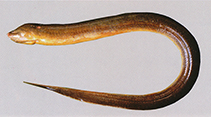
Anguilliform body; no scales; no pectoral and pelvic fins; dorsal, caudal and anal fins confluent and reduced to a skin fold; gill openings merged into single slit underneath the head (Ref. 27732). Rice paddy eels are red to brown with a sprinkling of dark flecks across their backs; large mouths and small eyes (Ref. 44091).
Body shape (shape guide): eel-like.
Obligate air-breathing (Ref. 126274); Found in hill streams to lowland wetlands (Ref. 57235) often occurring in ephemeral waters (Ref. 44894). Adults are found in medium to large rivers, flooded fields and stagnant waters including sluggish flowing canals (Ref. 12975, 12693), in streamlets and estuaries (Ref. 41236). Benthic (Ref. 58302), burrowing in moist earth in dry season surviving for long periods without water (Ref 2686). Occasionally dug out in old taro fields, in Hawaii, long after the field has been drained; more frequently observed in stream clearing operations using heavy equipment to remove large amounts of silt and vegetation where the eels are hidden (Ref. 44091). Nocturnal predators devouring fishes, worms, crustaceans, and other small aquatic animals (Ref. 44091); also feed on detritus. Are protandrous hermaphrodites. The male guards and builds nest or burrow (Ref. 205). Marketed fresh and can be kept alive for long periods of time as long as the skin is kept moist (Ref. 12693). Good flesh (Ref. 2686). Important fisheries throughout Southeast Asia (Ref. 57235).
Life cycle and mating behavior
Madurez | Reproducción | Puesta | Huevos | Fecundidad | Larva
Male builds a large free-floating bubblenest among the submerged vegetation close to the shoreline; eggs are spat into the nest after being laid; male guards the nest and continues to guard the young after hatching till they are on their own (Ref. 44091). Spawning occurs in shallow water (Ref. 2060). Sex reversal is completed in 8-30 weeks (Ref. 34260).
Talwar, P.K. and A.G. Jhingran, 1991. Inland fishes of India and adjacent countries. Volume 2. A.A. Balkema, Rotterdam, i-xxii + 543-1158, 1 pl. (Ref. 4833)
IUCN Red List Status (Ref. 130435: Version 2025-1)
Threat to humans
Harmless
Human uses
Pesquerías: comercial; Acuicultura: comercial; Acuario: Comercial
Herramientas
Special reports
Download XML
Fuentes de Internet
Estimates based on models
Phylogenetic diversity index (Referencia
82804): PD
50 = 0.5000 [Uniqueness, from 0.5 = low to 2.0 = high].
Bayesian length-weight: a=0.00059 (0.00037 - 0.00095), b=3.06 (2.92 - 3.20), in cm total length, based on LWR estimates for this species & (Sub)family-body (Ref.
93245).
Nivel trófico (Referencia
69278): 2.9 ±0.28 se; based on food items.
Generation time: 10.2 ( na - na) years. Estimated as median ln(3)/K based on 2
growth studies.
Resiliencia (Referencia
120179): Medio, población duplicada en un tiempo mínimo de 1.4-4.4 años (Fec = 1,000).
Fishing Vulnerability (Ref.
59153): High vulnerability (65 of 100).
🛈
Nutrients (Ref.
124155): Calcium = 260 [73, 603] mg/100g; Iron = 1.07 [0.42, 2.82] mg/100g; Protein = 18.4 [17.0, 19.8] %; Omega3 = 0.0997 [, ] g/100g; Selenium = 30.9 [14.1, 74.9] μg/100g; VitaminA = 13.2 [4.2, 37.6] μg/100g; Zinc = 1.44 [0.74, 2.67] mg/100g (wet weight); based on
nutrient studies.