



Aggiungete la vostra osservazione in Fish Watcher
| Native range | All suitable habitat | Point map | Year 2050 |

|
| This map was computer-generated and has not yet been reviewed. |
| Peprilus burti AquaMaps Data sources: GBIF OBIS |
Carica il tuo foto e Video
Immagini | Google image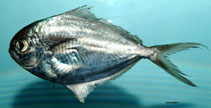 Peprilus burti
Immagine di NOAA\NMFS\Mississippi Laboratory
Immagini | Google image
Immagine di NOAA\NMFS\Mississippi Laboratory
Classificazione / Nomi Nomi Comuni | Sinonimi | Catalog of Fishes(Genere, Specie) | ITIS | CoL | WoRMS | Cloffa
> Scombriformes (Mackerels) > Stromateidae (Butterfishes)
Etymology: Peprilus: Greek, peprilos, paprax, certain fish from Tracia.
Eponymy: Professor Dr Charles Earle Burt (1904–1963) was a herpetologist. [...] (Ref. 128868), visit book page.
More on author: Fowler.
Etymology: Peprilus: Greek, peprilos, paprax, certain fish from Tracia.
Eponymy: Professor Dr Charles Earle Burt (1904–1963) was a herpetologist. [...] (Ref. 128868), visit book page.
More on author: Fowler.
Ambiente: milieu / zona climatica / distribuzione batimetrica / gamma di distribuzione Ecologia
marino benthopelagico; distribuzione batimetrica 2 - 275 m (Ref. 53006), usually 155 - 225 m (Ref. 53006). Subtropical; 39°N - 17°N, 99°W - 73°W
Distribuzione Territories | Aree FAO | Ecosistemi | Presenze | Mappa dei ritrovamenti | Introduzioni | Faunafri
Western Atlantic: entire Gulf of Mexico, from Tampa region in Florida, USA to Yucatan in Mexico; also in Virginia to northeastern Florida, USA (but possibly representing P. tricanthus instead, Ref. 53006).
Lunghezza alla prima maturità / Dimensione / Peso / Età
Maturità: Lm 13.0, range 10 - 16 cm
Max length : 25.0 cm TL maschio/sesso non determinato; (Ref. 7251)
Max length : 25.0 cm TL maschio/sesso non determinato; (Ref. 7251)
Breve descrizione Chiavi di identificazione | Morfologia | Morfometria
This species is distinguished by the following characters: body oval, deep (its depth less than 2.5 times in total length) and strongly compressed; eye surrounded by a small area of adipose tissue; snout short and blunt, lower jaw projecting somewhat beyond upper; mouth small, tip of maxillary not reaching below eye margin; teeth in jaws very small, in one row while those in the upper jaw flattened and with 3 tiny cusps; dorsal and anal fin bases very long (about equal in length), the anterior fin rays elevated, but fins not falcate, and both fins preceded by 3 short, weak, spines; caudal fin deeply forked; pectoral fins long (longer than head) and pointed; pelvic fins absent; distinct series of 17 to 25 pores along anterior half of body under the dorsal fin; lateral line high, following dorsal profile; scales small, present also on cheeks; caudal vertebrae 16 to 18; body color pale blue above, silvery below (fading after death), no spots (Ref. 53006).
Body shape (shape guide): short and / or deep.
Body shape (shape guide): short and / or deep.
A pelagic fish forming large loose schools across the continental shelf over sand/mud bottoms; depth range from 2 to 275 m at least, but most abundant at 155 to 225 m; found near the bottom during the day and migrating into the water column at night. Juveniles often found under floating weeds and with jellyfish. Adults feed on jellyfish, small fish, crustaceans, and worms; the juveniles are plankton and jellyfish feeders. Mature within 1 year and rarely lives past 2; spawning takes place at discrete intervals twice a year slightly offshore. Highly esteemed for food, marketed fresh and frozen; caught mainly with otter trawls (Ref. 53006).
Ciclo vitale e comportamento di accoppiamento Maturità | Riproduzione | Deposizione | Uova | Fecondità | Larve
Also Ref. 101194.
Riferimento principale
Caricare le referenze | Bibliografia | Coordinatore | Collaboratori
Robins, C.R. and G.C. Ray, 1986. A field guide to Atlantic coast fishes of North America. Houghton Mifflin Company, Boston, U.S.A. 354 p. (Ref. 7251)
Stato della Lista Rossa IUCN (Ref. 130435: Version 2025-2 (Global))
Least Concern (LC) ; Date assessed: 29 January 2013
CITES
Not Evaluated
Minaccia per l'uomo
Harmless
Usi umani
Pesca: commerciale
FAO - Publication: search | FishSource |
Informazioni ulteriori
Ecologia trofica
Articoli alimentari (prede)
Alimentazione
Consumo di cibo
Razioni alimentari
Predatori
Articoli alimentari (prede)
Alimentazione
Consumo di cibo
Razioni alimentari
Predatori
Dinamica della popolazione
Parametri di crescita
Età massima / dimensioni massime
Rapporto lunghezza-peso.
Lunghezza-lunghezza rel.
Lunghezza-frequenze
Conversione di massa
Reclutamento
Abbondanza
Parametri di crescita
Età massima / dimensioni massime
Rapporto lunghezza-peso.
Lunghezza-lunghezza rel.
Lunghezza-frequenze
Conversione di massa
Reclutamento
Abbondanza
Ciclo di vita
Riproduzione
Maturità
Maturità/Gli occhielli sono relativi.
Fecondità
Deposizione
Aggregazioni riproduttive
Uova
Sviluppo delle uova
Larve
Dinamica popolazioni larvali
Riproduzione
Maturità
Maturità/Gli occhielli sono relativi.
Fecondità
Deposizione
Aggregazioni riproduttive
Uova
Sviluppo delle uova
Larve
Dinamica popolazioni larvali
Anatomia
Area branchiale
Cervello
Otolite
Area branchiale
Cervello
Otolite
Fisiologia
Composizione corporea
Nutrienti
Consumo di ossigeno
Tipo di nuoto
Velocità di nuoto
Pigmenti visivi
Suono del pesce
Malattie e parassiti
Tossicità (LC50)
Composizione corporea
Nutrienti
Consumo di ossigeno
Tipo di nuoto
Velocità di nuoto
Pigmenti visivi
Suono del pesce
Malattie e parassiti
Tossicità (LC50)
Genetica
Genome
Genetica
Eterozigosi
Ereditarietà
Diversità genetica
Genome
Genetica
Eterozigosi
Ereditarietà
Diversità genetica
Legato all'uomo
Sistemi di acquacoltura
Profili di acquacoltura
Varietà
Casi di Ciguatera
Francobolli, monete, materiale vario.
Sistemi di acquacoltura
Profili di acquacoltura
Varietà
Casi di Ciguatera
Francobolli, monete, materiale vario.
Strumenti
Libro elettronico | Giuda pratica | Chiavi di identificazione | Generatore frequenze di lunghezza | Strumento Parametri Biologici | Mappa dei ritrovamenti |
Cattura-MSY |
Rapporti speciali
Controllo della manutenzione dell'acquario | Verificare la presenza di schede informative sulle specie | Verifica delle schede informative sull'acquacoltura
Scarica XML
Fonti Internet
AFORO (otoliths) | Aquatic Commons | BHL | Cloffa | Websites from users | Check FishWatcher | CISTI | Catalog of Fishes: Genere, Specie | DiscoverLife | ECOTOX | FAO - Publication: search | Faunafri | Fishipedia | Fishtrace | GloBI | GoMexSI (interaction data) | Google Books | Google Scholar | Google | IGFA World Record | OceanAdapt | OneZoom | Open Tree of Life | Otolith Atlas of Taiwan Fishes | PubMed | Reef Life Survey | Socotra Atlas | TreeBase | Tree of Life | Wikipedia: Go, ricerca | World Records Freshwater Fishing | Zoobank | Record zoologico
Stime basate su modelli
Temperatura preferita (Fonte Biblio. 123201): 14.7 - 22.3, mean 18.1 °C (based on 26 cells).
Indice di diversità filogenetica (Fonte Biblio. 82804): PD50 = 0.5020 [Uniqueness, from 0.5 = low to 2.0 = high].
Bayesian length-weight: a=0.01380 (0.00751 - 0.02539), b=3.01 (2.85 - 3.17), in cm total length, based on LWR estimates for this species & Genus-body shape (Ref. 93245).
Livello trofico (Fonte Biblio. 69278): 4.0 ±0.28 se; based on food items.
Generation time: 0.7 ( na - na) years. Estimated as median ln(3)/K based on 2 growth studies.
Resilienza (Fonte Biblio. 120179): Alto, tempo minimo di raddoppiamento della popolazione meno di 15 mesi (tm=1; tmax=2; K>0.3).