



Ajouter votre observation dans Fish Watcher
| Native range | All suitable habitat | Point map | Year 2050 |

|
| This map was computer-generated and has not yet been reviewed. |
| Peprilus burti AquaMaps Data sources: GBIF OBIS |
Envoyez vos Photos et vidéos
Images | Images Google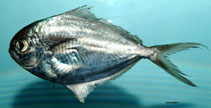 Peprilus burti
Photo de NOAA\NMFS\Mississippi Laboratory
Images | Images Google
Photo de NOAA\NMFS\Mississippi Laboratory
Classification / Noms Noms communs | Synonymes | Catalog of Fishes(Genre, Espèce) | ITIS | CoL | WoRMS | Cloffa
> Scombriformes (Mackerels) > Stromateidae (Butterfishes)
Etymology: Peprilus: Greek, peprilos, paprax, certain fish from Tracia.
Eponymy: Professor Dr Charles Earle Burt (1904–1963) was a herpetologist. [...] (Ref. 128868), visit book page.
More on author: Fowler.
Etymology: Peprilus: Greek, peprilos, paprax, certain fish from Tracia.
Eponymy: Professor Dr Charles Earle Burt (1904–1963) was a herpetologist. [...] (Ref. 128868), visit book page.
More on author: Fowler.
Environnement : milieu / zone climatique / profondeur / gamme de distribution Écologie
marin benthopélagique; profondeur 2 - 275 m (Ref. 53006), usually 155 - 225 m (Ref. 53006). Subtropical; 39°N - 17°N, 99°W - 73°W
Distribution Territoires | Zones FAO | Écosystèmes | Occurrences | Carte par point | Introductions | Faunafri
Western Atlantic: entire Gulf of Mexico, from Tampa region in Florida, USA to Yucatan in Mexico; also in Virginia to northeastern Florida, USA (but possibly representing P. tricanthus instead, Ref. 53006).
Longueur à la première maturité / Taille / Poids / Âge
Description synthétique Clés d'identification | Morphologie | Morphométrie
This species is distinguished by the following characters: body oval, deep (its depth less than 2.5 times in total length) and strongly compressed; eye surrounded by a small area of adipose tissue; snout short and blunt, lower jaw projecting somewhat beyond upper; mouth small, tip of maxillary not reaching below eye margin; teeth in jaws very small, in one row while those in the upper jaw flattened and with 3 tiny cusps; dorsal and anal fin bases very long (about equal in length), the anterior fin rays elevated, but fins not falcate, and both fins preceded by 3 short, weak, spines; caudal fin deeply forked; pectoral fins long (longer than head) and pointed; pelvic fins absent; distinct series of 17 to 25 pores along anterior half of body under the dorsal fin; lateral line high, following dorsal profile; scales small, present also on cheeks; caudal vertebrae 16 to 18; body color pale blue above, silvery below (fading after death), no spots (Ref. 53006).
Body shape (shape guide): short and / or deep.
Body shape (shape guide): short and / or deep.
A pelagic fish forming large loose schools across the continental shelf over sand/mud bottoms; depth range from 2 to 275 m at least, but most abundant at 155 to 225 m; found near the bottom during the day and migrating into the water column at night. Juveniles often found under floating weeds and with jellyfish. Adults feed on jellyfish, small fish, crustaceans, and worms; the juveniles are plankton and jellyfish feeders. Mature within 1 year and rarely lives past 2; spawning takes place at discrete intervals twice a year slightly offshore. Highly esteemed for food, marketed fresh and frozen; caught mainly with otter trawls (Ref. 53006).
Cycle de vie et comportement reproducteur Maturité | Reproduction | Frai | Œufs | Fécondité | Larves
Also Ref. 101194.
Référence principale
Téléchargez vos références | Références | Coordinateur | Collaborateurs
Robins, C.R. and G.C. Ray, 1986. A field guide to Atlantic coast fishes of North America. Houghton Mifflin Company, Boston, U.S.A. 354 p. (Ref. 7251)
Statut dans la liste rouge de l'IUCN (Ref. 130435: Version 2025-2 (Global))
Préoccupation mineure (LC) ; Date assessed: 29 January 2013
CITES
Not Evaluated
Menace pour l'homme
Harmless
Utilisations par l'homme
Pêcheries: commercial
FAO - Publication: search | FishSource |
Plus d'informations
Écologie trophique
Aliments (proies)
Composition du régime alimentaire
Consommation alimentaire
Rations alimentaires
Prédateurs
Aliments (proies)
Composition du régime alimentaire
Consommation alimentaire
Rations alimentaires
Prédateurs
Dynamique des populations
Paramètres de croissance
Âges / tailles maximales
Longueur-poids rel.
Rel. longueur-longueur.
Fréquences de longueurs
Conversion de masse
Recrutement
Abondance
Paramètres de croissance
Âges / tailles maximales
Longueur-poids rel.
Rel. longueur-longueur.
Fréquences de longueurs
Conversion de masse
Recrutement
Abondance
Cycle de vie
Reproduction
Maturité
Maturité/épines rel.
Fécondité
Frai
Agrégats de frai
Œufs
Développement de l'œuf
Larves
Dynamique des populations larvaires
Reproduction
Maturité
Maturité/épines rel.
Fécondité
Frai
Agrégats de frai
Œufs
Développement de l'œuf
Larves
Dynamique des populations larvaires
Anatomie
Surface branchiale
Cerveau
Otolithe
Surface branchiale
Cerveau
Otolithe
Physiologie
Composition corporelle
Nutriments
Consommation d'oxygène
Type de natation
Vitesse de nage
Pigments visuels
Son de poisson
Maladies et parasites
Toxicité (CL50)
Composition corporelle
Nutriments
Consommation d'oxygène
Type de natation
Vitesse de nage
Pigments visuels
Son de poisson
Maladies et parasites
Toxicité (CL50)
Génétique
génôme
Génétique
Hétérozygotie
Héritabilité
Diversité génétique
génôme
Génétique
Hétérozygotie
Héritabilité
Diversité génétique
Liées à l'homme
Systèmes d'aquaculture
Profils d'aquaculture
Souches
Cas de ciguatera
Timbres, pièces de monnaie, divers
Systèmes d'aquaculture
Profils d'aquaculture
Souches
Cas de ciguatera
Timbres, pièces de monnaie, divers
Outils
E-book | Guide de terrain | Clés d'identification | Générateur de fréquences de longueur | Outil de dynamique de population | Carte par point |
Capture-MSY |
Articles particuliers
Télécharger en XML
Sources Internet
AFORO (otoliths) | Aquatic Commons | BHL | Cloffa | Websites from users | FishWatcher | CISTI | Catalog of Fishes: Genre, Espèce | DiscoverLife | ECOTOX | FAO - Publication: search | Faunafri | Fishipedia | Fishtrace | GloBI | GoMexSI (interaction data) | Google Books | Google Scholar | Google | IGFA World Record | OceanAdapt | OneZoom | Open Tree of Life | Otolith Atlas of Taiwan Fishes | PubMed | Reef Life Survey | Socotra Atlas | TreeBase | Arbre de Vie | Wikipedia: aller à, chercher | World Records Freshwater Fishing | Zoobank | Zoological Record
Estimations basées sur des modèles
Température préférée (Réf. 123201): 14.7 - 22.3, mean 18.1 °C (based on 26 cells).
Indice de diversité phylogénétique (Réf. 82804): PD50 = 0.5020 [Uniqueness, from 0.5 = low to 2.0 = high].
Bayesian length-weight: a=0.01380 (0.00751 - 0.02539), b=3.01 (2.85 - 3.17), in cm total length, based on LWR estimates for this species & Genus-body shape (Ref. 93245).
Niveau trophique (Réf. 69278): 4.0 ±0.28 se; based on food items.
Generation time: 0.7 ( na - na) years. Estimated as median ln(3)/K based on 2 growth studies.
Résilience (Réf. 120179): Haut, temps minimum de doublement de population inférieur à 15 mois (tm=1; tmax=2; K>0.3).