>
Carangiformes (Jacks) >
Carangidae (Jacks and pompanos) > Caranginae
Etymology: Trachurus: Greek, trachys, -eia, -ys = rough + Greek, oura = tail (Ref. 45335); symmetricus: From symmetricus which means regularly formed - referring to the rough tail (Ref. 6885).
More on author: Ayres.
Environment: milieu / climate zone / distribuzione batimetrica / distribution range
Ecologia
marino pelagic-oceanic; oceanodromo (Ref. 51243); distribuzione batimetrica 0 - 400 m. Subtropical; 65°N - 13°N
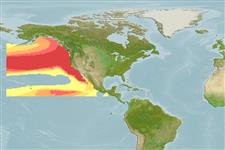
Eastern Pacific: southeastern Alaska to southern Baja California, Mexico and the Gulf of California; reported from Acapulco in Mexico and the Galapagos Islands.
Size / Peso / Age
Maturità: Lm ? range ? - 31 cm
Max length : 81.0 cm TL maschio/sesso non determinato; (Ref. 2850); common length : 55.0 cm TL maschio/sesso non determinato; (Ref. 9283); Età massima riportata: 30 anni (Ref. 766)
Short description
Chiavi di identificazione | Morfologia | Morfometria
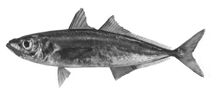
Spine dorsali (totale) : 8 - 9; Raggi dorsali molli (totale) : 28 - 38; Spine anali: 1 - 2; Raggi anali molli: 22 - 33; Vertebre: 23 - 25. Small specimens may have an additional forward-directed spine at first dorsal origin (embedded in larger specimens).
Body shape (shape guide): fusiform / normal.
Adults are often found offshore, up to 500 miles from the coast (Ref. 9283). They form large schools (Ref. 2850). Young frequently occur in school near kelp and under piers (Ref. 2850). They feed mainly on small crustaceans and fish larvae (Ref. 9283). Large individuals often move inshore and north in the summer (Ref. 2850). Marketed fresh, smoked, canned and frozen; eaten fried, broiled and baked (Ref. 9988).
Eschmeyer, W.N., E.S. Herald and H. Hammann, 1983. A field guide to Pacific coast fishes of North America. Boston (MA, USA): Houghton Mifflin Company. xii+336 p. (Ref. 2850)
IUCN Red List Status (Ref. 130435: Version 2025-1)
Threat to humans
Harmless
Human uses
Pesca: commerciale; Pesce da pesca sportiva: si
Strumenti
Special reports
Download XML
Fonti Internet
Estimates based on models
Preferred temperature (Fonte Biblio.
123201): 7 - 16.2, mean 9.2 °C (based on 50 cells).
Phylogenetic diversity index (Fonte Biblio.
82804): PD
50 = 0.5001 [Uniqueness, from 0.5 = low to 2.0 = high].
Bayesian length-weight: a=0.00955 (0.00581 - 0.01569), b=2.96 (2.82 - 3.10), in cm total length, based on LWR estimates for this species & Genus-body shape (Ref.
93245).
Trophic level (Fonte Biblio.
69278): 3.6 ±0.2 se; based on diet studies.
Resilienza (Fonte Biblio.
120179): Basso, tempo minimo di raddoppiamento della popolazione 4.5 - 14 anni (K=0.09-0.21;tm=2-3; tmax=30; Fec<50,000).
Fishing Vulnerability (Ref.
59153): High to very high vulnerability (66 of 100).
🛈
Climate Vulnerability (Ref.
125649): Moderate vulnerability (38 of 100).
🛈
Nutrients (Ref.
124155): Calcium = 256 [162, 427] mg/100g; Iron = 4.83 [2.91, 8.14] mg/100g; Protein = 19.8 [19.0, 20.6] %; Omega3 = 0.337 [0.227, 0.527] g/100g; Selenium = 34.8 [19.9, 61.1] μg/100g; VitaminA = 6.65 [1.75, 28.82] μg/100g; Zinc = 1.51 [1.11, 2.16] mg/100g (wet weight);