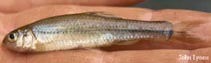
Pimephales vigilax, Bullhead minnow

You can sponsor this page

Pimephales vigilax (Baird & Girard, 1853)

Bullhead minnow
Upload your photos and videos
Immagini | Google image
Image of Pimephales vigilax (Bullhead minnow)
Pimephales vigilax
Picture by Lyons, J.

Classification / Names Nomi Comuni | Sinonimi | Catalog of Fishes(Genere, Specie) | ITIS | CoL | WoRMS | Cloffa

> Cypriniformes (Carps) > Leuciscidae (Minnows) > Pogonichthyinae
Etymology: Pimephales: Greek, pimeles, -es = fat + Greek, phales = whale; if the root is Greek, phales, -etos = penis (Ref. 45335)vigilax: vigilax, meaning watchful (Ref. 10294).
More on authors: Baird & Girard.

Environment: milieu / climate zone / distribuzione batimetrica / distribution range Ecologia

; acqua dolce demersale. Subtropical; 46°N - 27°N

Distribuzione Stati | Aree FAO | Ecosystems | Presenze | Mappa dei ritrovamenti | Introduzioni | Faunafri

North America: Mississippi River basin from western Pennsylvania to Minnesota in USA, and south to Gulf; Gulf Slope drainages from Mobile Bay in Georgia and Alabama to Rio Grande in Texas and New Mexico, USA and Mexico.

Size / Peso / Age

Maturità: Lm ?  range ? - ? cm
Max length : 9.2 cm TL maschio/sesso non determinato; (Ref. 10294); common length : 5.7 cm TL maschio/sesso non determinato; (Ref. 12193)

Biologia     Glossario (es. epibenthic)

Occurs in quiet pools and runs over sand, silt, or gravel, in small to large rivers. Most common in medium-sized rivers (Ref. 5723, 10294). Feeds on insect immatures (Ref. 10294).

Life cycle and mating behavior Maturità | Riproduzione | Deposizione | Uova | Fecundity | Larve

Main reference Upload your references | Bibliografia | Coordinatore | Collaboratori

Page, L.M. and B.M. Burr, 1991. A field guide to freshwater fishes of North America north of Mexico. Houghton Mifflin Company, Boston. 432 p. (Ref. 5723)

IUCN Red List Status (Ref. 130435: Version 2025-1)

  Least Concern (LC) ; Date assessed: 02 July 2018

CITES

Not Evaluated

CMS (Ref. 116361)

Not Evaluated

Threat to humans

  Harmless


Human uses

FAO - Publication: search | FishSource |

Informazioni ulteriori

Trophic ecology
Food items (preys)
Alimentazione
Consumo di cibo
Food rations
Predatori
Ecologia
Ecologia
Home ranges
Population dynamics
Growth parameters
Max. ages / sizes
Length-weight rel.
Length-length rel.
Length-frequencies
Mass conversion
Reclutamento
Abbondanza
Life cycle
Riproduzione
Maturità
Maturity/Gills rel.
Fecundity
Deposizione
Spawning aggregations
Uova
Egg development
Larve
Dinamica popolazioni larvali
Distribuzione
Stati
Aree FAO
Ecosystems
Presenze
Introduzioni
BRUVS - Videos
Anatomy
Area branchiale
Brain
Otolith
Physiology
Body composition
Nutrients
Oxygen consumption
Swimming type
Swimming speed
Visual pigments
Fish sound
Diseases & Parasites
Toxicity (LC50s)
Genetica
Genome
Genetica
Heterozygosity
Ereditarietà
Human related
Aquaculture systems
Profili di acquacoltura
Varietà
Ciguatera cases
Stamps, coins, misc.
Outreach
Collaboratori
Bibliografia
Bibliografia

Strumenti

Special reports

Download XML

Fonti Internet

AFORO (otoliths) | Alien/Invasive Species database | Aquatic Commons | BHL | Cloffa | Websites from users | Check FishWatcher | CISTI | Catalog of Fishes: Genere, Specie | DiscoverLife | ECOTOX | FAO - Publication: search | Faunafri | Fishipedia | Fishtrace | GloBI | Google Books | Google Scholar | Google | IGFA World Record | OneZoom | Open Tree of Life | Otolith Atlas of Taiwan Fishes | PubMed | Reef Life Survey | Socotra Atlas | TreeBase | Tree of Life | Wikipedia: Go, ricerca | Zoological Record

Estimates based on models

Phylogenetic diversity index (Fonte Biblio. 82804):  PD50 = 0.5625   [Uniqueness, from 0.5 = low to 2.0 = high].
Bayesian length-weight: a=0.00692 (0.00401 - 0.01194), b=3.17 (3.01 - 3.33), in cm total length, based on LWR estimates for this species & (Sub)family-body (Ref. 93245).
Trophic level (Fonte Biblio. 69278):  2.6   ±0.1 se; based on size and trophs of closest relatives
Resilienza (Fonte Biblio. 120179):  Alto, tempo minimo di raddoppiamento della popolazione meno di 15 mesi (Preliminary K or Fecundity.).
Fishing Vulnerability (Ref. 59153):  Low vulnerability (10 of 100). 🛈