



Hochladen Photos und videos
Bilder | Google Bild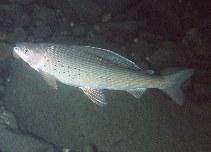 Thymallus arcticus
Photo von Keeley, E.R.
Bilder | Google Bild
Photo von Keeley, E.R.
Klassifizierung / Names Namen | Synonyme | Catalog of Fishes(Gattung, Arten) | ITIS | CoL | WoRMS | Cloffa
> Salmoniformes (Salmons) > Salmonidae (Salmonids) > Thymallinae
Etymology: Thymallus: Greek, thymallos, -ou = a kind of fish similar to salmon (Ref. 45335); arcticus: arcticus meaning of the arctic (Ref. 1998).
More on author: Pallas.
Etymology: Thymallus: Greek, thymallos, -ou = a kind of fish similar to salmon (Ref. 45335); arcticus: arcticus meaning of the arctic (Ref. 1998).
More on author: Pallas.
Umwelt: Milieu / Klimazone / Tiefenbereich / Verbreitungsgebiet Ökologie
; süßwasser benthopelagisch; potamodrom (Ref. 126106); tiefenbereich 30 - ? m (Ref. 5723). Temperate; 71°N - 44°N
Verbreitung Territorien | FAO Gebiete | Ökosysteme | Vorkommen | Punkt Karte | Einführungen | Faunafri
North America: widespread in Arctic drainages from Hudson Bay, Canada to Alaska and in Arctic and Pacific drainages to central Alberta and British Columbia in Canada; upper Missouri River drainage in Montana, USA. Formerly in Great Lakes basin in Michigan, USA (Ref. 5723). Arctic Ocean basin in Siberia from Ob to Yenisei drainages and in Europe in some tributaries of Pechora (Usa, Kosyu, Kozhim), Korotaikha and Kara (Ref. 59043).
Länge bei der ersten Reifung / Größe / Gewicht / Alter
Geschlechtsreife: Lm 24.5, range 23 - 26 cm
Max length : 76.0 cm TL Männchen/unbestimmt; (Ref. 5723); common length : 34.3 cm TL Männchen/unbestimmt; (Ref. 12193); max. veröff. Gewicht: 3.8 kg (Ref. 40637); max. veröff. Alter: 18 Jahre (Ref. 33969)
Max length : 76.0 cm TL Männchen/unbestimmt; (Ref. 5723); common length : 34.3 cm TL Männchen/unbestimmt; (Ref. 12193); max. veröff. Gewicht: 3.8 kg (Ref. 40637); max. veröff. Alter: 18 Jahre (Ref. 33969)
Kurzbeschreibung Bestimmungsschlüssel | Morphologie | Morphometrie
Rückenflossenstacheln (insgesamt) : 0; Rückenflossenweichstrahlen (insgesamt) : 17 - 25; Afterflossenstacheln: 0; Afterflossenweichstrahlen: 11 - 15; Wirbelzahl: 58 - 62. Distinguished by its greatly enlarged dorsal fin and its small mouth, which has fine teeth on both jaws (Ref. 27547). Dorsal greatly enlarged in adults (especially males), reaching adipose fin when depressed, but is shorter in females; pelvic fins rather long, reach anal fin in adult males, but not in females; lower lobe of caudal often longer than upper (Ref. 27547). A strikingly colored fish, the dorsal surface is dark purple, or blue black to blue gray, the sides gray to dark blue with pinkish iridescence, the ventral surface gray to white (Ref. 1998). Scattered dark spots on sides, these being more numerous on the young; a dark longitudinal stripe along lower sides between pectoral and pelvic fins; dorsal fin dark with narrow purple edge (rows of reddish to orange or purple to green spots on body of fin); pelvic fins dark with irregular diagonal orange-yellow stripes; adipose, dorsal, anal, caudal and pectorals dusky to dark (Ref. 27547).
Body shape (shape guide): fusiform / normal; Cross section: compressed.
Body shape (shape guide): fusiform / normal; Cross section: compressed.
Adults inhabit open water of clear, cold, medium to large rivers and lakes. They enter rocky creeks to spawn (Ref. 5723). They occur in piedmont and montane cold streams, rivers and lakes with high oxygen concentrations (Ref. 59043). They form schools in moderate numbers (Ref. 9988). Young feed on zooplankton with a gradual shift to immature insects; adults feed mainly on surface insects but also take in fishes, fish eggs, lemmings, and planktonic crustaceans (Ref. 1998). Spawning takes place in montane streams with heavy current on shallows with rock-gravel bottom (Ref. 59043). Utilized fresh and can be fried, broiled, boiled, and baked (Ref. 9988).
Lebenszyklus und Paarungsverhalten Geschlechtsreife | Fortpflanzung | Ablaichen | Eier | Fruchtbarkeit | Larven
Spawning adults move into tributaries and males establish territories. At spawning, the male follows a female, courting her with displays of his dorsal fin. He then drifts over beside her and curves his extended dorsal fin over the female. The pair vibrates and release eggs and milt. No redd is constructed, but the vibrations of the tails during the spawning act stirs up the substrate and produce a slight depression (Ref. 28876, 28879, 28880, 28881, 28882). A female may spawn only once, or several times in different areas (Ref. 1998). After spawning, adults establish summer territories in pools generally farther upstream from the spawning site, majority moving downstream in mid-September (Ref. 28885, 28886).
Hauptreferenz
Laden Sie Ihre Referenzen hoch | Referenzen | Koordinator | Partner
McClanes, A.J. (ed.), 1974. Field guide to freshwater fishes of North America. Holt, Rinehart and Winston, New York. 212 p. (Ref. 3221)
IUCN Rote Liste Status (Ref. 130435: Version 2025-2 (Global))
nicht bedroht (LC) ; Date assessed: 01 January 2008
CITES
Not Evaluated
Bedrohung für Menschen
Harmless
Nutzung durch Menschen
Fischereien: weniger kommerziell; Sportfisch: ja
FAO - Publication: search | FishSource |
Mehr Information
Trophische Ökologie
Lebensmittel (Beutetiere)
Nahrungszusammensetzung
Nahrungsaufnahme
Lebensmittelrationen
Räuber
Lebensmittel (Beutetiere)
Nahrungszusammensetzung
Nahrungsaufnahme
Lebensmittelrationen
Räuber
Populationsdynamik
Wachstumsparameter
Max. Alter/Größen
Länge-Gewicht-Rel.
Länge-Länge-Verhältnis.
Längenhäufigkeiten
Massenkonvertierung
Rekrutierung
Dichte
Wachstumsparameter
Max. Alter/Größen
Länge-Gewicht-Rel.
Länge-Länge-Verhältnis.
Längenhäufigkeiten
Massenkonvertierung
Rekrutierung
Dichte
Lebenszyklus
Fortpflanzung
Geschlechtsreife
Reifung/Kiemen rel.
Fruchtbarkeit
Ablaichen
Laichaggregationen
Eier
Eientwicklung
Larven
Larven Pop.Dyn.
Fortpflanzung
Geschlechtsreife
Reifung/Kiemen rel.
Fruchtbarkeit
Ablaichen
Laichaggregationen
Eier
Eientwicklung
Larven
Larven Pop.Dyn.
Anatomie
Kiemenoberfläche
Gehirn
Otolith
Kiemenoberfläche
Gehirn
Otolith
Physiologie
Körperliche Zusammensetzung
Nährstoffe
Sauerstoffverbrauch
Schwimmart
Schwimmgeschwindigkeit
Visuelle Pigmente
Fischgeräusche
Krankheiten und Parasiten
Toxizität (LC50s)
Körperliche Zusammensetzung
Nährstoffe
Sauerstoffverbrauch
Schwimmart
Schwimmgeschwindigkeit
Visuelle Pigmente
Fischgeräusche
Krankheiten und Parasiten
Toxizität (LC50s)
Menschenbezogen
Aquakultur-Systeme
Aquakultur Profile
Zuchtlinien
Ciguatera-Fälle
Briefmarken, Münzen, Verschiedenes.
Aquakultur-Systeme
Aquakultur Profile
Zuchtlinien
Ciguatera-Fälle
Briefmarken, Münzen, Verschiedenes.
Tools
Bio-Quiz | E-Book | Feldführer | Bestimmungsschlüssel | Längenhäufigkeits Tool | Lebensdaten Tool | Punkt Karte |
Catch-MSY |
Zusatzinformationen
Download XML
Zusammenfassung | Punktdaten | Namen | Photos
Internet Quellen
AFORO (otoliths) | Alien/Invasive Species database | Aquatic Commons | BHL | Cloffa | Websites from users | FishWatcher Einträge suchen | CISTI | Catalog of Fishes: Gattung, Arten | DiscoverLife | ECOTOX | FAO - Publication: search | Faunafri | Fishipedia | Fishtrace | GloBI | Google Books | Google Scholar | Google | IGFA World Record | OneZoom | Open Tree of Life | Otolith Atlas of Taiwan Fishes | PubMed | Reef Life Survey | Socotra Atlas | TreeBase | Tree of Life | Wikipedia: Gehe zu, Suchen | World Records Freshwater Fishing | Zoologischer Rekord
Schätzungen auf der Grundlage von Modellen
Phylogenetischer Diversitätsindex (Ref. 82804): PD50 = 0.5000 [Uniqueness, from 0.5 = low to 2.0 = high].
Bayesian length-weight: a=0.00813 (0.00578 - 0.01143), b=3.09 (3.00 - 3.18), in cm total length, based on LWR estimates for this species (Ref. 93245).
Trophische Ebene (Ref. 69278): 3.3 ±0.2 se; based on diet studies.
Generation time: 7.3 (5.5 - 9.2) years. Estimated as median ln(3)/K based on 10 growth studies.
Widerstandsfähigkeit (Ref. 120179): mittel, Verdopplung der Population dauert 1,4 - 4,4 Jahre. (K=0.10-0.23; tm=2-6; tmax=18; Fec=416).
Nährstoffe (Ref. 124155): Calcium = 30.1 [7.9, 61.1] mg/100g; Iron = 0.678 [0.213, 1.553] mg/100g; Protein = 18.6 [16.8, 20.3] %; Omega3 = 1.91 [0.63, 6.48] g/100g; Selenium = 59.2 [22.5, 181.7] μg/100g; VitaminA = 23.2 [6.6, 69.7] μg/100g; Zinc = 0.709 [0.384, 1.339] mg/100g (wet weight); based on nutrient studies.