



Alosa macedonica (Vinciguerra, 1921)
Macedonia shad
Carregue seu(sua) Fotos e vídeos
Fotos | Imagem do Google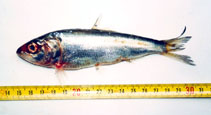 Alosa macedonica
Foto de Margies, P.
Fotos | Imagem do Google
Foto de Margies, P.
Classificação / Nomes Nomes comuns | Sinônimos | Catalog of Fishes(Gênero, Espécies) | ITIS | CoL | WoRMS | Cloffa
> Clupeiformes (Herrings) > Alosidae (Shads and Sardines)
Etymology: Alosa: Latin, alausa = a fish cited by Ausonius and Latin, halec = pickle, dealing with the Greek word hals = salt; it is also the old Saxon name for shad = "alli" ; 1591 (Ref. 45335).
Etymology: Alosa: Latin, alausa = a fish cited by Ausonius and Latin, halec = pickle, dealing with the Greek word hals = salt; it is also the old Saxon name for shad = "alli" ; 1591 (Ref. 45335).
Meio ambiente: milieu / Zona climática / intervalo de profundidade / faixa de distribuição Ecologia
; Água doce pelágico(a,os,as). Subtropical; 41°N - 40°N, 23°E - 24°E
Distribuição Territórios | Áreas da FAO | Ecossistemas | Ocorrências | Mapa de pontos | Introduções | Faunafri
Europe: Lakes Koronia (extirpated) and Volvi, Greece (ref. 59043).
Comprimento de primeira maturação / Tamanho / Peso / Idade
Maturidade: Lm 12.4, range 11 - 14 cm
Max length : 35.1 cm FL macho/indeterminado; (Ref. 10545); peso máx. publicado: 600.00 g (Ref. 10545); idade máx. registrada: 10 anos (Ref. 10545)
Max length : 35.1 cm FL macho/indeterminado; (Ref. 10545); peso máx. publicado: 600.00 g (Ref. 10545); idade máx. registrada: 10 anos (Ref. 10545)
Descrição suscinta Chaves de identificação | Morfologia | Morfometria
Espinhos dorsais (total) : 3 - 4; Raios dorsais (total) : 12 - 14; Espinhos anais: 3 - 4; Raios anais : 16 - 21. This species is distinguished from its congeners entering the freshwater in Mediterranean basin by the following characters: gill rakers 106-128; teeth on palatine and vomer well-developed, especially in juveniles (Ref. 59043).
Body shape (shape guide): fusiform / normal.
Body shape (shape guide): fusiform / normal.
Landlocked, lacustrine, pelagic, in upper water layers during summer and descending to deeper layers in winter. It spawns at 1-2 years, near shores above gravel or coarse sand, with most individuals spawning more than one season. Spawning starts when temperature reach about 19-20°C, in July to August (Ref. 59043). Adults form schools in the epilimnion during summer and tend to congregate in shallow waters near shores. They feed on plankton (cladocerans and copepods) and small fishes (Ref. 10545, 59043). It is threatened by water abstraction and pollution (Ref. 26100).
Ciclo de vida ou comportamento de acasalamento Maturidade | Reprodução | Desova | Ovos | Fecundidade | Larvas
Deposits eggs near the shore where the sediment consists of gravel or coarse sand (Ref. 10545). Most individuals spawn in more than one season (Ref. 59043).
Referência principal
Carregar suas referências | Referências | Coordenador | Colaboradores
Economidis, P.S. and A.I. Sinis, 1991. Alosa macedonica (Vinciguerra 1921). p. 297-308. In H. Hoestlandt (ed.) The freshwater fishes of Europe. Vol. 2. Clupeidae, Anguillidae. AULA-Verlag Wiesbaden. (Ref. 10545)
Status na Lista Vermelha da UICN (Ref. 130435: Version 2025-2 (Global))
Criticamente em perigo (CR) (B1ab(iii)); Date assessed: 04 November 2023
CITES
Not Evaluated
Ameaça para os humanos
Harmless
Uso pelos humanos
Pescarias: pouco comercial
FAO - Publication: search | FishSource |
Mais informação
Ecologia Trófica
Itens alimentares (presas)
Composição da dieta
Consumo alimentar
Rações alimentares
Predadores
Itens alimentares (presas)
Composição da dieta
Consumo alimentar
Rações alimentares
Predadores
Dinâmica populacional
Parâmetros de crescimento
Idade máxima / tamanhos
Relação comprimento-peso.
Relação comprimento-comprimento.
Frequências de comprimento
Conversão de massa
Recrutamento
Abundância
Parâmetros de crescimento
Idade máxima / tamanhos
Relação comprimento-peso.
Relação comprimento-comprimento.
Frequências de comprimento
Conversão de massa
Recrutamento
Abundância
Ciclo de vida
Reprodução
Maturidade
Maturidade/Rel. das guelras
Fecundidade
Desova
Agregações de desova
Ovos
Desenvolvimento dos ovos
Larvas
Dinâmica larval
Reprodução
Maturidade
Maturidade/Rel. das guelras
Fecundidade
Desova
Agregações de desova
Ovos
Desenvolvimento dos ovos
Larvas
Dinâmica larval
Anatomia
Área branquial
Cérebro
Otólito
Área branquial
Cérebro
Otólito
Fisiologia
Composição corporal
Nutrientes
Consumo de oxigênio
Tipo de natação
Velocidade de natação
Pigmentos visuais
Som de peixe
Doenças e Parasitas
Toxicidade (LC50s)
Composição corporal
Nutrientes
Consumo de oxigênio
Tipo de natação
Velocidade de natação
Pigmentos visuais
Som de peixe
Doenças e Parasitas
Toxicidade (LC50s)
Genética
genoma
Genética
Heterozigosidade
Hereditariedade
Diversidade genética
genoma
Genética
Heterozigosidade
Hereditariedade
Diversidade genética
Relacionado a humanos
Sistemas de aquicultura
Perfis para aquacultura
Estirpes
Casos de Ciguatera
Selos, moedas, diversos.
Sistemas de aquicultura
Perfis para aquacultura
Estirpes
Casos de Ciguatera
Selos, moedas, diversos.
Ferramentas
Livro eletrônico | Guia de campo | Ferramenta auxiliar de frequências de comprimento | Ferramenta sobre a história de vida | Mapa de pontos |
Catch-MSY |
Relatórios especiais
Checar Manutenção em Aquário | Checar Planilhas de Fatos sobre as Espécies | Checar Planilhas de Fatos sobre Aquicultura
Baixar XML
Fontes da internet
AFORO (otoliths) | Aquatic Commons | BHL | Cloffa | Websites from users | Checar Observador de Peixes (FishWatcher) | CISTI | Catalog of Fishes: Gênero, Espécies | DiscoverLife | ECOTOX | FAO - Publication: search | Faunafri | Fishipedia | Fishtrace | GloBI | Google Books | Google Scholar | Google | IGFA World Record | OneZoom | Open Tree of Life | Otolith Atlas of Taiwan Fishes | PubMed | Reef Life Survey | Socotra Atlas | TreeBase | Árvore da vida | Wikipedia: Ir para, procura | World Records Freshwater Fishing | Registro zoológico
Estimativas baseadas em modelos
Índice de diversidade filogenética (Ref. 82804): PD50 = 0.5000 [Uniqueness, from 0.5 = low to 2.0 = high].
Bayesian length-weight: a=0.00537 (0.00308 - 0.00936), b=2.99 (2.84 - 3.14), in cm total length, based on LWR estimates for this species & Genus-body shape (Ref. 93245).
Nível Trófico (Ref. 69278): 3.7 ±0.64 se; based on food items.
Resiliência (Ref. 120179): médio(a), tempo mínimo de duplicação da população 1,4 - 4,4 anos (tm=1; tmax=10; K=0.403).