Environment: milieu / climate zone / пределы глубины / distribution range
экология
морской; пресноводный; солоноватоводный демерсальный; пределы глубины 2 - 25 m (Ref. 55207), usually 2 - 6 m (Ref. 55207). Subtropical; 39°N - 17°N, 100°W - 75°W (Ref. 55207)
Western Atlantic: Chesapeake Bay to southern Florida in the USA and the Gulf of Mexico. Records from South America doubtful (Ref. 7251).
Length at first maturity / Size / Вес / Возраст
половая зрелость: Lm 22.0, range 22 - 23 cm
Max length : 61.0 cm WD самец/пол неопределен; (Ref. 6902); common length : 27.0 cm WD самец/пол неопределен; (Ref. 6902); common length :39 cm WD (female); наибольший вес (опубликованные данные): 4.9 kg (Ref. 40637)
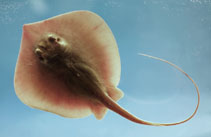
Prominent triangular snout. Broadly rounded outer corners of disc. Upper surface brown or yellowish brown, paler toward margins of disc. Lower surface white (Ref. 6902). Few scapular spines. Middorsal row of spines present, but few on tail beyond pelvic fins (Ref. 7251).
Body shape (shape guide): other.
Adults inhabit coastal waters, including estuaries and lagoons (Ref. 12951) and ascend rivers (Ref. 12951). They feed on tube anemones, polychaete worms, small crustaceans, clams, and serpent stars (Ref. 12951). Ovoviviparous (Ref. 50449). Parturition occurs in July and August (Ref. 27549). Litters of 2-3 pups; gestation 4 months (Ref. 114953).
Life cycle and mating behavior
половая зрелость | размножение | нерест | икра | Fecundity | личинки
Exhibit ovoviparity (aplacental viviparity), with embryos feeding initially on yolk, then receiving additional nourishment from the mother by indirect absorption of uterine fluid enriched with mucus, fat or protein through specialised structures (Ref. 50449). Distinct pairing with embrace (Ref. 205).
Robins, C.R. and G.C. Ray, 1986. A field guide to Atlantic coast fishes of North America. Houghton Mifflin Company, Boston, U.S.A. 354 p. (Ref. 7251)
Статус Красного Списка МСОП (Ref. 130435: Version 2025-1)
Угроза для людей
Harmless
Использование человеком
рыболовство: интереса не представляет
дополнительная информация
инструменты
Специальные отчеты
Скачать в формате XML
ресурсы в Интернет
Estimates based on models
Preferred temperature (ссылка
123201): 23.2 - 27, mean 25.5 °C (based on 272 cells).
Phylogenetic diversity index (ссылка
82804): PD
50 = 0.5020 [Uniqueness, from 0.5 = low to 2.0 = high].
Bayesian length-weight: a=0.00468 (0.00195 - 0.01123), b=3.12 (2.92 - 3.32), in cm total length, based on LWR estimates for this (Sub)family-body shape (Ref.
93245).
Trophic level (ссылка
69278): 3.5 ±0.42 se; based on food items.
устойчивость к внешним воздействиям (ссылка
120179): очень низкий, минимальное время удвоения популяции более 14 лет (K=0.26-0.31; Fec assumed <10).
Fishing Vulnerability (Ref.
59153): Very high vulnerability (90 of 100).
🛈
Nutrients (Ref.
124155): Calcium = 15.8 [2.1, 309.7] mg/100g; Iron = 0.739 [0.068, 8.595] mg/100g; Protein = 22.3 [20.0, 24.4] %; Omega3 = 0.199 [0.062, 0.591] g/100g; Selenium = 14.8 [2.7, 68.8] μg/100g; VitaminA = 6.9 [0.6, 69.4] μg/100g; Zinc = 0.726 [0.053, 8.530] mg/100g (wet weight); based on
nutrient studies.