分類 / Names
共通名の | 類義語 | Catalog of Fishes(部類, 種) | ITIS | CoL | WoRMS | Cloffa
Environment: milieu / climate zone / 深さの範囲 / distribution range
生態学
海; 新鮮な水; 汽水性の 底生の; 深さの範囲 2 - 25 m (Ref. 55207), usually 2 - 6 m (Ref. 55207). Subtropical; 39°N - 17°N, 100°W - 75°W (Ref. 55207)
Western Atlantic: Chesapeake Bay to southern Florida in the USA and the Gulf of Mexico. Records from South America doubtful (Ref. 7251).
Length at first maturity / サイズ / 重さ / 年齢
成熟: Lm 22.0, range 22 - 23 cm
Max length : 61.0 cm WD オス/雌雄の選別がない; (Ref. 6902); common length : 27.0 cm WD オス/雌雄の選別がない; (Ref. 6902); common length :39 cm WD (female); 最大公表体重: 4.9 kg (Ref. 40637)
簡単な記述
検索表 | 形態学 | 形態計測学
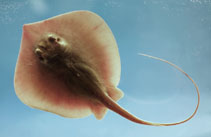
Prominent triangular snout. Broadly rounded outer corners of disc. Upper surface brown or yellowish brown, paler toward margins of disc. Lower surface white (Ref. 6902). Few scapular spines. Middorsal row of spines present, but few on tail beyond pelvic fins (Ref. 7251).
Body shape (shape guide): other.
Adults inhabit coastal waters, including estuaries and lagoons (Ref. 12951) and ascend rivers (Ref. 12951). They feed on tube anemones, polychaete worms, small crustaceans, clams, and serpent stars (Ref. 12951). Ovoviviparous (Ref. 50449). Parturition occurs in July and August (Ref. 27549). Litters of 2-3 pups; gestation 4 months (Ref. 114953).
Life cycle and mating behavior
成熟 | 繁殖 | 放精 | 卵 | 生産力 | 幼生
Exhibit ovoviparity (aplacental viviparity), with embryos feeding initially on yolk, then receiving additional nourishment from the mother by indirect absorption of uterine fluid enriched with mucus, fat or protein through specialised structures (Ref. 50449). Distinct pairing with embrace (Ref. 205).
Robins, C.R. and G.C. Ray, 1986. A field guide to Atlantic coast fishes of North America. Houghton Mifflin Company, Boston, U.S.A. 354 p. (Ref. 7251)
IUCNのレッドリストの状況は (Ref. 130435: Version 2025-1)
Human uses
水産業: 興味がない
用具
特記事項
XMLをダウンロードして下さい
インターネットの情報源
Estimates based on models
Preferred temperature (参照
123201): 23.2 - 27, mean 25.5 °C (based on 272 cells).
Phylogenetic diversity index (参照
82804): PD
50 = 0.5020 [Uniqueness, from 0.5 = low to 2.0 = high].
Bayesian length-weight: a=0.00468 (0.00195 - 0.01123), b=3.12 (2.92 - 3.32), in cm total length, based on LWR estimates for this (Sub)family-body shape (Ref.
93245).
栄養段階 (参照
69278): 3.5 ±0.42 se; based on food items.
回復力 (参照
120179): 非常に低い, 14年以上の倍増期間の最小個体群 (K=0.26-0.31; Fec assumed <10).
Fishing Vulnerability (Ref.
59153): Very high vulnerability (90 of 100).
🛈
Nutrients (Ref.
124155): Calcium = 15.8 [2.1, 309.7] mg/100g; Iron = 0.739 [0.068, 8.595] mg/100g; Protein = 22.3 [20.0, 24.4] %; Omega3 = 0.199 [0.062, 0.591] g/100g; Selenium = 14.8 [2.7, 68.8] μg/100g; VitaminA = 6.9 [0.6, 69.4] μg/100g; Zinc = 0.726 [0.053, 8.530] mg/100g (wet weight); based on
nutrient studies.