Myxine glutinosa, Atlantic hagfish

You can sponsor this page

Myxine glutinosa Linnaeus, 1758

Atlantic hagfish
Добавить Ваши наблюдения в Fish Watcher
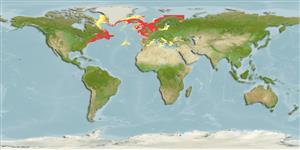
Native range | All suitable habitat | Point map | Year 2050
This map was computer-generated and has not yet been reviewed.
Myxine glutinosa   AquaMaps   Data sources: GBIF OBIS
Загрузить свой Фото и Видео
изображения | Видео | Изображение на Google
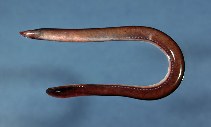
Image of Myxine glutinosa (Atlantic hagfish)
Myxine glutinosa
Изображение сделано Flescher, D.

Классификация / Names народные названия | синонимы | Catalog of Fishes(род, виды) | ITIS | CoL | WoRMS | Cloffa

Myxini (миксины) (hagfishes) > Myxiniformes (Hagfishes) > Myxinidae (Hagfishes) > Myxininae
Etymology: Myxine: Ancient Greek word for a slimy fish: myxa, slime; -inus, one who, referring to copious amounts of slime produced by M. glutinosa (See ETYFish)glutinosa: Latin for viscous or sticky, referring to its seeming ability to turn water into slime (See ETYFish).
More on author: Linnaeus.

Environment: milieu / climate zone / пределы глубины / distribution range экология

морской батидемерсальный; немигрирующий; пределы глубины 20 - 1200 m (Ref. 117245), usually 27 - 460 m (Ref. 119696). Boreal; 2°C - 13°C (Ref. 119696); 72°N - 24°N, 89°W - 41°E

распространение страны | регионы FAO | Ecosystems | места находок | карта точек | интродукции | Faunafri

North Atlantic: Murmansk to the Mediterranean Sea; Greenland to USA. Absent in eastern Mediterranean and Black Sea. Only hagfish in the Northeast Atlantic.

Length at first maturity / Size / Вес / Возраст

половая зрелость: Lm ?, range 25 - ? cm
Max length : 95.0 cm TL самец/пол неопределен; (Ref. 119696); common length : 30.0 cm TL самец/пол неопределен; (Ref. 35388); common length :40 cm TL (female)

Краткое описание определительные ключи | морфология | морфометрия

Jawless mouth, single nasal aperture, only a single pair of external gill openings, no operculum or covering fold of skin. Grayish or reddish brown above, either plain. Variations in color correspond to the color of the sea bottom.
Body shape (shape guide): eel-like.

биология     глоссарий (например epibenthic)

Benthic with reported depths to 782 off Greenland; 960 m in Northwestern Atlantic; and 1,100 m off Norway (Ref. 119696). Found on muddy bottoms where they hide in the mud. Slime is used for defense. Feeds chiefly on dead and dying fish of varying species by boring into the body and consuming viscera and musculature. Chiefly nocturnal. Its eggs are few in number about 19-30 and large (20-25 mm), the horny shell has a cluster of anchor-tipped filaments at each end.

Life cycle and mating behavior половая зрелость | размножение | нерест | икра | Fecundity | личинки

Copulatory organ absent. The gonads of hagfishes are situated in the peritoneal cavity. The ovary is found in the anterior portion of the gonad, and the testis is found in the posterior part. The animal becomes female if the cranial part of the gonad develops or male if the caudal part undergoes differentiation. If none develops, then the animal becomes sterile. If both anterior and posterior parts develop, then the animal becomes a functional hermaphrodite. However, hermaphroditism being characterised as functional needs to be validated by more reproduction studies (Ref. 51361 ). Probably breed throughout the year in deep water (Ref. 35388).

Основная ссылка Upload your references | ссылки | координатор | соавторы

Fernholm, B., 1998. Hagfish systematics. p. 33-44. In J.M. Jørgensen, J.P. Lomholt, R.E. Weber and H. Malte (eds.) The biology of hagfishes. Chapman & Hall, London. 578 p. (Ref. 31276)

Статус Красного Списка МСОП (Ref. 130435: Version 2025-1)

  Не вызывающий беспокойства (LC) ; Date assessed: 12 November 2009

CITES

Not Evaluated

CMS (Ref. 116361)

Not Evaluated

Угроза для людей

  Harmless


Использование человеком

рыболовство: интереса не представляет
FAO - Publication: search | FishSource | Sea Around Us

дополнительная информация

Trophic ecology
Food items (preys)
состав пищи
потребление пищи
Food rations
хищники
экология
экология
Home ranges
Population dynamics
Growth parameters
Max. ages / sizes
Length-weight rel.
Length-length rel.
Размерный состав
Mass conversion
пополнение
численность
Life cycle
размножение
половая зрелость
Maturity/Gills rel.
Fecundity
нерест
Spawning aggregations
икра
Развитие икры
личинки
динамика численности личинок
распространение
страны
регионы FAO
Ecosystems
места находок
интродукции
BRUVS - Videos
Anatomy
жаберная область
Brain
Otolith
Physiology
Body composition
Nutrients
Oxygen consumption
Swimming type
Swimming speed
Visual pigments
Fish sound
Diseases & Parasites
Toxicity (LC50s)
генетика
Геном
генетика
Heterozygosity
наследуемость
Human related
Aquaculture systems
особенности рыбоводства
степень растяжения
Ciguatera cases
Stamps, coins, misc.
Outreach
соавторы
ссылки
ссылки

инструменты

Специальные отчеты

Скачать в формате XML

ресурсы в Интернет

Estimates based on models

Preferred temperature (ссылка 123201): 1 - 10.2, mean 5.3 °C (based on 550 cells).
Phylogenetic diversity index (ссылка 82804):  PD50 = 0.5000   [Uniqueness, from 0.5 = low to 2.0 = high].
Bayesian length-weight: a=0.00115 (0.00044 - 0.00298), b=3.03 (2.80 - 3.26), in cm total length, based on LWR estimates for this (Sub)family-body shape (Ref. 93245).
Trophic level (ссылка 69278):  4.5   ±0.0 se; based on diet studies.
устойчивость к внешним воздействиям (ссылка 120179):  низкий, минимальное время удвоения популяции 4.5-14 лет (Fec= 20-30).
Prior r = 0.10, 95% CL = 0.07 - 0.15, Based on 1 full stock assessment.
Fishing Vulnerability (Ref. 59153):  High vulnerability (58 of 100). 🛈
Climate Vulnerability (Ref. 125649):  Moderate vulnerability (38 of 100). 🛈
Nutrients (Ref. 124155):  Calcium = 7.79 [2.08, 25.45] mg/100g; Iron = 0.278 [0.095, 0.782] mg/100g; Protein = 2.26 [0.00, 6.14] %; Omega3 = 0.301 [0.116, 0.790] g/100g; Selenium = 18.8 [5.5, 64.6] μg/100g; VitaminA = 11 [2, 52] μg/100g; Zinc = 0.281 [0.133, 0.569] mg/100g (wet weight);