>
Eupercaria/misc (Various families in series Eupercaria) >
Lutjanidae (Snappers) > Etelinae
Etymology: Randallichthys: After John Randall, marine biologist, Bishop Museum of Hawaii; he worked in systematic ichthyology with fishes of Indopacific region + Greek, ichthys = fish.
Eponymy: Dr John ‘Jack’ Ernest Randall Jr. [...] (Ref. 128868), visit book page.
Environment: milieu / climate zone / intervalo de profundidade / distribution range
Ecologia
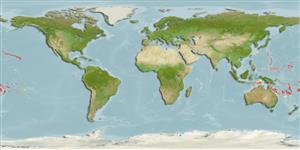
marinhas bentopelágico; intervalo de profundidade 150 - 300 m (Ref. 55). Deep-water; 35°N - 24°S, 121°E - 147°W (Ref. 55)
Pacific Ocean: known only from the Hawaiian Islands, Cook Islands, New Caledonia, and Okinawa, Japan but probably widespread in the area. Recently recorded from Tonga (Ref. 53797). Eastern Indian Ocean: Scott Reefs, northwestern Australia (Ref. 82665).
Tamanho / Peso / Idade
Maturidade: Lm ? range ? - ? cm
Max length : 50.0 cm SL macho/indeterminado; (Ref. 9821); common length : 40.0 cm SL macho/indeterminado; (Ref. 9821)
Espinhos dorsais (total) : 10; Raios dorsais moles (total) : 12; Espinhos anais: 3; Raios anais moles: 9. Head blunt. Interorbital space flat. Eye large. Preorbital bone relatively narrow. Snout short. Lower jaw protruding. Pectoral fins short, not reaching level of anus. Lower lobe of caudal fin with some rays excessively produced and filamentous in young. Scale rows on back parallel to lateral line. Overall color rosy red with a yellowish tinge; the dorsal fin grayish, the outer edge of its spinous portion black; the outer edge of the pelvic fins also black.
Body shape (shape guide): fusiform / normal; Cross section: oval.
Adults are found on rocky bottoms in relatively deep water (Ref. 55). Marketed fresh (Ref. 55).
Life cycle and mating behavior
Maturidade | Reprodução | Desova | Ovos | Fecundidade | Larvas
Allen, G.R., 1985. FAO Species Catalogue. Vol. 6. Snappers of the world. An annotated and illustrated catalogue of lutjanid species known to date. FAO Fish. Synop. 125(6):208 p. Rome: FAO. (Ref. 55)
Categoria na Lista Vermelha da IUCN (Ref. 130435: Version 2025-1)
Ameaça para o homem
Harmless
Utilização humana
Pescarias: pouco comercial
Ferramentas
Relatórios especiais
Descarregue XML
Fontes da internet
Estimates based on models
Preferred temperature (Ref.
123201): 13.3 - 23.4, mean 19.3 °C (based on 11 cells).
Phylogenetic diversity index (Ref.
82804): PD
50 = 1.0000 [Uniqueness, from 0.5 = low to 2.0 = high].
Bayesian length-weight: a=0.01549 (0.00709 - 0.03381), b=2.95 (2.77 - 3.13), in cm total length, based on LWR estimates for this (Sub)family-body shape (Ref.
93245).
Nível Trófico (Ref.
69278): 4.0 ±0.4 se; based on size and trophs of closest relatives
Resiliência (Ref.
120179): Médio, tempo mínimo de duplicação da população 1,4 - 4,4 anos (Preliminary K or Fecundity.).
Fishing Vulnerability (Ref.
59153): Moderate vulnerability (44 of 100).
🛈