>
Carangiformes (Jacks) >
Carangidae (Jacks and pompanos) > Caranginae
Etymology: Selene: Greek, selene = moon (Ref. 45335).
Eponymy: James Carson Brevoort (1818–1887) was an American collector of coins and rare books. [...] (Ref. 128868), visit book page.
More on author: Gill.
Environment: milieu / climate zone / rango de profundidad / distribution range
Ecología
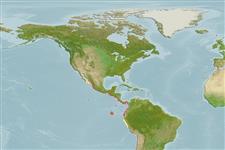
marino bentopelágico; rango de profundidad 1 - 50 m. Tropical; 27°N - 18°S, 112°W - 70°W
Eastern Pacific: southern tip of Baja California, Mexico to Ecuador.
Tamaño / Peso / Age
Madurez: Lm ? range ? - ? cm
Max length : 38.0 cm FL macho / no sexado; (Ref. 9283); common length : 25.0 cm FL macho / no sexado; (Ref. 9283)
Short description
Claves de identificación | Morfología | Morfometría
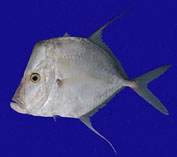
Body short, deep, and strongly compressed; lower branch of first gill arch with 29 to 34 gill rakers; dorsal fin with 8 spines followed by another spine and 20 to 23 soft rays (VIII+1,20-23); anterior lobes of second dorsal and anal fins very long in adults; anterior dorsal spines greatly prolonged in juveniles; body scaleless; lateral line scutes very weak and poorly differentiated; body golden or silvery with metallic blue highlights; juveniles yellowish, with indistinct, interrupted, dark, transverse bars (Ref. 55763).
Body shape (shape guide): short and / or deep.
Adults are found in shallow coastal waters in small schools near the bottom (Ref. 9283). They feed on small squids, shrimps, polychaetes and small fishes (Ref. 9283). Marketed fresh and salted (Ref. 9283). Depth range assumed (RF).
Life cycle and mating behavior
Madurez | Reproducción | Puesta | Huevos | Fecundidad | Larva
Smith-Vaniz, W.F., 1995. Carangidae. Jureles, pámpanos, cojinúas, zapateros, cocineros, casabes, macarelas, chicharros, jorobados, medregales, pez pilota. p. 940-986. In W. Fischer, F. Krupp, W. Schneider, C. Sommer, K.E. Carpenter and V. Niem (eds.) Guia FAO para Identification de Especies para lo Fines de la Pesca. Pacifico Centro-Oriental. 3 Vols. FAO, Rome. (Ref. 9283)
IUCN Red List Status (Ref. 130435: Version 2025-1)
Threat to humans
Harmless
Human uses
Pesquerías: escaso valor comercial; pesca deportiva: si
Herramientas
Special reports
Download XML
Fuentes de Internet
Estimates based on models
Preferred temperature (Referencia
123201): 21 - 28.4, mean 26 °C (based on 50 cells).
Phylogenetic diversity index (Referencia
82804): PD
50 = 0.5078 [Uniqueness, from 0.5 = low to 2.0 = high].
Bayesian length-weight: a=0.01738 (0.01092 - 0.02766), b=2.81 (2.67 - 2.95), in cm total length, based on LWR estimates for this species & (Sub)family-body (Ref.
93245).
Nivel trófico (Referencia
69278): 3.8 ±0.4 se; based on diet studies.
Resiliencia (Referencia
120179): Alto, población duplicada en un tiempo mínimo inferior a 15 meses (Preliminary K or Fecundity.).
Fishing Vulnerability (Ref.
59153): Low to moderate vulnerability (32 of 100).
🛈
Nutrients (Ref.
124155): Calcium = 124 [64, 264] mg/100g; Iron = 1.1 [0.6, 2.4] mg/100g; Protein = 17.1 [14.9, 19.4] %; Omega3 = 0.189 [0.093, 0.392] g/100g; Selenium = 56.5 [27.7, 135.1] μg/100g; VitaminA = 17.7 [4.5, 61.7] μg/100g; Zinc = 0.989 [0.640, 1.569] mg/100g (wet weight);