>
Aulopiformes (Grinners) >
Chlorophthalmidae (Greeneyes)
Etymology: Chlorophthalmus: Greek, chloros = green + Greek, ophthlamos = eye (Ref. 45335).
Eponymy: Jean Louis Rudolphe Agassiz (1807–1873) was a Swiss-American geologist, glaciologist and zoologist whose speciality was ichthyology. [...] (Ref. 128868), visit book page.
More on author: Bonaparte.
Environment: milieu / Zona climática / intervalo de profundidade / distribution range
Ecologia
marinhas; estuarina batidemersal; intervalo de profundidade 50 - 1000 m (Ref. 6688). Deep-water; 5°C - 13°C; 45°N - 29°S, 180°W - 180°E
Circumglobal in temperate and tropical regions. Eastern Atlantic: Spain to at least 19°S, including the Mediterranean, Canary Islands and Cape Verde. Western Atlantic: southern New England, USA and northern Gulf of Mexico to northern South America (Ref. 7251). Northwest Atlantic: Canada (Ref. 5951).
Tamanho / Peso / Idade
Maturidade: Lm ? range ? - ? cm
Max length : 40.0 cm TL macho/indeterminado; (Ref. 36731); common length : 20.0 cm SL macho/indeterminado; (Ref. 2683)
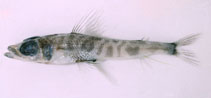
Espinhos dorsais (total) : 0; Raios dorsais (total) : 10 - 11; Espinhos anais: 0; Raios anais : 8 - 10. Body slightly compressed. The head is small; eyes large, diameter greater than snout length. Color is yellow-fawn, with irregular oblique brown blotches on the sides. The operculum is silver-black; anus and gill cavity black; belly stippled black; caudal fin base and inner ventral fin rays black.
Body shape (shape guide): elongated; Cross section: oval.
Found on the continental shelf and upper slope over mud and clay bottom. Catch data indicate a schooling habit. Feeds mainly on bottom-living invertebrates. Also known to feed on pelagic crustaceans like euphausiids, decapods and mysids (Ref. 27637). A hermaphroditic species. Marketed fresh and sometimes made into fishmeal (Ref. 6688). Young are pelagic, living near the surface, the adults are demersal, living between 50 and 1000 m depth (Ref. 47377).
Ciclo de vida ou comportamento de acasalamento
Maturidade | Reprodução | Desova | Ovos | Fecundidade | Larvas
Merrett, N.R., 1990. Chlorophthalmidae. p. 351-360. In J.C. Quero, J.C. Hureau, C. Karrer, A. Post and L. Saldanha (eds.) Check-list of the fishes of the eastern tropical Atlantic (CLOFETA). JNICT, Lisbon; SEI, Paris; and UNESCO, Paris. Vol. 1. (Ref. 3590)
Status na Lista Vermelha da UICN (Ref. 130435: Version 2025-1)
Ameaça para os humanos
Harmless
Uso pelos humanos
Pescarias: pouco comercial
Ferramentas
Relatórios especiais
Baixar XML
Fontes da internet
Estimates based on models
Preferred temperature (Ref.
123201): 6.4 - 19.2, mean 12.7 °C (based on 1136 cells).
Índice de diversidade filogenética (Ref.
82804): PD
50 = 0.5000 [Uniqueness, from 0.5 = low to 2.0 = high].
Bayesian length-weight: a=0.00427 (0.00327 - 0.00556), b=3.17 (3.09 - 3.25), in cm total length, based on LWR estimates for this species (Ref.
93245).
Nível Trófico (Ref.
69278): 3.7 ±0.0 se; based on diet studies.
Resiliência (Ref.
120179): médio(a), tempo mínimo de duplicação da população 1,4 - 4,4 anos (Assuming tm=3-4).
Fishing Vulnerability (Ref.
59153): Low to moderate vulnerability (30 of 100).
🛈
Nutrients (Ref.
124155): Calcium = 24.1 [9.7, 65.8] mg/100g; Iron = 0.373 [0.127, 0.790] mg/100g; Protein = 15.2 [12.2, 17.6] %; Omega3 = 0.213 [0.066, 0.535] g/100g; Selenium = 19.3 [6.0, 45.3] μg/100g; VitaminA = 10.2 [1.8, 53.4] μg/100g; Zinc = 0.481 [0.300, 0.738] mg/100g (wet weight); based on
nutrient studies.