



Brevoortia tyrannus (Latrobe, 1802)
Atlantic menhaden
Beobachtung melden im Fish Watcher
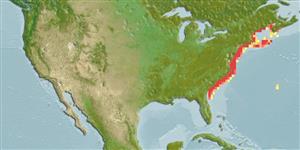
| Native range | All suitable habitat | Point map | Year 2050 |
|
| This map was computer-generated and has not yet been reviewed. |
| Brevoortia tyrannus AquaMaps Data sources: GBIF OBIS |
Hochladen Photos und videos
Bilder | Laute | Google Bild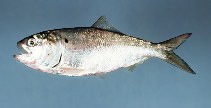 Brevoortia tyrannus
Photo von Flescher, D.
Bilder | Laute | Google Bild
Photo von Flescher, D.
Klassifizierung / Names Namen | Synonyme | Catalog of Fishes(Gattung, Arten) | ITIS | CoL | WoRMS | Cloffa
> Clupeiformes (Herrings) > Alosidae (Shads and Sardines)
Etymology: Brevoortia: From James Carson Brevoort (1818-1887), studie the fauna from Ohio and South Caroline (Ref. 45335).
Eponymy: James Carson Brevoort (1818–1887) was an American collector of coins and rare books. [...] (Ref. 128868), visit book page.
Etymology: Brevoortia: From James Carson Brevoort (1818-1887), studie the fauna from Ohio and South Caroline (Ref. 45335).
Eponymy: James Carson Brevoort (1818–1887) was an American collector of coins and rare books. [...] (Ref. 128868), visit book page.
Umwelt: Milieu / Klimazone / Tiefenbereich / Verbreitungsgebiet Ökologie
seewasser; brackwasser pelagic-neritic; pH range: 1.0 - 36.0; ozeanodrom (Ref. 51243); tiefenbereich 0 - 50 m (Ref. 188). Subtropical; ? - 26°C (Ref. 38970); 46°N - 30°N, 81°W - 64°W (Ref. 54290)
Verbreitung Territorien | FAO Gebiete | Ökosysteme | Vorkommen | Punkt Karte | Einführungen | Faunafri
Western Atlantic: Nova Scotia, Canada southward to Indian River, Florida, USA.
Länge bei der ersten Reifung / Größe / Gewicht / Alter
Kurzbeschreibung Bestimmungsschlüssel | Morphologie | Morphometrie
Rückenflossenstacheln (insgesamt) : 0; Rückenflossenweichstrahlen (insgesamt) : 18 - 24; Afterflossenstacheln: 0; Afterflossenweichstrahlen: 18 - 24. Upper jaw with median notch. Pelvic fin with rounded hind margin, inner fin rays equal or nearly equal to outer fin rays when fin folded back. Pre-dorsal scales modified; scales on back, above base of anal fin and at base of tail much smaller and irregularly placed. A black spot behind gill opening, followed along flank by approximately 6 lines of smaller spots (Ref. 188). Silvery, with brassy sides and a dark bluish green back (Ref. 7251).
Body shape (shape guide): fusiform / normal; Cross section: compressed.
Body shape (shape guide): fusiform / normal; Cross section: compressed.
Found inshore in summer, but at least some moving into deeper water in winter. Adults are found in near surface waters (Ref. 38984), usually in shallow areas overlying continental shelf, in greatest abundance immediately adjacent to major estuaries (Ref. 4639). Juveniles are also generally pelagic, with smallest size groups farthest up river (Ref. 38986). Form large and very compact schools, both of juveniles and adults. Migrate north - south; also in and out of bays and inlets. Feed by filtering phytoplankton (diatoms (Ref. 5951)) and zooplankton (small crustaceans, annelid worms and detritus (Ref. 5951)). High water temperatures apparently limit breeding. Spawn probably all year; nursery areas in estuaries. Larvae are pelagic (Ref. 38985), probably spend about a month in waters over continental shelf (Ref. 38983), entering estuarine waters at about 10 mm and larger (Ref. 844). Marketed fresh, salted, canned or smoked. Mainly used for production of oil, fertilizer and fishmeal (Ref. 188). Parasites found are isopods, copepod, cestodes and trematodes (Ref. 37032).
Lebenszyklus und Paarungsverhalten Geschlechtsreife | Fortpflanzung | Ablaichen | Eier | Fruchtbarkeit | Larven
Breeding season apparently limited by high water temperatures (20.5°C monthly mean maximum). Spawning activity occurring almost every month in some part of the range (Ref. 2472, 39013, 844). Spawning temperature ranges from 4.4°C to 23.6°C, with peak activity at 15-18°C (Ref. 39014). Salinity ranges from 10 ppt (Ref. 39015) to usually greater than 25 ppt (Ref. 844). Fecundity observed is from 38,000 to 631,000 eggs per season (Ref. 39013).
Hauptreferenz
Laden Sie Ihre Referenzen hoch | Referenzen | Koordinator | Partner
Whitehead, P.J.P., 1985. FAO Species Catalogue. Vol. 7. Clupeoid fishes of the world (suborder Clupeoidei). An annotated and illustrated catalogue of the herrings, sardines, pilchards, sprats, shads, anchovies and wolf-herrings. FAO Fish. Synop. 125(7/1):1-303. Rome: FAO. (Ref. 188)
IUCN Rote Liste Status (Ref. 130435: Version 2025-2 (Global))
nicht bedroht (LC) ; Date assessed: 07 July 2015
CITES
Not Evaluated
Bedrohung für Menschen
Harmless
Nutzung durch Menschen
Fischereien: hoch kommerziell
FAO - Fischereien: landungen, Artbeschreibung; Publication: search | FishSource | Das Meer um uns herum
Mehr Information
Trophische Ökologie
Lebensmittel (Beutetiere)
Nahrungszusammensetzung
Nahrungsaufnahme
Lebensmittelrationen
Räuber
Lebensmittel (Beutetiere)
Nahrungszusammensetzung
Nahrungsaufnahme
Lebensmittelrationen
Räuber
Populationsdynamik
Wachstumsparameter
Max. Alter/Größen
Länge-Gewicht-Rel.
Länge-Länge-Verhältnis.
Längenhäufigkeiten
Massenkonvertierung
Rekrutierung
Dichte
Wachstumsparameter
Max. Alter/Größen
Länge-Gewicht-Rel.
Länge-Länge-Verhältnis.
Längenhäufigkeiten
Massenkonvertierung
Rekrutierung
Dichte
Lebenszyklus
Fortpflanzung
Geschlechtsreife
Reifung/Kiemen rel.
Fruchtbarkeit
Ablaichen
Laichaggregationen
Eier
Eientwicklung
Larven
Larven Pop.Dyn.
Fortpflanzung
Geschlechtsreife
Reifung/Kiemen rel.
Fruchtbarkeit
Ablaichen
Laichaggregationen
Eier
Eientwicklung
Larven
Larven Pop.Dyn.
Physiologie
Körperliche Zusammensetzung
Nährstoffe
Sauerstoffverbrauch
Schwimmart
Schwimmgeschwindigkeit
Visuelle Pigmente
Fischgeräusche
Krankheiten und Parasiten
Toxizität (LC50s)
Körperliche Zusammensetzung
Nährstoffe
Sauerstoffverbrauch
Schwimmart
Schwimmgeschwindigkeit
Visuelle Pigmente
Fischgeräusche
Krankheiten und Parasiten
Toxizität (LC50s)
Menschenbezogen
Aquakultur-Systeme
Aquakultur Profile
Zuchtlinien
Ciguatera-Fälle
Briefmarken, Münzen, Verschiedenes.
Aquakultur-Systeme
Aquakultur Profile
Zuchtlinien
Ciguatera-Fälle
Briefmarken, Münzen, Verschiedenes.
Tools
E-Book | Feldführer | Bestimmungsschlüssel | Längenhäufigkeits Tool | Lebensdaten Tool | Punkt Karte |
Catch-MSY |
Zusatzinformationen
Download XML
Zusammenfassung | Punktdaten | Namen | Photos
Internet Quellen
AFORO (otoliths) | Aquatic Commons | BHL | Cloffa | Websites from users | FishWatcher Einträge suchen | CISTI | Catalog of Fishes: Gattung, Arten | DiscoverLife | ECOTOX | FAO - Fischereien: landungen, Artbeschreibung; Publication: search | Faunafri | Fishipedia | Fishtrace | GloBI | Google Books | Google Scholar | Google | IGFA World Record | OceanAdapt | OneZoom | Open Tree of Life | Otolith Atlas of Taiwan Fishes | PubMed | Reef Life Survey | Socotra Atlas | TreeBase | Tree of Life | Wikipedia: Gehe zu, Suchen | World Records Freshwater Fishing | Zoologischer Rekord
Schätzungen auf der Grundlage von Modellen
Bevorzugte Temperatur (Ref. 123201): 7.5 - 24.4, mean 13.2 °C (based on 120 cells).
Phylogenetischer Diversitätsindex (Ref. 82804): PD50 = 0.5156 [Uniqueness, from 0.5 = low to 2.0 = high].
Bayesian length-weight: a=0.01023 (0.00598 - 0.01751), b=3.14 (2.99 - 3.29), in cm total length, based on LWR estimates for this species & (Sub)family-body (Ref. 93245).
Trophische Ebene (Ref. 69278): 3.2 ±0.2 se; based on diet studies.
Generation time: 2.8 (2.4 - 3.6) years. Estimated as median ln(3)/K based on 38 growth studies.
Widerstandsfähigkeit (Ref. 120179): mittel, Verdopplung der Population dauert 1,4 - 4,4 Jahre. (K=0.4; tm=1-3; Fec=38,000).
Prior r = 0.31, 95% CL = 0.20 - 0.46, Based on 1 data-limited stock assessment.
Nährstoffe (Ref. 124155): Calcium = 87.7 [51.9, 140.0] mg/100g; Iron = 1.45 [0.83, 2.30] mg/100g; Protein = 20 [19, 21] %; Omega3 = 0.58 [0.35, 0.93] g/100g; Selenium = 21.6 [11.4, 40.2] μg/100g; VitaminA = 8.6 [3.6, 21.0] μg/100g; Zinc = 0.964 [0.676, 1.343] mg/100g (wet weight);