>
Ovalentaria/misc (Various families in series Ovalentaria) >
Pseudochromidae (Dottybacks) > Pseudoplesiopinae
Eponymy: AMS is institutional code in ichthyology for the Australian Museum (Sydney). [...] Ronald Knight, Sr. of Manus, Papua New Guinea, was honoured “for his generous hospitality during a collecting visit to the island in 1982.” (Ref. 128868), visit book page.
Environment: milieu / Zona climática / intervalo de profundidade / distribution range
Ecologia
marinhas associadas(os) a recifes; intervalo de profundidade 10 - 30 m (Ref. 90102). Tropical
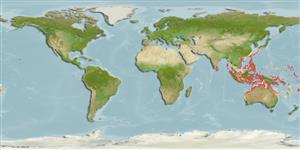
Western Pacific: Philippines (Ref. 48613) to northern Australia (including Western Australia) and Papua New Guinea to Solomon Islands (Ref. 90102).
Tamanho / Peso / Idade
Maturidade: Lm ? range ? - ? cm
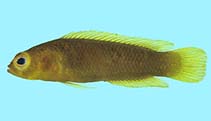
Max length : 4.5 cm TL macho/indeterminado; (Ref. 48635)
Espinhos dorsais (total) : 1; Raios dorsais (total) : 23 - 24; Espinhos anais: 1 - 2; Raios anais : 13 - 15.
Body shape (shape guide): short and / or deep; Cross section: compressed.
Found in coastal reef slopes amongst algae boulder habitat to about 20 m depth (Ref. 48635); also inhabits inshore reefs (Ref. 7300). Cryptic and seen with the use of collecting chemicals (Ref 90102).
Ciclo de vida ou comportamento de acasalamento
Maturidade | Reprodução | Desova | Ovos | Fecundidade | Larvas
Paxton, J.R., D.F. Hoese, G.R. Allen and J.E. Hanley, 1989. Pisces. Petromyzontidae to Carangidae. Zoological Catalogue of Australia, Vol. 7. Australian Government Publishing Service, Canberra, 665 p. (Ref. 7300)
Status na Lista Vermelha da UICN (Ref. 130435: Version 2025-1)
Ameaça para os humanos
Harmless
Uso pelos humanos
Pescarias: sem interesse
Ferramentas
Relatórios especiais
Baixar XML
Fontes da internet
Estimates based on models
Preferred temperature (Ref.
123201): 25.4 - 29, mean 28 °C (based on 268 cells).
Índice de diversidade filogenética (Ref.
82804): PD
50 = 1.0000 [Uniqueness, from 0.5 = low to 2.0 = high].
Bayesian length-weight: a=0.01995 (0.00906 - 0.04395), b=3.01 (2.83 - 3.19), in cm total length, based on all LWR estimates for this body shape (Ref.
93245).
Nível Trófico (Ref.
69278): 3.3 ±0.5 se; based on size and trophs of closest relatives
Fishing Vulnerability (Ref.
59153): Low vulnerability (10 of 100).
🛈
Nutrients (Ref.
124155): Calcium = 217 [102, 392] mg/100g; Iron = 1.11 [0.61, 2.03] mg/100g; Protein = 18.4 [17.1, 19.7] %; Omega3 = 0.146 [0.073, 0.282] g/100g; Selenium = 26.5 [11.5, 55.4] μg/100g; VitaminA = 98.1 [26.6, 359.1] μg/100g; Zinc = 2.2 [1.4, 3.4] mg/100g (wet weight);