



Sube tu fotos y Vídeos
Imágenes | Google image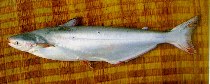 Pangasius krempfi
Foto de Roberts, T.R.
Imágenes | Google image
Foto de Roberts, T.R.
Clasificación / Nombres Nombres comunes | Sinónimos | Catalog of Fishes(Género, Especie) | ITIS | CoL | WoRMS | Cloffa
> Siluriformes (Catfishes) > Pangasiidae (Shark catfishes)
Etymology: Pangasius: The Vietnamese name of a fish (Ref. 45335).
Eponymy: Dr Armand-Alfred-Antoine Krempf (d: 1879) was a French marine biologist, who first went to Vietnam (1903) as part of a scientific expedition to Hanoi. [...] (Ref. 128868), visit book page.
Etymology: Pangasius: The Vietnamese name of a fish (Ref. 45335).
Eponymy: Dr Armand-Alfred-Antoine Krempf (d: 1879) was a French marine biologist, who first went to Vietnam (1903) as part of a scientific expedition to Hanoi. [...] (Ref. 128868), visit book page.
Entorno: milieu / zona climática / rango de profundidad / gama de distribución Ecología
marino; agua dulce; salobre bentopelágico; potamodromo (Ref. 138296). Tropical
Distribución Territorios | Áreas FAO | Ecosistemas | Ocurrencias, apariciones | Mapa de puntos | Introducciones | Faunafri
Asia.
Tamaño / Peso / Edad
Madurez: Lm ? range ? - ? cm
Max length : 120 cm SL macho / no sexado; (Ref. 30857); peso máximo publicado: 14.0 kg (Ref. 9497)
Max length : 120 cm SL macho / no sexado; (Ref. 30857); peso máximo publicado: 14.0 kg (Ref. 9497)
Descripción breve Claves de identificación | Morfología | Morfometría
Espinas dorsales (total) : 1; Radios blandos dorsales (total) : 6 - 7; Espinas anales: 4; Radios blandos anales: 31 - 34. Body depth 4.5-5.0 times in SL (Ref. 43281). Dorsum sky blue; submarginal caudal-fin stripes absent; no humeral spot; vomerine teeth separate at midline, joined to palatine teeth on each side forming long crescentic patches; 18-22 gill rakers in first arch (Ref. 12693). Body dark blackish gray on top and sides, silver gray on abdomen and fins lightly yellow (Ref. 45563).
Body shape (shape guide): elongated.
Body shape (shape guide): elongated.
Facultative air-breathing (Ref. 126274); Dietary habits have not been studied. Taxonomy of this species may be problematic (Ref. 12693). Unique among pangasiid species in the Mekong in spending a major part of its life in marine coastal waters. Migrates into the Mekong River (but not into any other rivers) in order to breed (Ref. 12369). Regarded to be anadromous (Ref. 12369). It was hypothesized that at least two populations in the Mekong undertake migration (Ref. 37770). One population migrates during May-September from just south of Khone Falls upstream to spawning grounds along the mainstream Mekong all the way to Chiang Khong near the Lao-Thai-Myanmar border. The other population migrates downstream from around Stung Treng to unknown spawning grounds somewhere between Stung Treng and Kompong Cham in Cambodia during the spawning season between May and August. When water level starts to fall in October, the fish moves back to the main river to initiate an upstream dispersal migration, reaching the stretch just below the Khone Falls. Stays in deep pools within the mainstream during the dry season (Ref. 37770). Only two specimens of the fish were collected on April 5, 1956 and September 10, 1957 in Beihai City, Guangxi (Ref. 45563). Another on November 22, 1963 at Shanwei City of Guangdong Province (Ref. 45563).
Ciclo vital y comportamiento de apareamiento Madurez | Reproducción | Puesta | Huevos | Fecundidad | Larva
Referencia principal
Suba sus referencias | Referencias | Coordinador | Colaboradores
Roberts, T.R. and C. Vidthayanon, 1991. Systematic revision of the Asian catfish family Pangasiidae, with biological observations and descriptions of three new species. Proc. Acad. Nat. Sci. Philad. 143:97-144. (Ref. 7432)
Situación en la Lista Roja de la UICN (Ref. 130435: Version 2025-2 (Global))
Vulnerable (VU) (A2d); Date assessed: 24 February 2011
CITES
Not Evaluated
Amenaza para el ser humano
Harmless
Usos humanos
Pesquerías: comercial
FAO - Publication: search | FishSource |
Más información
Ecología Trófica
Alimentos (presas)
Composición de la dieta
consumo de alimento
Raciones de comida
Despredadores
Alimentos (presas)
Composición de la dieta
consumo de alimento
Raciones de comida
Despredadores
Dinámica de la población
Coeficiente del crecimiento para
Edades / tallas máximas
Longitud-peso rel.
Longitud-longitud rel.
Longitud-frecuencias
Conversión de masas
Reclutamiento
Abundancia
Coeficiente del crecimiento para
Edades / tallas máximas
Longitud-peso rel.
Longitud-longitud rel.
Longitud-frecuencias
Conversión de masas
Reclutamiento
Abundancia
Ciclo de vida
Reproducción
Madurez
Madurez/Gills rel.
Fecundidad
Puesta
Agregaciones de desove
Huevos
Desarrollo de los huevos
Larva
Dinámica larvaria
Reproducción
Madurez
Madurez/Gills rel.
Fecundidad
Puesta
Agregaciones de desove
Huevos
Desarrollo de los huevos
Larva
Dinámica larvaria
Distribución
Territorios
Áreas FAO
Ecosistemas
Ocurrencias, apariciones
Introducciones
BRUVS - Vídeos
Territorios
Áreas FAO
Ecosistemas
Ocurrencias, apariciones
Introducciones
BRUVS - Vídeos
Anatomía
Superficie branquial
Cerebro
Otolito
Superficie branquial
Cerebro
Otolito
Fisiología
Composición corporal
Nutrientes
Consumo del oxígeno
Tipo de natación
Velocidad de natación
Pigmentos visuales
Sonido de peces
Enfermedades y parásitos
Toxicidad (CL50)
Composición corporal
Nutrientes
Consumo del oxígeno
Tipo de natación
Velocidad de natación
Pigmentos visuales
Sonido de peces
Enfermedades y parásitos
Toxicidad (CL50)
Genética
Genoma
Genética
Heterocigosidad
heritabilidad
Diversidad genética
Genoma
Genética
Heterocigosidad
heritabilidad
Diversidad genética
Relacionados con el ser humano
Sistemas de acuicultura
Perfiles de acuicultura
Razas
Ciguatera cases
Sellos, monedas, varios
Sistemas de acuicultura
Perfiles de acuicultura
Razas
Ciguatera cases
Sellos, monedas, varios
Herramientas
Libro electrónico | Guía de campo | Asistente para frecuencias de tallas | Herramienta de ciclo de vida | Mapa de puntos |
Catch-MSY |
Informes especiales
Comprobar el mantenimiento del acuario | Buscar fichas sobre especies | Consulte las hojas informativas sobre acuicultura
Descargar XML
Fuentes de Internet
AFORO (otoliths) | Aquatic Commons | BHL | Cloffa | Websites from users | Check FishWatcher | CISTI | Catalog of Fishes: Género, Especie | DiscoverLife | ECOTOX | FAO - Publication: search | Faunafri | Fishipedia | Fishtrace | GloBI | Google Books | Google Scholar | Google | IGFA World Record | OneZoom | Open Tree of Life | Otolith Atlas of Taiwan Fishes | PubMed | Reef Life Survey | Socotra Atlas | TreeBase | Árbol de la vida | Wikipedia: Go, búsqueda | World Records Freshwater Fishing | Zoobank | Expediente Zoológico
Estimaciones basadas en modelos
Índice de diversidad filogenética (Referencia 82804): PD50 = 0.5000 [Uniqueness, from 0.5 = low to 2.0 = high].
Bayesian length-weight: a=0.00457 (0.00217 - 0.00962), b=3.09 (2.91 - 3.27), in cm total length, based on LWR estimates for this (Sub)family-body shape (Ref. 93245).
Nivel trófico (Referencia 69278): 2.0 ±0.00 se; based on food items.
Nutrientes (Ref. 124155): Calcium = 21.4 [8.8, 59.4] mg/100g; Iron = 0.416 [0.152, 1.286] mg/100g; Protein = 14.6 [13.0, 16.4] %; Omega3 = 0.119 [0.059, 0.245] g/100g; Selenium = 93.9 [40.2, 228.6] μg/100g; VitaminA = 13.1 [2.6, 67.8] μg/100g; Zinc = 2.72 [0.96, 5.04] mg/100g (wet weight);