>
Kurtiformes (Nurseryfishes, cardinalfishes.) >
Apogonidae (Cardinalfishes) > Apogoninae
Etymology: Apogon: Greek, a = without + Greek pogon = chin, beard (Ref. 45335).
More on author: Garman.
Environment: milieu / Klimaatzone / Diepte / distribution range
Ecologie
marien rifbewoner; diepte 18 - 55 m (Ref. 37816). Tropical
Indo-Pacific. Replaced by Apogon coccineus from the Red Sea to Persian Gulf and by Apogon erythrinus in the Hawaiian Islands (Ref. 37816).
Grootte / Gewicht / Leeftijd
Maturiteit: Lm ? range ? - ? cm
Max length : 5.0 cm TL mannelijk / geslacht onbekend; (Ref. 90102); common length : 4.5 cm SL mannelijk / geslacht onbekend; (Ref. 37816)
Korte beschrijving
Determinatiesleutels | Morfologie | Morfometrie
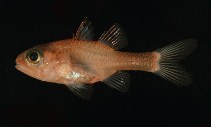
Dorsale stekels (totaal) : 7; Dorsale zachte stralen (totaal) : 9; Anale stekels: 2; Anale zachte stralen: 8. Distinguished by having the following characteristics: dorsal-fin rays VI-I, 9; anal-fin rays II,8; pectoral fin rays 13; pelvic fin rays I,5; pored lateral line scales 24; predorsal scales 5-6; large scale between first dorsal fin and lateral line 1; circumpeduncular scales 12; total gill rakers 15-16, developed gill rakers 8-9; full scale between first dorsal fin and lateral line 1, often with smaller second scale (Ref. 93839). Resembles A. unicolor but distinguished by fewer spines in the 1st dorsal fin (6 against 7), large scales, and fewer lateral line scales (23 against 25). Body color uniformly dark reddish, each scale mottled with brown. Attains 10 cm TL. Further characterized by having a semi-transparent red color, with a thin, dark red stripe on mid-lateral surface of the body (Ref. 93839) greatest depth of body 2.7-3.0 in SL (Ref. 90102).
Body shape (shape guide): short and / or deep; Cross section: compressed.
Found on inshore reefs, lagoons, and seaward reefs (Ref. 37816). Nocturnal species (Ref. 7300). Feeds on small benthic crustaceans (Ref. 37816). Maximum depth reported taken from Ref. 57178.
Levenscyclus en paargedrag
Maturiteit | Voortplanting | Paaien | Eieren | Fecunditeit | Larven
Mouthbrooders (Ref. 240). Distinct pairing during courtship and spawning (Ref. 205).
Paxton, J.R., D.F. Hoese, G.R. Allen and J.E. Hanley, 1989. Pisces. Petromyzontidae to Carangidae. Zoological Catalogue of Australia, Vol. 7. Australian Government Publishing Service, Canberra, 665 p. (Ref. 7300)
Status op de Rode Lijst van het IUCN (Ref. 130435: Version 2025-1)
Gevaar voor de mens
Harmless
Gebruik door de mens
Tools
Speciale rapporten
Download XML
Internetbronnen
Estimates based on models
Preferred temperature (Ref.
123201): 23 - 28.5, mean 27 °C (based on 152 cells).
Fylogenetische diversiteitsindex (Ref.
82804): PD
50 = 0.5000 [Uniqueness, from 0.5 = low to 2.0 = high].
Bayesian length-weight: a=0.01445 (0.00680 - 0.03071), b=3.07 (2.89 - 3.25), in cm total length, based on LWR estimates for this (Sub)family-body shape (Ref.
93245).
Trofisch niveau (Ref.
69278): 3.5 ±0.50 se; based on food items.
Weerstandsvermogen (Ref.
120179): Hoog, minimale populatieverdubbelingstijd minder dan 15 maanden (Preliminary K or Fecundity.).
Fishing Vulnerability (Ref.
59153): Low vulnerability (10 of 100).
🛈
Nutrients (Ref.
124155): Calcium = 281 [116, 644] mg/100g; Iron = 1.64 [0.79, 3.41] mg/100g; Protein = 18.4 [16.9, 19.9] %; Omega3 = 0.142 [0.053, 0.381] g/100g; Selenium = 52 [17, 138] μg/100g; VitaminA = 39.4 [8.1, 194.1] μg/100g; Zinc = 2.8 [1.6, 4.7] mg/100g (wet weight);