Environment: milieu / climate zone / djupintervall / distribution range
Ekologi
marina; brackvatten pelagic-neritic; djupintervall 1 - 70 m (Ref. 189). Subtropical; 44°N - 36°S, 98°W - 32°W (Ref. 189)
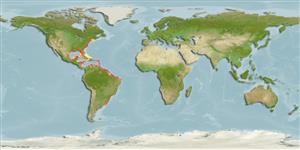
Western Atlantic: Massachusetts, USA perhaps occasionally straying north to Maine or even Nova Scotia (Canada), south to Fort Pierce, Florida (but not Florida Keys) and at least northern Gulf of Mexico; also from Gulf of Venezuela south to Uruguay. Replaced by Anchoa colonensis in the West Indies.
Size / Vikt / Age
Könsmognad: Lm ? range ? - ? cm
Max length : 15.3 cm TL hane/ej könsbestämd; (Ref. 37032); common length : 11.0 cm TL hane/ej könsbestämd; (Ref. 5217)
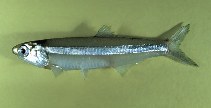
Taggstrålar i ryggfenan (totalt) : 0; Mjukstrålar i ryggfenan (totalt) : 14 - 17; Taggstrålar i analfenan: 0; Mjukstrålar i analfenan: 20 - 24. Snout pointed, about 3/4 eye diameter; maxilla long, tips pointed, reaching beyond hind border of pre-operculum, almost to gill opening; gill cover canals of panamensis-type. Anal fin origin below about midpoint of dorsal fin base. Anus nearer to anal fin origin than to pelvic fin tips. Silver stripe along flank (a dark line above) of uniform width, narrowed immediately behind band (Ref. 189). Back greenish, some yellowish on head. Melanophores outline all dorsal scales (Ref. 7251).
Body shape (shape guide): elongated; Cross section: oval.
Forms dense schools, often in shallow waters close to shore. Able to tolerate a wide range of salinities, from hypersaline to almost fresh. Feeds on copepods when young, then on gastropods, foraminifers and an occasional ostracods and annelid. Breeding was recorded in April through to July at Beaufort, North Carolina. Breeds in harbors, estuaries and sounds. Eggs are elliptical, transparent, without oil globule, the yolk appearing `cellular' (Ref. 189). Great variation. Principal parasites are nematodes and cestodes (Scolex polymorphus and Rhynchobothrium sp.) and trematodes (Distomum appendiculatum and Distomum sp). Marketed as food (Ref. 37032).
Spawn in school (Ref. 205).
Whitehead, P.J.P., G.J. Nelson and T. Wongratana, 1988. FAO Species Catalogue. Vol. 7. Clupeoid fishes of the world (Suborder Clupeoidei). An annotated and illustrated catalogue of the herrings, sardines, pilchards, sprats, shads, anchovies and wolf-herrings. FAO Fish. Synop. 125(7/2):305-579. Rome: FAO. (Ref. 189)
IUCN Red List Status (Ref. 130435: Version 2025-1)
Threat to humans
Harmless
Human uses
Fiskeri: mindre kommeriell; bete: usually
Verktyg
Special reports
Download XML
Internet-källor
Estimates based on models
Preferred temperature (Ref.
123201): 15 - 28, mean 24.4 °C (based on 480 cells).
Phylogenetic diversity index (Ref.
82804): PD
50 = 0.5000 [Uniqueness, from 0.5 = low to 2.0 = high].
Bayesian length-weight: a=0.00525 (0.00417 - 0.00661), b=3.15 (3.11 - 3.19), in cm total length, based on LWR estimates for this species (Ref.
93245).
Trofisk nivå (Ref.
69278): 3.3 ±0.0 se; based on diet studies.
Resiliens (Ref.
120179): Hög, lägsta populationsfördubblingstid mindre än 15 månader (tm=1; Fec=5700).
Fishing Vulnerability (Ref.
59153): Low vulnerability (10 of 100).
🛈
Climate Vulnerability (Ref.
125649): Low vulnerability (21 of 100).
🛈
Nutrients (Ref.
124155): Calcium = 187 [107, 388] mg/100g; Iron = 1.73 [0.91, 3.05] mg/100g; Protein = 18.1 [15.8, 20.8] %; Omega3 = 0.514 [0.268, 0.972] g/100g; Selenium = 20.3 [9.1, 47.5] μg/100g; VitaminA = 11.2 [3.4, 32.7] μg/100g; Zinc = 1.4 [1.0, 2.1] mg/100g (wet weight); based on
nutrient studies.