



Saurida undosquamis (Richardson, 1848)
Brushtooth lizardfish
Lägg till din observation i Fish Watcher
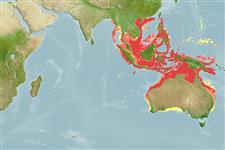
| Native range | All suitable habitat | Point map | Year 2050 |
|
| This map was computer-generated and has not yet been reviewed. |
| Saurida undosquamis AquaMaps Data sources: GBIF OBIS |
Ladda upp din foton och Videor
Bilder | Videor | Google image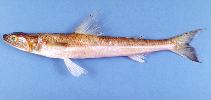 Saurida undosquamis
Bild av Hermosa, Jr., G.V.
Bilder | Videor | Google image
Bild av Hermosa, Jr., G.V.
Klassificering / Namn Populärnamn | synonymer | Catalog of Fishes(Släkte, Arter) | ITIS | CoL | WoRMS | Cloffa
> Aulopiformes (Grinners) > Synodontidae (Lizardfishes) > Harpadontinae
Etymology: Saurida: Derived from Greek, sauros = lizard (Ref. 45335).
More on author: Richardson.
Etymology: Saurida: Derived from Greek, sauros = lizard (Ref. 45335).
More on author: Richardson.
Taxonomic Remarks
Distribution needs major revision due to questionable (unconfirmed) occurences reported by major references (Ref. 57869:385-6).
Miljö: miljö / Klimatzon / djupintervall / distributionsområde Ekologi
marina revassocierade; amfidrom (Ref. 51243); djupintervall 1 - 350 m (Ref. 38189). Subtropical; 45°N - 44°S, 89°E - 154°E
Utbredning Territorier | FAO områden | Ekosystem | Förekomster | Prickkarta | Utplanteringar | Faunafri
Eastern Indian Ocean, Malay Peninsula, southern Philippines, northern Java, Arafura Sea, Louisiade Archipelago, and northern half and southwestern Australia. Reports of Introduction in the Mediterranean are questionable. Confirmed and questionable reports of its occurrence (and references) are discussed in Inoue & Nakabo 2006 (Ref. 57869:385-6).
Längd vid första mognad / Storlek / Vikt / Ålder
Könsmognad: Lm 19.8 range ? - ? cm
Max length : 50.0 cm SL hane/ej könsbestämd; (Ref. 3397); common length : 30.0 cm TL hane/ej könsbestämd; (Ref. 5450); rapporterad maxålder: 7 år (Ref. 94612)
Max length : 50.0 cm SL hane/ej könsbestämd; (Ref. 3397); common length : 30.0 cm TL hane/ej könsbestämd; (Ref. 5450); rapporterad maxålder: 7 år (Ref. 94612)
Kort beskrivning Bestämningsnycklar | Morfologi | Morfometri
Taggstrålar i ryggfenan (totalt) : 0; Mjukstrålar i ryggfenan (totalt) : 11 - 12; Taggstrålar i analfenan: 0; Mjukstrålar i analfenan: 11 - 12. Cigar-shaped, rounded or slightly compressed; the head pointed and depressed; the snout rounded. Dorsal origin closer to the adipose origin than the snout tip. Anal fin origin is closer to the tail base than the operculum. Color is brown-gray above and creamy below, with 8-10 indistinct darker spots along the middle of the sides.
Body shape (shape guide): elongated; Cross section: circular.
Body shape (shape guide): elongated; Cross section: circular.
Found on the sublittoral zone above 100 m over sand or mud bottoms of coastal waters (Ref. 11228, 11230). Feeds on fishes (anchovy and red mullet Mullus surmuletus), crustaceans, and other invertebrates (Ref. 5213). Spawns from April to May off Japan. Generally marketed frozen, sometimes fresh and as fish cakes ('kamaboko') in Japan (Ref. 4964). Minimum depth from Ref. 12260.
Livscykel och parningsbeteende Könsmognad | Reproduktion | Lek | Ägg | Fekunditet | Larver
Huvudreferens
Ladda upp dina referenser | referenser | Koordinator | Medarbetare
Russell, B.C., 1999. Synodontidae: lizardfishes (also bombay ducks, sauries). p. 1928-1945. In K.E. Carpenter and V.H. Niem (eds.) FAO species identification guide for fishery purposes. The living marine resources of the Western Central Pacific. Vol. 3. Batoid fishes, chimaeras and bony fishes. Part 1 (Elopidae to Linophrynidae). FAO, Rome. pp. 1397-2068. (Ref. 38189)
Status på IUCN:s rödlista (Ref. 130435: Version 2025-2 (Global))
Least Concern (LC) ; Date assessed: 02 March 2015
CITES
Not Evaluated
Hot mot människor
Harmless
Mänskliga användningsområden
Fiskeri: mindre kommeriell
FAO - fiskeri: landningar; Publication: search | FishSource | Havet omkring oss
Ytterligare information
Populationsdynamik
Tillväxtparametrar
Max. åldrar / storlekar
Längd-vikt rel.
Längd-längd rel.
Längd-frekvenser
Massakonvertering
Rekrytering
Abundans
Tillväxtparametrar
Max. åldrar / storlekar
Längd-vikt rel.
Längd-längd rel.
Längd-frekvenser
Massakonvertering
Rekrytering
Abundans
Livscykel
Reproduktion
Könsmognad
Mognad/Gills rel.
Fekunditet
Lek
Lekande aggregat
Ägg
Utveckling av ägg
Larver
Larvdynamik
Reproduktion
Könsmognad
Mognad/Gills rel.
Fekunditet
Lek
Lekande aggregat
Ägg
Utveckling av ägg
Larver
Larvdynamik
Fysiologi
Kroppssammansättning
Näringsämnen
Syreförbrukning
Typ av simning
Simhastighet
Visuella pigment
Ljud från fisk
Sjukdomar & Parasiter
Toxicitet (LC50)
Kroppssammansättning
Näringsämnen
Syreförbrukning
Typ av simning
Simhastighet
Visuella pigment
Ljud från fisk
Sjukdomar & Parasiter
Toxicitet (LC50)
Människorelaterad
Vattenbrukssystem
Vattenbruksprofiler
Avelslinjer
Ciguatera-fall
Frimärken, mynt, diverse.
Vattenbrukssystem
Vattenbruksprofiler
Avelslinjer
Ciguatera-fall
Frimärken, mynt, diverse.
Verktyg
E-bok | Fälthandbok | Bestämningsnycklar | Längdfördelnings-verktyg | Livshistorie-verktyg | Prickkarta |
Fångst-MSY |
Särskilda rapporter
Kontrollera för underhåll av akvarium | Kontrollera om det finns faktablad om arter | Kontrollera om det finns faktablad om vattenbruk
Ladda ner XML
Internet-källor
AFORO (otoliths) | Alien/Invasive Species database | Aquatic Commons | BHL | Cloffa | Websites from users | Check FishWatcher | CISTI | Catalog of Fishes: Släkte, Arter | DiscoverLife | ECOTOX | FAO - fiskeri: landningar; Publication: search | Faunafri | Fishipedia | Fishtrace | GloBI | Google Books | Google Scholar | Google | IGFA World Record | Nationella databaser | OneZoom | Open Tree of Life | Otolith Atlas of Taiwan Fishes | PubMed | Reef Life Survey | Socotra Atlas | TreeBase | Tree of Life | Wikipedia: Go, sök | World Records Freshwater Fishing | Zoologiskt register
Uppskattningar baserade på modeller
Önskad temperatur (Ref. 123201): 18.8 - 27.9, mean 26 °C (based on 583 cells).
Index för fylogenetisk mångfald (Ref. 82804): PD50 = 0.5000 [Uniqueness, from 0.5 = low to 2.0 = high].
Bayesian length-weight: a=0.00550 (0.00479 - 0.00630), b=3.10 (3.06 - 3.14), in cm total length, based on LWR estimates for this species (Ref. 93245).
Trofisk nivå (Ref. 69278): 4.5 ±0.4 se; based on diet studies.
Generation time: 2.7 (1.8 - 3.5) years. Estimated as median ln(3)/K based on 40 growth studies.
Resiliens (Ref. 120179): Mellan, lägsta populationsfördubblingstid 1,4-4,4 år (K=0.3-0.9; tm=1-2; tmax=8; Fec=84,802).
Näringsämnen (Ref. 124155): Calcium = 20.3 [6.4, 45.4] mg/100g; Iron = 0.406 [0.138, 0.948] mg/100g; Protein = 16 [14, 19] %; Omega3 = 0.105 [0.035, 0.259] g/100g; Selenium = 22.4 [8.0, 51.5] μg/100g; VitaminA = 63.6 [15.2, 235.3] μg/100g; Zinc = 0.508 [0.287, 0.826] mg/100g (wet weight); based on nutrient studies.