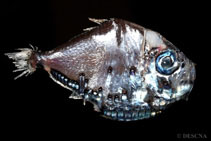
>
Stomiiformes (Lightfishes and dragonfishes) >
Sternoptychidae (Marine hatchetfishes) > Sternoptychinae
Etymology: Polyipnus: Greek, poly = a lot of + Greek, ipnos = lanterns.
Eponymy: Dr Max Fernand Leon Poll (1908–1991) was a Belgian ichthyologist, and ‘connoisseur of the fish fauna’. [...] (Ref. 128868), visit book page.
More on author: Schultz.
Environment: milieu / climate zone / गहराई सीमा / distribution range
पारिस्थितिकी
समुद्री बाथीड़िमरसल; गैर प्रवासी; गहराई सीमा 250 - 600 m (Ref. 4462). Deep-water; 31°N - 25°S
Eastern Atlantic: Greenland to Namibia.
आकार / वज़न / Age
परिपक्व अवधि: Lm ? range ? - ? cm
Max length : 5.0 cm SL पुल्लिंग / अलिंग; (Ref. 26382)
पृष्ठीय रीढ़ (सम्पूर्ण) : 0; पृष्ठीय सौफट रेज़ (सम्पूर्ण) : 14 - 16; गुदा कांटा: 0; ऐनल सौफट रेज़: 15 - 18. Deep body and deeper caudal peduncle (Ref. 37473).
Body shape (shape guide): short and / or deep.
Non-migrant. Dioecious, adult photophore complement acquired at about 20 mm SL (Ref. 4739).
Life cycle and mating behavior
परिपक्व अवधि | पुनरुत्पत्ति | मछलीऔ का अंडे देना | अंडे | Fecundity | लार्वा
Harold, A.S., 1994. A taxonomic revision of the sternoptychid genus Polyipnus (Teleostei: Stomiiformes) with an analysis of phylogenetic relationships. Bull. Mar. Sci. 54(2):428-534. (Ref. 26382)
IUCN Red List Status (Ref. 130435: Version 2025-1)
Threat to humans
Harmless
Human uses
मात्स्यिकी: कोई रुचि बग़ैर
साधन
Special reports
Download XML
इंटरनेट स्रोत
Estimates based on models
Preferred temperature (संदर्भ
123201): 4.4 - 10.8, mean 7.3 °C (based on 114 cells).
Phylogenetic diversity index (संदर्भ
82804): PD
50 = 0.5000 [Uniqueness, from 0.5 = low to 2.0 = high].
Bayesian length-weight: a=0.02399 (0.01252 - 0.04595), b=2.91 (2.74 - 3.08), in cm total length, based on LWR estimates for this species & (Sub)family-body (Ref.
93245).
Trophic level (संदर्भ
69278): 3.2 ±0.3 se; based on size and trophs of closest relatives
लौटाव (संदर्भ
120179): ऊंचा, न्यूनतम जनसंख्या दुगनी समय अवलागत 15 महीने। (Preliminary K or Fecundity.).
Fishing Vulnerability (Ref.
59153): Low vulnerability (10 of 100).
🛈