



Mastacembelus armatus (Lacepède, 1800)
Zig-zag eel
Carica il tuo foto e Video
Immagini | Francobolli, monete, materiale vario. | Google image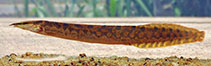 Mastacembelus armatus
Immagine di Ramani Shirantha
Immagini | Francobolli, monete, materiale vario. | Google image
Immagine di Ramani Shirantha
Classificazione / Nomi Nomi Comuni | Sinonimi | Catalog of Fishes(Genere, Specie) | ITIS | CoL | WoRMS | Cloffa
> Synbranchiformes (Spiny eels) > Mastacembelidae (Spiny eels)
Etymology: Mastacembelus: Greek, mastax, -agos = bite + Greek, emballo = to throw oneself (Ref. 45335).
More on author: Lacepède.
Etymology: Mastacembelus: Greek, mastax, -agos = bite + Greek, emballo = to throw oneself (Ref. 45335).
More on author: Lacepède.
Ambiente: milieu / zona climatica / distribuzione batimetrica / gamma di distribuzione Ecologia
; acqua dolce; salmastro demersale; pH range: 6.5 - 7.5; dH range: ? - 15; potamodromo (Ref. 51243). Tropical; 22°C - 28°C (Ref. 1672); 38°N - 1°N
Distribuzione Territories | Aree FAO | Ecosistemi | Presenze | Mappa dei ritrovamenti | Introduzioni | Faunafri
Asia: Pakistan to Viet Nam and Indonesia.
Dimensione / Peso / Età
Maturità: Lm ? range ? - ? cm
Max length : 90.0 cm TL maschio/sesso non determinato; (Ref. 37770); peso massimo pubblicato: 500.00 g (Ref. 9671)
Max length : 90.0 cm TL maschio/sesso non determinato; (Ref. 37770); peso massimo pubblicato: 500.00 g (Ref. 9671)
Breve descrizione Chiavi di identificazione | Morfologia | Morfometria
Spine dorsali (totale) : 33 - 40; Raggi dorsali molli (totale) : 67 - 82; Raggi anali molli: 67 - 83; Vertebre: 87 - 98. Body dull brown with 1-3 darker, longitudinal zigzag lines, more or less connected to form a reticulated pattern, more or less distinct and restricted to the dorsal two thirds of the body (Ref. 27732).
Body shape (shape guide): eel-like.
Body shape (shape guide): eel-like.
Adults live in highland streams to lowland wetlands (Ref. 57235). Usually found in streams and rivers with sand, pebble, or boulder substrate. They seldom leave the bottom except when disturbed. Also occur in still waters, both in coastal marshes and dry zone tanks. Sometimes stays partially buried in fine substrate. Enter flooded forest (Ref. 9497). Reported to occur in areas with rocky bottoms in the Mekong mainstream during the dry season, but enter canals, lakes and other floodplain areas during the flood season (Ref. 37770). Forages at night on benthic insect larvae, worms and some submerged plant material (Ref. 12693). Common during the summer months. Marketed fresh and frequently seen in the aquarium trade (Ref. 12693). Economic important species, both food and aquarium trades (Ref. 57235).
Ciclo vitale e comportamento di accoppiamento Maturità | Riproduzione | Deposizione | Uova | Fecondità | Larve
Riferimento principale
Caricare le referenze | Bibliografia | Coordinatore | Collaboratori
Pethiyagoda, R., 1991. Freshwater fishes of Sri Lanka. The Wildlife Heritage Trust of Sri Lanka, Colombo. 362 p. (Ref. 6028)
Stato della Lista Rossa IUCN (Ref. 130435: Version 2025-2 (Global))
Least Concern (LC) ; Date assessed: 11 August 2019
CITES
Not Evaluated
Minaccia per l'uomo
Harmless
Usi umani
Pesca: commerciale; Acquario: Commerciale
FAO - Publication: search | FishSource |
Informazioni ulteriori
Ecologia trofica
Articoli alimentari (prede)
Alimentazione
Consumo di cibo
Razioni alimentari
Predatori
Articoli alimentari (prede)
Alimentazione
Consumo di cibo
Razioni alimentari
Predatori
Dinamica della popolazione
Parametri di crescita
Età massima / dimensioni massime
Rapporto lunghezza-peso.
Lunghezza-lunghezza rel.
Lunghezza-frequenze
Conversione di massa
Reclutamento
Abbondanza
Parametri di crescita
Età massima / dimensioni massime
Rapporto lunghezza-peso.
Lunghezza-lunghezza rel.
Lunghezza-frequenze
Conversione di massa
Reclutamento
Abbondanza
Ciclo di vita
Riproduzione
Maturità
Maturità/Gli occhielli sono relativi.
Fecondità
Deposizione
Aggregazioni riproduttive
Uova
Sviluppo delle uova
Larve
Dinamica popolazioni larvali
Riproduzione
Maturità
Maturità/Gli occhielli sono relativi.
Fecondità
Deposizione
Aggregazioni riproduttive
Uova
Sviluppo delle uova
Larve
Dinamica popolazioni larvali
Anatomia
Area branchiale
Cervello
Otolite
Area branchiale
Cervello
Otolite
Fisiologia
Composizione corporea
Nutrienti
Consumo di ossigeno
Tipo di nuoto
Velocità di nuoto
Pigmenti visivi
Suono del pesce
Malattie e parassiti
Tossicità (LC50)
Composizione corporea
Nutrienti
Consumo di ossigeno
Tipo di nuoto
Velocità di nuoto
Pigmenti visivi
Suono del pesce
Malattie e parassiti
Tossicità (LC50)
Legato all'uomo
Sistemi di acquacoltura
Profili di acquacoltura
Varietà
Casi di Ciguatera
Francobolli, monete, materiale vario.
Sistemi di acquacoltura
Profili di acquacoltura
Varietà
Casi di Ciguatera
Francobolli, monete, materiale vario.
Strumenti
Quiz organico | Libro elettronico | Giuda pratica | Generatore frequenze di lunghezza | Strumento Parametri Biologici | Mappa dei ritrovamenti |
Cattura-MSY |
Rapporti speciali
Controllo della manutenzione dell'acquario | Verificare la presenza di schede informative sulle specie | Verifica delle schede informative sull'acquacoltura
Scarica XML
Fonti Internet
AFORO (otoliths) | Aquatic Commons | BHL | Cloffa | Websites from users | Check FishWatcher | CISTI | Catalog of Fishes: Genere, Specie | DiscoverLife | ECOTOX | FAO - Publication: search | Faunafri | Fishipedia | Fishtrace | GloBI | Google Books | Google Scholar | Google | IGFA World Record | OneZoom | Open Tree of Life | Otolith Atlas of Taiwan Fishes | Acquari pubblici | PubMed | Reef Life Survey | Socotra Atlas | TreeBase | Tree of Life | Wikipedia: Go, ricerca | World Records Freshwater Fishing | Record zoologico
Stime basate su modelli
Indice di diversità filogenetica (Fonte Biblio. 82804): PD50 = 0.5000 [Uniqueness, from 0.5 = low to 2.0 = high].
Bayesian length-weight: a=0.00372 (0.00275 - 0.00501), b=2.90 (2.81 - 2.99), in cm total length, based on LWR estimates for this species (Ref. 93245).
Livello trofico (Fonte Biblio. 69278): 2.8 ±0.27 se; based on food items.
Resilienza (Fonte Biblio. 120179): Medio, tempo minimo di raddoppiamento della popolazione 1.4 - 4.4 anni (Preliminary K or Fecundity.).
Nutrienti (Ref. 124155): Calcium = 261 [124, 515] mg/100g; Iron = 1.88 [0.89, 3.98] mg/100g; Protein = 17.4 [15.6, 19.2] %; Omega3 = 0.126 [0.064, 0.232] g/100g; Selenium = 22.6 [8.4, 64.1] μg/100g; VitaminA = 14.9 [5.4, 38.0] μg/100g; Zinc = 1.19 [0.67, 2.32] mg/100g (wet weight); based on nutrient studies.