



Mastacembelus armatus (Lacepède, 1800)
Zig-zag eel
Hochladen Photos und videos
Bilder | Briefmarken, Münzen, Verschiedenes. | Google Bild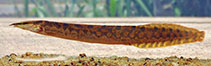 Mastacembelus armatus
Photo von Ramani Shirantha
Bilder | Briefmarken, Münzen, Verschiedenes. | Google Bild
Photo von Ramani Shirantha
Klassifizierung / Names Namen | Synonyme | Catalog of Fishes(Gattung, Arten) | ITIS | CoL | WoRMS | Cloffa
> Synbranchiformes (Spiny eels) > Mastacembelidae (Spiny eels)
Etymology: Mastacembelus: Greek, mastax, -agos = bite + Greek, emballo = to throw oneself (Ref. 45335).
More on author: Lacepède.
Etymology: Mastacembelus: Greek, mastax, -agos = bite + Greek, emballo = to throw oneself (Ref. 45335).
More on author: Lacepède.
Umwelt: Milieu / Klimazone / Tiefenbereich / Verbreitungsgebiet Ökologie
; süßwasser; brackwasser demersal; pH range: 6.5 - 7.5; dH range: ? - 15; potamodrom (Ref. 51243). Tropical; 22°C - 28°C (Ref. 1672); 38°N - 1°N
Verbreitung Territorien | FAO Gebiete | Ökosysteme | Vorkommen | Punkt Karte | Einführungen | Faunafri
Asia: Pakistan to Viet Nam and Indonesia.
Größe / Gewicht / Alter
Geschlechtsreife: Lm ? range ? - ? cm
Max length : 90.0 cm TL Männchen/unbestimmt; (Ref. 37770); max. veröff. Gewicht: 500.00 g (Ref. 9671)
Max length : 90.0 cm TL Männchen/unbestimmt; (Ref. 37770); max. veröff. Gewicht: 500.00 g (Ref. 9671)
Kurzbeschreibung Bestimmungsschlüssel | Morphologie | Morphometrie
Rückenflossenstacheln (insgesamt) : 33 - 40; Rückenflossenweichstrahlen (insgesamt) : 67 - 82; Afterflossenweichstrahlen: 67 - 83; Wirbelzahl: 87 - 98. Body dull brown with 1-3 darker, longitudinal zigzag lines, more or less connected to form a reticulated pattern, more or less distinct and restricted to the dorsal two thirds of the body (Ref. 27732).
Body shape (shape guide): eel-like.
Body shape (shape guide): eel-like.
Adults live in highland streams to lowland wetlands (Ref. 57235). Usually found in streams and rivers with sand, pebble, or boulder substrate. They seldom leave the bottom except when disturbed. Also occur in still waters, both in coastal marshes and dry zone tanks. Sometimes stays partially buried in fine substrate. Enter flooded forest (Ref. 9497). Reported to occur in areas with rocky bottoms in the Mekong mainstream during the dry season, but enter canals, lakes and other floodplain areas during the flood season (Ref. 37770). Forages at night on benthic insect larvae, worms and some submerged plant material (Ref. 12693). Common during the summer months. Marketed fresh and frequently seen in the aquarium trade (Ref. 12693). Economic important species, both food and aquarium trades (Ref. 57235).
Lebenszyklus und Paarungsverhalten Geschlechtsreife | Fortpflanzung | Ablaichen | Eier | Fruchtbarkeit | Larven
Hauptreferenz
Laden Sie Ihre Referenzen hoch | Referenzen | Koordinator | Partner
Pethiyagoda, R., 1991. Freshwater fishes of Sri Lanka. The Wildlife Heritage Trust of Sri Lanka, Colombo. 362 p. (Ref. 6028)
IUCN Rote Liste Status (Ref. 130435: Version 2025-2 (Global))
nicht bedroht (LC) ; Date assessed: 11 August 2019
CITES
Not Evaluated
Bedrohung für Menschen
Harmless
Nutzung durch Menschen
Fischereien: kommerziell; Aquarium: Kommerziell
FAO - Publication: search | FishSource |
Mehr Information
Trophische Ökologie
Lebensmittel (Beutetiere)
Nahrungszusammensetzung
Nahrungsaufnahme
Lebensmittelrationen
Räuber
Lebensmittel (Beutetiere)
Nahrungszusammensetzung
Nahrungsaufnahme
Lebensmittelrationen
Räuber
Populationsdynamik
Wachstumsparameter
Max. Alter/Größen
Länge-Gewicht-Rel.
Länge-Länge-Verhältnis.
Längenhäufigkeiten
Massenkonvertierung
Rekrutierung
Dichte
Wachstumsparameter
Max. Alter/Größen
Länge-Gewicht-Rel.
Länge-Länge-Verhältnis.
Längenhäufigkeiten
Massenkonvertierung
Rekrutierung
Dichte
Lebenszyklus
Fortpflanzung
Geschlechtsreife
Reifung/Kiemen rel.
Fruchtbarkeit
Ablaichen
Laichaggregationen
Eier
Eientwicklung
Larven
Larven Pop.Dyn.
Fortpflanzung
Geschlechtsreife
Reifung/Kiemen rel.
Fruchtbarkeit
Ablaichen
Laichaggregationen
Eier
Eientwicklung
Larven
Larven Pop.Dyn.
Anatomie
Kiemenoberfläche
Gehirn
Otolith
Kiemenoberfläche
Gehirn
Otolith
Physiologie
Körperliche Zusammensetzung
Nährstoffe
Sauerstoffverbrauch
Schwimmart
Schwimmgeschwindigkeit
Visuelle Pigmente
Fischgeräusche
Krankheiten und Parasiten
Toxizität (LC50s)
Körperliche Zusammensetzung
Nährstoffe
Sauerstoffverbrauch
Schwimmart
Schwimmgeschwindigkeit
Visuelle Pigmente
Fischgeräusche
Krankheiten und Parasiten
Toxizität (LC50s)
Menschenbezogen
Aquakultur-Systeme
Aquakultur Profile
Zuchtlinien
Ciguatera-Fälle
Briefmarken, Münzen, Verschiedenes.
Aquakultur-Systeme
Aquakultur Profile
Zuchtlinien
Ciguatera-Fälle
Briefmarken, Münzen, Verschiedenes.
Tools
Bio-Quiz | E-Book | Feldführer | Längenhäufigkeits Tool | Lebensdaten Tool | Punkt Karte |
Catch-MSY |
Zusatzinformationen
Download XML
Zusammenfassung | Punktdaten | Namen | Photos
Internet Quellen
AFORO (otoliths) | Aquatic Commons | BHL | Cloffa | Websites from users | FishWatcher Einträge suchen | CISTI | Catalog of Fishes: Gattung, Arten | DiscoverLife | ECOTOX | FAO - Publication: search | Faunafri | Fishipedia | Fishtrace | GloBI | Google Books | Google Scholar | Google | IGFA World Record | OneZoom | Open Tree of Life | Otolith Atlas of Taiwan Fishes | Öffentliche Aquarien | PubMed | Reef Life Survey | Socotra Atlas | TreeBase | Tree of Life | Wikipedia: Gehe zu, Suchen | World Records Freshwater Fishing | Zoologischer Rekord
Schätzungen auf der Grundlage von Modellen
Phylogenetischer Diversitätsindex (Ref. 82804): PD50 = 0.5000 [Uniqueness, from 0.5 = low to 2.0 = high].
Bayesian length-weight: a=0.00372 (0.00275 - 0.00501), b=2.90 (2.81 - 2.99), in cm total length, based on LWR estimates for this species (Ref. 93245).
Trophische Ebene (Ref. 69278): 2.8 ±0.27 se; based on food items.
Widerstandsfähigkeit (Ref. 120179): mittel, Verdopplung der Population dauert 1,4 - 4,4 Jahre. (Preliminary K or Fecundity.).
Nährstoffe (Ref. 124155): Calcium = 261 [124, 515] mg/100g; Iron = 1.88 [0.89, 3.98] mg/100g; Protein = 17.4 [15.6, 19.2] %; Omega3 = 0.126 [0.064, 0.232] g/100g; Selenium = 22.6 [8.4, 64.1] μg/100g; VitaminA = 14.9 [5.4, 38.0] μg/100g; Zinc = 1.19 [0.67, 2.32] mg/100g (wet weight); based on nutrient studies.