



Trygonorrhina dumerilii (Castelnau, 1873)
Southern fiddler ray
Upload your photos and videos
Google image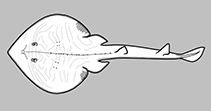 No image available for this species;
drawing shows typical species in Trygonorrhinidae.
Google image
drawing shows typical species in Trygonorrhinidae.
Classification / Names Common names | Synonyms | Catalog of Fishes(genus, species) | ITIS | CoL | WoRMS | Cloffa
Elasmobranchii (sharks and rays) > Rhinopristiformes (Shovelnose rays) > Trygonorrhinidae (Banjo rays, Fiddler rays)
Etymology: Trygonorrhina: Greek, trygon = a sting ray + Greek, rhinos = nose (Ref. 45335).
Eponymy: Auguste Henri André Duméril (1812–1870), was a physician and zoologist like his father (see next entry) and followed much in his father’s footsteps. [...] (Ref. 128868), visit book page.
Etymology: Trygonorrhina: Greek, trygon = a sting ray + Greek, rhinos = nose (Ref. 45335).
Eponymy: Auguste Henri André Duméril (1812–1870), was a physician and zoologist like his father (see next entry) and followed much in his father’s footsteps. [...] (Ref. 128868), visit book page.
Environment: milieu / climate zone / depth range / distribution range Ecology
Marine; demersal; depth range 5 - 205 m (Ref. 114953). Subtropical; 31°S - 41°S, 114°E - 148°E (Ref. 114953)
Distribution Territories | FAO areas | Ecosystems | Occurrences | Point map | Introductions | Faunafri
Eastern Indian Ocean: endemic to southern Australia.
Length at first maturity / Size / Weight / Age
Short description Identification keys | Morphology | Morphometrics
This large shovelnose ray is distinguished by the following characters: suboval disc, short and broadly rounded snout with nostrils partly covered with a large nasal curtain; ridges of small thorns present on mid-line of disc and shoulders; behind interorbital space is an ornate pattern of dark-edged bands without the distinct triangular or diamond-shaped marking (Ref. 114953).
Body shape (shape guide): other; Cross section: flattened.
Body shape (shape guide): other; Cross section: flattened.
A benthic species that occurs on continental shelf, mainly found on soft bottoms and seagrasses. Feeds on bottom crustaceans, worms, molluscs and small fishes. Produces litters of 2-5 pups. Maturity size of males at ca. 70 cm TL, females at 89 cm TL; birth size at 21-25 cm TL (Ref. 114953).
Life cycle and mating behavior Maturity | Reproduction | Spawning | Eggs | Fecundity | Larvae
Main reference
Upload your references | References | Coordinator | Collaborators
Last, P.R. and J.D. Stevens, 2009. Sharks and rays of Australia. CSIRO, Australia. 656 p. (Ref. 109431)
IUCN Red List Status (Ref. 130435: Version 2025-2 (Global))
Least Concern (LC) ; Date assessed: 24 March 2015
CITES
Not Evaluated
Threat to humans
Harmless
Human uses
FAO - Publication: search | FishSource |
More information
Trophic ecology
Food items (preys)
Diet composition
Food consumption
Food rations
Predators
Food items (preys)
Diet composition
Food consumption
Food rations
Predators
Ecology
Ecology
Ecology
Population dynamics
Growth parameters
Max. ages / sizes
Length-weight rel.
Length-length rel.
Length-frequencies
Mass conversion
Recruitment
Abundance
Growth parameters
Max. ages / sizes
Length-weight rel.
Length-length rel.
Length-frequencies
Mass conversion
Recruitment
Abundance
Anatomy
Gill area
Brain
Otolith
Gill area
Brain
Otolith
Physiology
Body composition
Nutrients
Oxygen consumption
Swimming type
Swimming speed
Visual pigments
Fish sound
Diseases & Parasites
Toxicity (LC50s)
Body composition
Nutrients
Oxygen consumption
Swimming type
Swimming speed
Visual pigments
Fish sound
Diseases & Parasites
Toxicity (LC50s)
Genetics
Genome
Genetics
Heterozygosity
Heritability
Genetic Diversity
Genome
Genetics
Heterozygosity
Heritability
Genetic Diversity
Human related
Aquaculture systems
Aquaculture profiles
Strains
Ciguatera cases
Stamps, coins, misc.
Aquaculture systems
Aquaculture profiles
Strains
Ciguatera cases
Stamps, coins, misc.
Tools
Special reports
Download XML
Internet sources
AFORO (otoliths) | Aquatic Commons | BHL | Cloffa | Websites from users | Check FishWatcher | CISTI | Catalog of Fishes: genus, species | DiscoverLife | ECOTOX | FAO - Publication: search | Faunafri | Fishipedia | Fishtrace | GloBI | Google Books | Google Scholar | Google | IGFA World Record | OneZoom | Open Tree of Life | Otolith Atlas of Taiwan Fishes | PubMed | Reef Life Survey | Socotra Atlas | TreeBase | Tree of Life | Wikipedia: Go, Search | | Zoological Record
Estimates based on models
|
Phylogenetic diversity index (Ref. 82804) |
PD50 = 0.7539 [Uniqueness, from 0.5 = low to 2.0 = high]. |
| Bayesian length-weight | a=0.00661 (0.00304 - 0.01436), b=2.98 (2.77 - 3.19), in cm total length, based on LWR estimates for this species & (Sub)family-body (Ref. 93245). |
|
Trophic level (Ref. 69278) |
3.7 ±0.6 se; based on size and trophs of closest relatives |
|
Resilience (Ref. 120179) |
Medium, minimum population doubling time 1.4 - 4.4 years (Preliminary K or Fecundity.). |
|
Fishing Vulnerability (Ref. 59153) |
High vulnerability (65 of 100). 🛈 |
|
Nutrients (Ref. 124155) |
Calcium = 19.7 [4.0, 90.7] mg/100g; Iron = 0.678 [0.174, 1.975] mg/100g; Protein = 19.4 [17.3, 21.3] %; Omega3 = 0.225 [0.101, 0.486] g/100g; Selenium = 31.6 [9.1, 86.6] μg/100g; VitaminA = 6.08 [2.13, 16.80] μg/100g; Zinc = 0.499 [0.251, 0.904] mg/100g (wet weight); |