>
Siluriformes (Catfishes) >
Bagridae (Bagrid catfishes)
Etymology: Hemibagrus: Greek, hemi = the half + Mozarabic, bagre, Greek, pagros = a fish, Dentex sp. (Ref. 45335).
More on author: Valenciennes.
Environment: milieu / climate zone / пределы глубины / distribution range
экология
; пресноводный; солоноватоводный донно-пелагический; pH range: 7.0 - 8.2; dH range: 10 - 25; мигрирует в реке (Ref. 51243); пределы глубины 5 - ? m (Ref. 27732). Tropical; 22°C - 25°C (Ref. 2060); 19°N - 6°S
Asia: Mekong, Chao Phraya and Xe Bangfai basins; also from the Malay Peninsula, Sumatra, Java, Borneo.
Size / Вес / Возраст
половая зрелость: Lm ? range ? - ? cm
Max length : 65.0 cm SL самец/пол неопределен; (Ref. 30857)
Краткое описание
определительные ключи | морфология | морфометрия
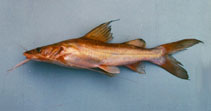
колючие лучи спинного плавника (общее число) : 2; членистые (мягкие) лучи спинного плавника (общее число) : 7; колючие лучи анального плавника: 0; членистые (мягкие) лучи анального плавника: 10 - 13. Body color brown often with greenish sheen. Fins gray with violet tint. Pectoral fin spines serrated along the inner edge. Base of adipose fin shorter than that of dorsal fin and about equal to that of anal fin. Barbels four pairs; nasal barbels extending to or beyond eyes, maxillary ones in anal fin, mandibulary ones beyond base of pectoral fins, mental ones 2/3 - 3/4 the distance between their base and insertion of pectoral fins (Ref. 4792). Head flattened rather than conical; rugose skull roof; depressed dorsal fin not reaching adipose fin; pectoral fin smooth in front; 9 branched anal rays (Ref. 12693).
Body shape (shape guide): fusiform / normal; Cross section: oval.
Occurs in most habitat types, but most frequent in large muddy rivers, with slow current and soft bottom (Ref. 27732). Enters flooded forest (Ref. 9497). Feeds on exogenous insects, aquatic insect larvae, shrimps, other crustaceans and fishes. Moves into flooded forests to spawn and the young are usually first seen in August. In Tonlé Sap (Cambodia), maximum numbers are found as it returns to rivers in November and December. A highly priced aquarium fish. Usually marketed fresh (Ref. 12693). High in nutritive values especially omega-3 fatty acids (EPA, DHA) (Ref. 53337).
Life cycle and mating behavior
половая зрелость | размножение | нерест | икра | Fecundity | личинки
Rainboth, W.J., 1996. Fishes of the Cambodian Mekong. FAO species identification field guide for fishery purposes. FAO, Rome, 265 p. (Ref. 12693)
Статус Красного Списка МСОП (Ref. 130435: Version 2025-1)
Угроза для людей
Harmless
Использование человеком
рыболовство: коммерческий; аквакультура (рыбоводство): коммерческий; аквариум: коммерческий
дополнительная информация
инструменты
Специальные отчеты
Скачать в формате XML
ресурсы в Интернет
Estimates based on models
Phylogenetic diversity index (ссылка
82804): PD
50 = 0.5000 [Uniqueness, from 0.5 = low to 2.0 = high].
Bayesian length-weight: a=0.01000 (0.00817 - 0.01224), b=2.96 (2.91 - 3.01), in cm total length, based on LWR estimates for this species (Ref.
93245).
Trophic level (ссылка
69278): 3.6 ±0.59 se; based on food items.
устойчивость к внешним воздействиям (ссылка
120179): низкий, минимальное время удвоения популяции 4.5-14 лет (Preliminary K or Fecundity.).
Fishing Vulnerability (Ref.
59153): Moderate to high vulnerability (52 of 100).
🛈
Nutrients (Ref.
124155): Calcium = 36.9 [9.7, 157.6] mg/100g; Iron = 0.636 [0.255, 1.924] mg/100g; Protein = 16.8 [14.9, 18.6] %; Omega3 = 0.24 [0.11, 0.47] g/100g; Selenium = 62.8 [33.2, 125.8] μg/100g; VitaminA = 42.3 [9.1, 169.8] μg/100g; Zinc = 1.21 [0.85, 1.74] mg/100g (wet weight); based on
nutrient studies.