



Sicyopterus lagocephalus (Pallas, 1770)
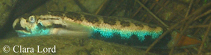
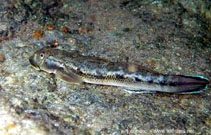
Red-tailed goby
個人による観察記録の追加 Fish Watcher
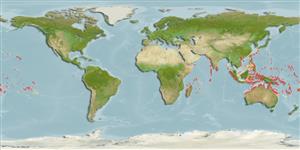
| Native range | All suitable habitat | Point map | Year 2050 |
|
| This map was computer-generated and has not yet been reviewed. |
| Sicyopterus lagocephalus AquaMaps Data sources: GBIF OBIS |
分類 / 名前 共通名の | 類義語 | Catalog of Fishes(部類, 種) | ITIS | CoL | WoRMS | Cloffa
> Gobiiformes (Gobies) > Gobiidae (Gobies) > Sicydiinae
Etymology: Sicyopterus: Greek, sika, sikya = cucumber + Greek, pteron = wing, fin (Ref. 45335).
More on author: Pallas.
Etymology: Sicyopterus: Greek, sika, sikya = cucumber + Greek, pteron = wing, fin (Ref. 45335).
More on author: Pallas.
環境:環境 / 気候帯 / 深さの範囲 / 分布範囲 生態学
海; 新鮮な水; 汽水性の 底生の; 両側回遊性 (Ref. 48660); 深さの範囲 0 - 5 m (Ref. 86942). Tropical; 42°N - 26°S, 42°E - 128°W
分布 領土 | 国連食糧農業機関の区域 | エコシステム | 事件 | 目的のマップ | 導入 | Faunafri
Indo-Pacific: Comoros Islands (East Africa) to Australs Island (French Polynesia) (Ref. 77107). In the Indian Ocean, from Comoros to Mascarene Is. and in the Pacific Ocean, from Japan to French Polynesia, New-Caledonia and Vanuatu (Ref. 87781).
初回成熟時の長さ / サイズ / 重さ / 年齢
簡単な記述 検索表 | 形態学 | 形態計測学
背面の脊椎 (合計) : 6 - 7; 背鰭 (合計) : 9 - 10; 肛門の骨: 1; 臀鰭: 10. Usually 11 unsegmented rays in second dorsal fin. Pectoral rays usually 19. Predorsal midline usually with 13-16 cycloid scales, anterior scales smaller than those posteriorly. Scales on flanks same size as those on caudal peduncle. Belly always with fairly large cycloid scales, about the same size as those on the caudal peduncle. Caudal fin with blackish or dusky horseshoe-shaped band close to margin, medial rays blackish or dusky (Ref. 37578).
Body shape (shape guide): fusiform / normal.
Body shape (shape guide): fusiform / normal.
Adults inhabit fast-flowing sections of clear rainforest streams over rocky bottoms (Ref. 44894). Hatching and larval stage occur at sea, postlarval stage to adult in freshwater (Ref. 4343, 79840). Commercial in Reunion, where they are caught during the few days when they return from sea to enter the rivers (Doug Fenner, pers. comm., 2002, Ref. 79840). Smallest gravid female reported 5.03 cm SL (Ref. 37578).
ライフサイクルと交尾行動 成熟 | 繁殖 | 放精 | 卵 | 生産力 | 幼生
Females when ready to spawn wriggles under a loosely set stone. The eggs are spread into a flat mass as the fish holds fast to the under surface of a stone. The eggs are fastened to the stones by the gelatinous threads that cover them (Ref. 110258). The male ejects his milt on the mass of eggs (Ref. 110258).
Spawning occurs in freshwater afterwhich eggs and larvae are washed down by the river current into the sea and goes back up the river after a month or so (Ref. 110258). The embryo development occurs in freshwater and the larvae should migrate to saltwater a few days following hatching. The larvae are carried by current to the sea where they grow up to the juvenile stage ("bichique"). At this stage the alevins get to the rivers and start going upstream during the new moon. They can go up to waterfalls higher than 10 meters with the help of their sucker-disc, that they can colonize waters up to 800m altitude (Ref. 48660).
主な参考文献
参考文献のアップロード | 参考文献 | コーディネーター | 協力者
Maugé, L.A., 1986. Gobiidae. p. 358-388. In J. Daget, J.-P. Gosse and D.F.E. Thys van den Audenaerde (eds.) Check-list of the freshwater fishes of Africa (CLOFFA). ISNB, Brussels; MRAC, Tervuren; and ORSTOM, Paris. Vol. 2. (Ref. 4343)
CITES
Not Evaluated
人間に対する脅威
Harmless
人間の用途
水産業: 商業
FAO - 水産業: 着陸; Publication: search | FishSource | 私達の周りの海
より多くの情報
用具
オーガニック・クイズ | 電子書籍 | 野外観察図鑑 | 長さ-周波数ウィザード | 生活史の基盤ツール | 目的のマップ |
キャッチ-MSY |
特記事項
XMLをダウンロードして下さい
インターネットの情報源
AFORO (otoliths) | Aquatic Commons | BHL | Cloffa | Websites from users | Check FishWatcher | CISTI | Catalog of Fishes: 部類, 種 | DiscoverLife | ECOTOX | FAO - 水産業: 着陸; Publication: search | Faunafri | Fishipedia | Fishtrace | GloBI | Google Books | Google Scholar | Google | IGFA World Record | OneZoom | Open Tree of Life | Otolith Atlas of Taiwan Fishes | PubMed | Reef Life Survey | Socotra Atlas | TreeBase | 生命の木 | Wikipedia: 行く, 検索する | World Records Freshwater Fishing | 動物に関する記録
モデルに基づく推定値
好ましい温度 (参照 123201): 25.6 - 28.5, mean 26.9 °C (based on 319 cells).
系統多様性指数 (参照 82804): PD50 = 0.5000 [Uniqueness, from 0.5 = low to 2.0 = high].
Bayesian length-weight: a=0.01122 (0.00514 - 0.02450), b=3.04 (2.87 - 3.21), in cm total length, based on all LWR estimates for this body shape (Ref. 93245).
栄養段階 (参照 69278): 2.8 ±0.31 se; based on food items.
回復力 (参照 120179): 高い, 15か月以下の倍増期間の最小個体群 (Fec=46,000).
栄養素 (Ref. 124155): Calcium = 314 [164, 772] mg/100g; Iron = 1.44 [0.79, 2.74] mg/100g; Protein = 17.9 [16.0, 19.5] %; Omega3 = 0.2 [0.1, 0.4] g/100g; Selenium = 24.7 [12.4, 51.7] μg/100g; VitaminA = 30.7 [9.3, 83.0] μg/100g; Zinc = 2.39 [1.64, 3.57] mg/100g (wet weight);