>
Carangiformes (Jacks) >
Carangidae (Jacks and pompanos) > Naucratinae
Etymology: Naucrates: Greek, naykrates, -es, -es = supremacy in the sea (Ref. 45335).
More on author: Linnaeus.
Environment: milieu / climate zone / profondeur / distribution range
Écologie
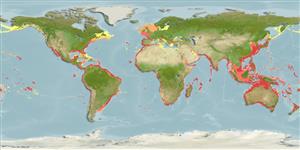
marin récifal; profondeur 0 - 300 m (Ref. 86942). Subtropical; 61°N - 43°S, 180°W - 180°E
Circumtropical in tropical seas. Western Atlantic: Nova Scotia, Canada to Argentina (Ref. 7251). Eastern Atlantic: British Isles (rare vagrant), Norway and Bay of Biscay to Namibia, including the Mediterranean and Canary Islands. Eastern Pacific: Vancouver Island (British Columbia, Canada) to the Galapagos Islands (Ref. 2850) and Chile (Ref. 115205). Common throughout the Indian Ocean (Ref. 3197).
Taille / Poids / Âge
Maturité: Lm ? range ? - ? cm
Max length : 70.0 cm TL mâle / non sexé; (Ref. 5288); common length : 40.0 cm TL mâle / non sexé; (Ref. 9626)
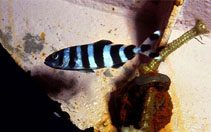
Épines dorsales (Total) : 5 - 6; Rayons mous dorsaux (Total) : 25 - 29; Épines anales: 3; Rayons mous anaux: 15 - 17. Body elongate, slender, and not strongly compressed; posterior end of upper jaw located at anterior rim of eye; dorsal fin with 4 or 5 spines followed by another spine and 25 to 29 soft rays (IV-V+I 25-29); lateral line without scutes; caudal peduncle with well developed fleshy keels and with dorsal and ventral peduncular fossae (Ref. 55763). Body dark to pale bluish, with 6-7 broad, dark bars; white tips on caudal lobes and on second dorsal and anal lobes (Ref. 3197).
Body shape (shape guide): fusiform / normal.
Oceanic species with a semi-obligate commensal relationship with sharks, rays, other bony fishes and turtles (Ref. 5217). Young are usually associated with jellyfish and drifting seaweed (Ref. 2850, 9563). Feed on scraps of host's left over, parasites and excrement; also on small fishes and invertebrates (Ref. 5288). Eggs are pelagic (Ref. 4233). Marketed fresh and salted or dried (Ref. 9283). Captured at the surface using hand nets (Ref. 26165).
Life cycle and mating behavior
Maturité | Reproduction | Frai | Œufs | Fécondité | Larves
Smith-Vaniz, W.F., J.-C. Quéro and M. Desoutter, 1990. Carangidae. p. 729-755. In J.C. Quero, J.C. Hureau, C. Karrer, A. Post and L. Saldanha (eds.) Check-list of the fishes of the eastern tropical Atlantic (CLOFETA). JNICT, Lisbon; SEI, Paris; and UNESCO, Paris. Vol. 2. (Ref. 7097)
Statut dans la liste rouge de l'IUCN (Ref. 130435: Version 2025-1)
Menace pour l'homme
Harmless
Utilisations par l'homme
Pêcheries: intérêt commercial mineur; pêche sportive: oui; Aquarium: Aquariums publics
Outils
Articles particuliers
Télécharger en XML
Sources Internet
Estimates based on models
Preferred temperature (Réf.
123201): 7.9 - 28.1, mean 20.9 °C (based on 3025 cells).
Phylogenetic diversity index (Réf.
82804): PD
50 = 1.0000 [Uniqueness, from 0.5 = low to 2.0 = high].
Bayesian length-weight: a=0.01413 (0.00659 - 0.03029), b=2.93 (2.74 - 3.12), in cm total length, based on LWR estimates for this species & (Sub)family-body (Ref.
93245).
Niveau trophique (Réf.
69278): 3.4 ±0.43 se; based on food items.
Résilience (Réf.
120179): Milieu, temps minimum de doublement de population : 1,4 à 4,4 années (Preliminary K or Fecundity.).
Fishing Vulnerability (Ref.
59153): Moderate to high vulnerability (48 of 100).
🛈
Nutrients (Ref.
124155): Calcium = 53.5 [24.2, 150.1] mg/100g; Iron = 1.83 [0.82, 3.87] mg/100g; Protein = 20.4 [18.9, 21.9] %; Omega3 = 0.235 [0.085, 0.623] g/100g; Selenium = 61.3 [21.5, 188.7] μg/100g; VitaminA = 7.63 [1.58, 39.34] μg/100g; Zinc = 0.869 [0.481, 1.541] mg/100g (wet weight);