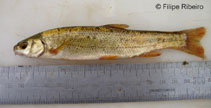
>
Cypriniformes (Carps) >
Leuciscidae (Minnows) > Leuciscinae
Etymology: Iberochondrostoma: Name referring to the Iberian Peninsula where the genus is distributed.
Eponymy: There is little prospect of finding out who or what is referred to here! The original text does not help, plus there is the fact that originally Steindachner spelt the binomial as leminingii -presumably in error and not by design? (Ref. 128868), visit book page.
More on author: Steindachner.
Environment: milieu / climate zone / rango de profundidad / distribution range
Ecología
; agua dulce bentopelágico. Temperate; 42°N - 36°N, 9°W - 1°W
Europe: Spain and Portugal: Tagus, Guadiana, Odiel, Guadalquivir (except Jándula system) and southwestern Douro drainages.
Length at first maturity / Tamaño / Peso / Age
Madurez: Lm 4.3, range 4 - 4.5 cm
Max length : 25.0 cm TL macho / no sexado; (Ref. 556); common length : 15.0 cm TL macho / no sexado; (Ref. 556)
Short description
Claves de identificación | Morfología | Morfometría
Diagnosed from its congeners by having usually 49-59 + 2-3 scales on the lateral line, 4½-7 scale rows between lateral line and pelvic origin, and eye diameter 1.0-1.5 times snout length (Ref. 59043).
Body shape (shape guide): elongated.
Occurs in the middle reaches of streams with moderate current and abundant aquatic vegetation (Ref. 59043) and in the lower reaches of rivers with slow current and abundant submerged plants (Ref. 26100). Feeds on invertebrates, plants (Ref. 26100) and zooplankton (Ref. 59043). Spawns from March to May. Threatened due to water abstraction and the introduction of other species (Ref. 26100).
Life cycle and mating behavior
Madurez | Reproducción | Puesta | Huevos | Fecundidad | Larva
Kottelat, M. and J. Freyhof, 2007. Handbook of European freshwater fishes. Publications Kottelat, Cornol and Freyhof, Berlin. 646 pp. (Ref. 59043)
IUCN Red List Status (Ref. 130435: Version 2025-1)
Threat to humans
Harmless
Human uses
Pesquerías: sin interés
Herramientas
Special reports
Download XML
Fuentes de Internet
Estimates based on models
Phylogenetic diversity index (Referencia
82804): PD
50 = 0.5312 [Uniqueness, from 0.5 = low to 2.0 = high].
Bayesian length-weight: a=0.00794 (0.00430 - 0.01467), b=3.13 (2.97 - 3.29), in cm total length, based on LWR estimates for this species & (Sub)family-body (Ref.
93245).
Nivel trófico (Referencia
69278): 2.8 ±0.30 se; based on food items.
Resiliencia (Referencia
120179): Medio, población duplicada en un tiempo mínimo de 1.4-4.4 años (K=0.22 (?); tm=1).
Fishing Vulnerability (Ref.
59153): Low vulnerability (15 of 100).
🛈