>
Carangiformes (Jacks) >
Carangidae (Jacks and pompanos) > Caranginae
Etymology: Decapterus: Greek, deka = ten + Greek, pteron = wing, fin (Ref. 45335).
More on author: Cuvier.
Environment: milieu / climate zone / Tiefenbereich / distribution range
Ökologie
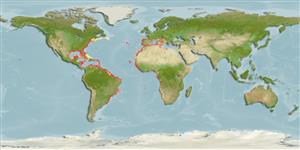
seewasser riff-verbunden; tiefenbereich 0 - 100 m (Ref. 2683). Subtropical; 45°N - 35°S, 98°W - 20°E
Western Atlantic: Nova Scotia, Canada (Ref. 7251) southward through the Gulf of Mexico and the Caribbean to Rio de Janeiro, Brazil. Eastern Atlantic: Morocco to South Africa, including the Madeira, Canary, Cape Verde, Ascension and St. Helena islands (Ref. 7097).
Length at first maturity / Size / Gewicht / Alter
Geschlechtsreife: Lm 11.0 range ? - ? cm
Max length : 30.0 cm SL Männchen/unbestimmt; (Ref. 3277); common length : 18.0 cm TL Männchen/unbestimmt; (Ref. 5217); max. veröff. Gewicht: 300.00 g (Ref. 26340)
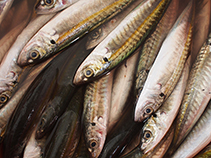
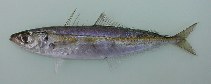
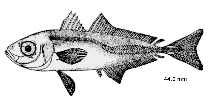
Rückenflossenstacheln (insgesamt) : 9; Rückenflossenweichstrahlen (insgesamt) : 30 - 34; Afterflossenstacheln: 3; Afterflossenweichstrahlen: 26 - 29. Greenish above, whitish below; adults with 3-1 small black spots on curved LL; opercle with small black spot (Ref. 3197).
Body shape (shape guide): fusiform / normal.
Adults inhabit neritic waters, often near sandy beaches (Ref. 5217). A shoaling species, generally near the bottom (Ref. 27121). They feed on planktonic invertebrates, primarily copepods, but also on gastropod larvae, ostracods and pteropods (Ref. 3277). Spawning occurs well offshore year-round (Ref. 26938). Eggs are pelagic (Ref. 4233). A good food fish (Ref. 9626). Caught commercially and used mainly for bait.
Smith-Vaniz, W.F., J.-C. Quéro and M. Desoutter, 1990. Carangidae. p. 729-755. In J.C. Quero, J.C. Hureau, C. Karrer, A. Post and L. Saldanha (eds.) Check-list of the fishes of the eastern tropical Atlantic (CLOFETA). JNICT, Lisbon; SEI, Paris; and UNESCO, Paris. Vol. 2. (Ref. 7097)
IUCN Rote Liste Status (Ref. 130435: Version 2025-1)
Bedrohung für Menschen
Harmless
Nutzung durch Menschen
Fischereien: weniger kommerziell; Köder: usually
Tools
Zusatzinformationen
Download XML
Internet Quellen
Estimates based on models
Preferred temperature (Ref.
123201): 13.5 - 27.8, mean 24.3 °C (based on 900 cells).
Phylogenetic diversity index (Ref.
82804): PD
50 = 0.5005 [Uniqueness, from 0.5 = low to 2.0 = high].
Bayesian length-weight: a=0.01148 (0.00752 - 0.01752), b=2.99 (2.86 - 3.12), in cm total length, based on LWR estimates for this species & Genus-body shape (Ref.
93245).
Trophic level (Ref.
69278): 4.4 ±0.0 se; based on diet studies.
Generation time: 3.5 ( na - na) years. Estimated as median ln(3)/K based on 1
growth studies.
Widerstandsfähigkeit (Ref.
120179): hoch, Verdopplung der Population dauert weniger als 15 Monate. (K=0.32; tm<1; Fec=28,600).
Prior r = 1.20, 95% CL = 0.79 - 1.80, Based on 1 data-limited stock assessment.
Fishing Vulnerability (Ref.
59153): Low to moderate vulnerability (34 of 100).
🛈
Nutrients (Ref.
124155): Calcium = 143 [39, 362] mg/100g; Iron = 1.97 [0.70, 4.60] mg/100g; Protein = 21.6 [20.2, 22.8] %; Omega3 = 0.358 [0.176, 0.741] g/100g; Selenium = 23.8 [7.1, 68.8] μg/100g; VitaminA = 36.4 [8.6, 154.8] μg/100g; Zinc = 0.817 [0.464, 1.440] mg/100g (wet weight); based on
nutrient studies.