



Monodactylus sebae (Cuvier, 1829)
African moony
Beobachtung melden im Fish Watcher
| Native range | All suitable habitat | Point map | Year 2050 |

|
| This map was computer-generated and has not yet been reviewed. |
| Monodactylus sebae AquaMaps Data sources: GBIF OBIS |
Hochladen Photos und videos
Bilder | Briefmarken, Münzen, Verschiedenes. | Google Bild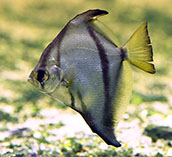 Monodactylus sebae
Photo von Muséum-Aquarium de Nancy/B. Alenda
Bilder | Briefmarken, Münzen, Verschiedenes. | Google Bild
Photo von Muséum-Aquarium de Nancy/B. Alenda
Klassifizierung / Names Namen | Synonyme | Catalog of Fishes(Gattung, Arten) | ITIS | CoL | WoRMS | Cloffa
> Eupercaria/misc (Various families in series Eupercaria) > Monodactylidae (Moonyfishes or fingerfishes)
Etymology: Monodactylus: Greek, monos = one + Greek, daktylos = finger (Ref. 45335).
Eponymy: Albertus Seba (1665–1736) was a very wealthy Dutch apothecary, zoologist and natural history collector, who published a lavish series of illustrations depicting, in part, marine life of the Indo-Pacific. [...] (Ref. 128868), visit book page.
More on author: Cuvier.
Etymology: Monodactylus: Greek, monos = one + Greek, daktylos = finger (Ref. 45335).
Eponymy: Albertus Seba (1665–1736) was a very wealthy Dutch apothecary, zoologist and natural history collector, who published a lavish series of illustrations depicting, in part, marine life of the Indo-Pacific. [...] (Ref. 128868), visit book page.
More on author: Cuvier.
Umwelt: Milieu / Klimazone / Tiefenbereich / Verbreitungsgebiet Ökologie
seewasser; süßwasser; brackwasser pelagic-neritic. Tropical; 24°C - 28°C (Ref. 2060); 16°N - 17°S, 25°W - 14°E
Verbreitung Territorien | FAO Gebiete | Ökosysteme | Vorkommen | Punkt Karte | Einführungen | Faunafri
Eastern Atlantic: west African coast, from Cape Verde to Angola (Ref. 81286, 81657), including the Canary Islands (Ref. 7314, 81657) and Senegal (Ref. 28587, 81657).
Länge bei der ersten Reifung / Größe / Gewicht / Alter
Geschlechtsreife: Lm 8.0 range ? - ? cm
Max length : 25.0 cm TL Männchen/unbestimmt; (Ref. 2683); common length : 15.0 cm TL Männchen/unbestimmt; (Ref. 2683)
Max length : 25.0 cm TL Männchen/unbestimmt; (Ref. 2683); common length : 15.0 cm TL Männchen/unbestimmt; (Ref. 2683)
Kurzbeschreibung Bestimmungsschlüssel | Morphologie | Morphometrie
Rückenflossenstacheln (insgesamt) : 7 - 8; Rückenflossenweichstrahlen (insgesamt) : 32 - 38; Afterflossenstacheln: 3; Afterflossenweichstrahlen: 36 - 38. Diagnosis: body very deep (depth greater than body length) and strongly compressed, its anterior profile very steep; head small; eyes large (Ref. 81286, 81657). Mouth small, oblique (Ref. 81286, 81657), maxilla extending beyond level of anterior eye (Ref. 81286). Jaws with villiform teeth; granular teeth present on roof of mouth and tongue (Ref. 81286). Preopercle smooth or with minute serrations; 1st gill arch with 22-27/1/7-11 (total 31-37) gill rakers (Ref. 81657). Dorsal and anal fins triangular (Ref. 81657), long-based and very high anteriorly (Ref. 81286, 81657). Only tip of dorsal fin spines visible (Ref. 81286, 81657). Pectoral fins short; pelvic fins present in young individuals, rudimentary or absent in adults (Ref. 81286). Scales covering all of body, head and bases of dorsal and anal fins (Ref. 81286, 81657). About 50 tubed scales in lateral line (Ref. 81286). Caudal fin slightly emarginated (Ref. 81657).
Coloration: silvery grey/brownish (Ref. 81286, 81657), somewhat darker dorsally (Ref. 81657), with 4 dark brownish-black/soot-coloured vertical bars, more distinct in young individuals (Ref. 81286, 81657) and already fading or almost absent at >50 mm SL (Ref. 81657), 1st at level of eye, 2nd between dorsal- and anal-fin origins, 3rd between tips of these fins, and 4th on caudal peduncle (Ref. 81286, 81657). In adults, dorsal and anal fin tips, basal part of dorsal and anal fins and hind caudal edge blackish; dorsal and anal fin edge and basal part of caudal fin pale; pectoral fins smoky grey to white or even transparent (Ref. 81657).
Body shape (shape guide): short and / or deep; Cross section: compressed.
Body shape (shape guide): short and / or deep; Cross section: compressed.
Very common in estuaries and lagoons (Ref. 2683, 81286, 81657) where reproduction takes place, marshes and lower courses of rivers, sometimes ascending over long distances into freshwater (Ref. 81286, 81657). Also lives in the sea, mainly in shallow bays and harbour areas (Ref. 81286). Sometimes found in shoals composed of several hundred individuals (Ref. 81657). Feeds on fish, shrimps, zooplankton (Ref. 28587, 81657) and various small invertebrates (Ref. 81657). Neither anterolateral glandular groove nor venom gland is present (Ref. 57406). Maximum reported standard length 200 mm (Ref. 81657).
Lebenszyklus und Paarungsverhalten Geschlechtsreife | Fortpflanzung | Ablaichen | Eier | Fruchtbarkeit | Larven
Distinct pairing (Ref. 205). After a stormy courtship a female lays 15,000 or more eggs which hatch in 24 hours (Ref. 7020).
Hauptreferenz
Laden Sie Ihre Referenzen hoch | Referenzen | Koordinator | Partner
Bauchot, M.L., 2003. Monodactylidae. p. 512-513. In D. Paugy, C. Lévêque and G.G Teugels (eds.) The fresh and brackish water fishes of West Africa Volume 2. Coll. faune et flore tropicales 40. Institut de recherche de développement, Paris, France, Muséum national d'histoire naturelle, Paris, France and Musée royal de l'Afrique Central, Tervuren, Belgium, 815p. (Ref. 81286)
CITES
Not Evaluated
Bedrohung für Menschen
Harmless
Nutzung durch Menschen
Fischereien: weniger kommerziell; Aquarium: Kommerziell
FAO - Publication: search | FishSource |
Mehr Information
Trophische Ökologie
Lebensmittel (Beutetiere)
Nahrungszusammensetzung
Nahrungsaufnahme
Lebensmittelrationen
Räuber
Lebensmittel (Beutetiere)
Nahrungszusammensetzung
Nahrungsaufnahme
Lebensmittelrationen
Räuber
Populationsdynamik
Wachstumsparameter
Max. Alter/Größen
Länge-Gewicht-Rel.
Länge-Länge-Verhältnis.
Längenhäufigkeiten
Massenkonvertierung
Rekrutierung
Dichte
Wachstumsparameter
Max. Alter/Größen
Länge-Gewicht-Rel.
Länge-Länge-Verhältnis.
Längenhäufigkeiten
Massenkonvertierung
Rekrutierung
Dichte
Lebenszyklus
Fortpflanzung
Geschlechtsreife
Reifung/Kiemen rel.
Fruchtbarkeit
Ablaichen
Laichaggregationen
Eier
Eientwicklung
Larven
Larven Pop.Dyn.
Fortpflanzung
Geschlechtsreife
Reifung/Kiemen rel.
Fruchtbarkeit
Ablaichen
Laichaggregationen
Eier
Eientwicklung
Larven
Larven Pop.Dyn.
Anatomie
Kiemenoberfläche
Gehirn
Otolith
Kiemenoberfläche
Gehirn
Otolith
Physiologie
Körperliche Zusammensetzung
Nährstoffe
Sauerstoffverbrauch
Schwimmart
Schwimmgeschwindigkeit
Visuelle Pigmente
Fischgeräusche
Krankheiten und Parasiten
Toxizität (LC50s)
Körperliche Zusammensetzung
Nährstoffe
Sauerstoffverbrauch
Schwimmart
Schwimmgeschwindigkeit
Visuelle Pigmente
Fischgeräusche
Krankheiten und Parasiten
Toxizität (LC50s)
Menschenbezogen
Aquakultur-Systeme
Aquakultur Profile
Zuchtlinien
Ciguatera-Fälle
Briefmarken, Münzen, Verschiedenes.
Aquakultur-Systeme
Aquakultur Profile
Zuchtlinien
Ciguatera-Fälle
Briefmarken, Münzen, Verschiedenes.
Tools
Bio-Quiz | E-Book | Feldführer | Längenhäufigkeits Tool | Lebensdaten Tool | Punkt Karte |
Catch-MSY |
Zusatzinformationen
Download XML
Zusammenfassung | Punktdaten | Namen | Photos
Internet Quellen
AFORO (otoliths) | Aquatic Commons | BHL | Cloffa | Websites from users | FishWatcher Einträge suchen | CISTI | Catalog of Fishes: Gattung, Arten | DiscoverLife | ECOTOX | FAO - Publication: search | Faunafri | Fishipedia | Fishtrace | GloBI | Google Books | Google Scholar | Google | IGFA World Record | Nationale Datenbanken | OneZoom | Open Tree of Life | Otolith Atlas of Taiwan Fishes | Öffentliche Aquarien | PubMed | Reef Life Survey | Socotra Atlas | TreeBase | Tree of Life | Wikipedia: Gehe zu, Suchen | World Records Freshwater Fishing | Zoologischer Rekord
Schätzungen auf der Grundlage von Modellen
Bevorzugte Temperatur (Ref. 123201): 24.4 - 27.9, mean 27.2 °C (based on 22 cells).
Phylogenetischer Diversitätsindex (Ref. 82804): PD50 = 0.6250 [Uniqueness, from 0.5 = low to 2.0 = high].
Bayesian length-weight: a=0.02188 (0.01350 - 0.03546), b=3.02 (2.88 - 3.16), in cm total length, based on LWR estimates for this species & (Sub)family-body (Ref. 93245).
Trophische Ebene (Ref. 69278): 3.9 ±0.64 se; based on food items.
Nährstoffe (Ref. 124155): Calcium = 167 [87, 313] mg/100g; Iron = 1.38 [0.81, 2.51] mg/100g; Protein = 18.5 [17.4, 19.6] %; Omega3 = 0.196 [0.099, 0.365] g/100g; Selenium = 24.4 [11.0, 53.2] μg/100g; VitaminA = 35 [11, 110] μg/100g; Zinc = 1.35 [0.87, 2.01] mg/100g (wet weight);