Environment: milieu / climate zone / Tiefenbereich / distribution range
Ökologie
; süßwasser benthopelagisch; standorttreu. Tropical; 22°C - 28°C (Ref. 2059)
Africa: Unguja Island, Zanzibar archipelago, and adjacent mainland coastal rivers in eastern Tanzania (Ref. 83514, 122075); also reported from Umba and Ramisi rivers in Kenya (Ref. 83514).
Size / Gewicht / Alter
Geschlechtsreife: Lm ? range ? - ? cm
Max length : 5.0 cm SL Männchen/unbestimmt; (Ref. 122075); 5.3 cm SL (female)
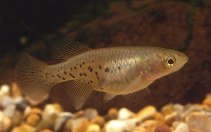
Rückenflossenstacheln (insgesamt) : 0; Rückenflossenweichstrahlen (insgesamt) : 15 - 17; Afterflossenstacheln: 0; Afterflossenweichstrahlen: 16 - 19; Wirbelzahl: 30 - 32. Diagnosis: Distinguished from all congeners by the combination of the following character states: caudal fin red with black posterior margin in males, narrow white margin to dorsal and anal fins, and silver iris; posterior portion of flank and unpaired fins with black spots in females; pre-dorsal length in males 62.4-65.1% of standard length; 5 + 15-16 gill-rakers on first branchial arch; 29-31 scales in longitudinal series; 16-18 series of scales around caudal peduncle; two longitudinal rows of scales between anterior supraorbital series of neuromasts; anterior supraorbital series of neuromasts arranged continuously, with four well-developed neuromasts; four neuromasts in posterior supraorbital series; 29-31 caudal-fin rays; 30-31 vertebrae; second proximal radial of dorsal fin between neural spines of 13th and 15th vertebrae (Ref. 83514, 122075). This species differs from Nothobranchius lucius in having a plain red caudal fin with narrow margin at the upper and lower corners in male (Ref. 83514).
Body shape (shape guide): fusiform / normal; Cross section: compressed.
Found in temporary pools in floodplains, rice fields, swamps, ditches and small streams (Ref. 3788). Found in water-filled depressions in floodplains of rivers; with vegetation often near edges, usually grasses; occasionally grasses cover the entire pool; if aquatic vegetation is present, it may comprise of Nymphea, Ottelia, Lagarosiphon, and Utricularia species; annual species; eggs deposited in substrate where they survive dry season; hatching at onset of wet season; rapid growth of fry; sexual maturity may be attained in six weeks; may be associated with other annual or non-annual fish species (Ref. 83514). Bottom spawner; 4 months incubation; difficult to maintain in aquarium (Ref. 27139).
Life cycle and mating behavior
Geschlechtsreife | Fortpflanzung | Ablaichen | Eier | Fecundity | Larven
Annual fishes.
Costa, W.J.E.M., 2017. Taxonomic revision of the seasonal killifish genus Nothobranchius from Zanzibar, East Africa (Cyprinodontoidei: Aplocheilidae). J. Nat. Hist. 51(27/28):1-16. (Ref. 122075)
IUCN Rote Liste Status (Ref. 130435: Version 2025-1)
Bedrohung für Menschen
Harmless
Nutzung durch Menschen
Fischereien: nicht kommerziell; Aquarium: Kommerziell
Tools
Zusatzinformationen
Download XML
Internet Quellen
Estimates based on models
Phylogenetic diversity index (Ref.
82804): PD
50 = 0.5000 [Uniqueness, from 0.5 = low to 2.0 = high].
Bayesian length-weight: a=0.01072 (0.00471 - 0.02436), b=2.95 (2.75 - 3.15), in cm total length, based on LWR estimates for this species & (Sub)family-body (Ref.
93245).
Trophic level (Ref.
69278): 3.3 ±0.45 se; based on food items.
Fishing Vulnerability (Ref.
59153): Low vulnerability (10 of 100).
🛈