



Nothobranchius jubbi Wildekamp & Berkenkamp, 1979
Uploaden van uw Foto's en video's
Afbeeldingen | Google afbeelding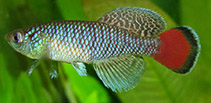 Nothobranchius jubbi
Afbeelding van Nagy, B.
Afbeeldingen | Google afbeelding
Afbeelding van Nagy, B.
Classificatie / Namen Lokale namen | Synoniemen | Catalog of Fishes(Genus, Soort(en)) | ITIS | CoL | WoRMS | Cloffa
> Cyprinodontiformes (Rivulines, killifishes and live bearers) > Nothobranchiidae (African rivulines)
Etymology: Nothobranchius: Greek, nothos = false + Greek, brangchia = gill (Ref. 45335).
Eponymy: Dr Reginald Arthur ‘Rex’ Jubb (1905–1987) was a South African ichthyologist whose bachelor’s degree was awarded by Rhodes University, Grahamstown, which also awarded him a DSc. [...] (Ref. 128868), visit book page.
Etymology: Nothobranchius: Greek, nothos = false + Greek, brangchia = gill (Ref. 45335).
Eponymy: Dr Reginald Arthur ‘Rex’ Jubb (1905–1987) was a South African ichthyologist whose bachelor’s degree was awarded by Rhodes University, Grahamstown, which also awarded him a DSc. [...] (Ref. 128868), visit book page.
Milieu: milieu / Klimaatzone / Diepte / verspreidingsgebied Ecologie
; zoet water benthopelagisch; standvastig. Tropical; 24°C - 26°C (Ref. 2060)
Verspreiding Gebieden | FAO regio's | Ecosystemen | Voorkomen | Verspreidingskaart | Introducties | Faunafri
Africa: lower Tana and Sabaki river drainages in eastern Kenya and Juba river drainage in southern Somalia (Ref. 27139). Reported from the Wabi Shebele basin in Ethiopia (Ref. 58460).
Grootte / Gewicht / Leeftijd
It occurs in temporary pools, swamps and ditches or rain pans, usually without connection to river courses (Ref. 30558). The adults die when waterbodies dry out with low rainfall (Ref. 30558). Males display to attract ripe females, pair off and spawn, grasping the female by folding over the large dorsal and anal fins (Ref. 30558). Spawning occurs daily for an extended period with a few eggs laid at a time (Ref. 30558). It is a bottom spawner (Ref. 27139, Ref. 30558) and development is suspended when the water bodies dry out (Ref. 30558). The eggs hatch the following rainy season when the pan fills, the fish growing to maturity in a few weeks (Ref. 30558). It are aggressive predators on insects and other aquatic invertebrates (Ref. 30558); therefore it is used for mosquito larva control (Ref. 30558). It is easy to maintain in the aquarium (Ref. 27139) and thus a popular aquarium fish (Ref. 30558).
Levenscyclus en paargedrag Maturiteit | Voortplanting | Paaien | Eieren | Fecunditeit | Larven
Males display to attract ripe females, pair off and spawn, grasping the female by folding over the large dorsal and anal fins; spawning occurs daily for an extended period; few eggs are laid at a time; eggs are laid in the bottom sediments and development is suspended when the waterbodies dry out; eggs can endure dessication; eggs hatch the following rainy season when the pan fills, fish growing to maturity in a few weeks; males grow larger than females and are brightly colored; usually complete their life within a year (Ref. 30558).
Hoofdreferentie
Upload uw referenties | Referenties | Coördinator | Medewerkers
Wildekamp, R.H., R. Romand and J.J. Scheel, 1986. Cyprinodontidae. p. 165-276. In J. Daget, J.-P. Gosse and D.F.E. Thys van den Audenaerde (eds.) Check-list of the freshwater fishes of Africa (CLOFFA). ISNB, Brussels, MRAC; Tervuren; and ORSTOM, Paris. Vol. 2. (Ref. 3788)
Status op de Rode Lijst van het IUCN (Ref. 130435: Version 2025-2 (Global))
Niet bedreigd (LC) ; Date assessed: 09 December 2018
CITES
Not Evaluated
Gevaar voor de mens
Harmless
Gebruik door de mens
Visserij: commercieel; Aquarium: Commercieel
FAO - Publication: search | FishSource |
Meer informatie
Trofische ecologie
Voedsel (prooien)
Dieetsamenstelling
Voedselconsumptie
Voedselrantsoenen
Predatoren
Voedsel (prooien)
Dieetsamenstelling
Voedselconsumptie
Voedselrantsoenen
Predatoren
Populatiedynamica
Groeiparameters
Max. leeftijden / maten
Lengte-gewicht rel.
Lengte-lengte rel.
Lengtefrequenties
Massaconversie
Rekrutering
Abundantie
Groeiparameters
Max. leeftijden / maten
Lengte-gewicht rel.
Lengte-lengte rel.
Lengtefrequenties
Massaconversie
Rekrutering
Abundantie
Levenscyclus
Voortplanting
Maturiteit
Rijpheid/kieuwen rel.
Fecunditeit
Paaien
Paaibestanden
Eieren
Ontwikkeling van de eieren
Larven
Larvale populatiedynamiek
Voortplanting
Maturiteit
Rijpheid/kieuwen rel.
Fecunditeit
Paaien
Paaibestanden
Eieren
Ontwikkeling van de eieren
Larven
Larvale populatiedynamiek
Anatomie
Kieuwoppervlak
Hersenen
Otoliet
Kieuwoppervlak
Hersenen
Otoliet
Fysiologie
Lichaamssamenstelling
Voedingsstoffen
Zuurstofverbruik
Type zwemmen
Zwemsnelheid
Visuele pigmenten
Vis geluid
Ziekten en parasieten
Toxiciteit (LC50)
Lichaamssamenstelling
Voedingsstoffen
Zuurstofverbruik
Type zwemmen
Zwemsnelheid
Visuele pigmenten
Vis geluid
Ziekten en parasieten
Toxiciteit (LC50)
Genetica
genoom
Genetica
Heterozygositeit
Erfelijkheid
Genetische diversiteit
genoom
Genetica
Heterozygositeit
Erfelijkheid
Genetische diversiteit
Menselijk gerelateerd
Aquacultuursystemen
Aquacultuurprofielen
Kweeklijnen
Ciguatera gevallen
Postzegels, munten, diversen.
Aquacultuursystemen
Aquacultuurprofielen
Kweeklijnen
Ciguatera gevallen
Postzegels, munten, diversen.
Tools
Biologische quiz | E-boek | Veldgids | Lengtefrequentie Tool | Levenscyclus tool | Verspreidingskaart |
Vangst-MSY |
Speciale rapporten
Bekijk gegevens voor het houden in een aquarium | Bekijk Fact Sheets voor de soort | Bekijk Aquacultuur Fact Sheets
Download XML
Internetbronnen
AFORO (otoliths) | Aquatic Commons | BHL | Cloffa | Websites from users | Bekijk FishWatcher | CISTI | Catalog of Fishes: Genus, Soort(en) | DiscoverLife | ECOTOX | FAO - Publication: search | Faunafri | Fishipedia | Fishtrace | GloBI | Google Books | Google Scholar | Google | IGFA World Record | OneZoom | Open Tree of Life | Otolith Atlas of Taiwan Fishes | PubMed | Reef Life Survey | Socotra Atlas | TreeBase | Tree of Life | Wikipedia: ga naar, zoek | World Records Freshwater Fishing | Zoobank | Zoological Record
Schattingen op basis van modellen
Fylogenetische diversiteitsindex (Ref. 82804): PD50 = 0.5000 [Uniqueness, from 0.5 = low to 2.0 = high].
Bayesian length-weight: a=0.00603 (0.00250 - 0.01453), b=3.13 (2.93 - 3.33), in cm total length, based on LWR estimates for this (Sub)family-body shape (Ref. 93245).
Trofisch niveau (Ref. 69278): 3.2 ±0.40 se; based on food items.
Weerstandsvermogen (Ref. 120179): Hoog, minimale populatieverdubbelingstijd minder dan 15 maanden (tm<1).