



Squalius carolitertii (Doadrio, 1988)
Bordallo
Adicionar o seu Fotografias e vídeos
Fotografias | Imagem do Google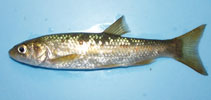 Squalius carolitertii
Fotografia de Ribeiro, F.
Fotografias | Imagem do Google
Fotografia de Ribeiro, F.
Classificação / Nomes Nomes comuns | Sinónimos | Catalog of Fishes(Género, Espécies) | ITIS | CoL | WoRMS | Cloffa
> Cypriniformes (Carps) > Leuciscidae (Minnows) > Leuciscinae
Eponymy: Carlos III (1716–1788) was King of Spain (1759–1788). The binomial is a Latinized version of ‘Carlos the third’. He founded the Museo Nacional de Ciencias Naturales, Madrid (1777) where the holotype of this species is housed. (Ref. 128868), visit book page.
Eponymy: Carlos III (1716–1788) was King of Spain (1759–1788). The binomial is a Latinized version of ‘Carlos the third’. He founded the Museo Nacional de Ciencias Naturales, Madrid (1777) where the holotype of this species is housed. (Ref. 128868), visit book page.
Ambiente: milieu / zona climática / intervalo de profundidade / gama de distribuição Ecologia
; Água doce bentopelágico; potamódromo (Ref. 138297). Subtropical; 44°N - 36°N
Distribuição Territórios | Áreas FAO | Ecossistemas | Ocorrências | Mapa dos pontos | Introduções | Faunafri
Europe: Iberian Peninsula in Douro, Mondego, Umia, Limia, Tagus, Miño and Lérez drainages (Ref. 59043). Listed in the Spanish Red Data Book (Ref. 35754).
Tamanho / Peso / Idade
Maturidade: Lm ? range ? - ? cm
Max length : 25.0 cm TL macho/indeterminado; (Ref. 35754); common length : 13.6 cm SL macho/indeterminado; (Ref. 28035)
Max length : 25.0 cm TL macho/indeterminado; (Ref. 35754); common length : 13.6 cm SL macho/indeterminado; (Ref. 28035)
Descrição breve Chaves de identificação | Morfologia | Morfometria
Espinhos dorsais (total) : 3; Raios dorsais moles (total) : 7 - 9; Espinhos anais: 3; Raios anais moles: 6 - 9; Vértebras: 39 - 41. Mouth subterminal, snout rounded; head length about equal to maximum body depth; infraorbitals 4 and 5 expanded; communication preopercular-mandibular and infraorbital canals present; supraethmoid narrow and short (Ref. 28035). Diagnosed from its congeners in Iberian Peninsula by the following characters: scales on lateral line 39-44 + 2-3; 3-4½ scale rows between lateral line and pelvic fin origin; infraorbital bones narrow, width of infraorbitals 2 and 5 about 2 times width of sensory canal on same bones; snout rounded, mouth subterminal; and head length about equal to body depth (Ref. 59043).
Body shape (shape guide): fusiform / normal.
Body shape (shape guide): fusiform / normal.
Adults inhabit hill streams to middle stretches of rivers (Ref. 59043). They occur in rivers on the low plains and at high attitudes. Can withstand low levels of oxygen during summer. Juveniles are omnivorous whereas adults feed on arthropods and other animals (Ref. 35754). Reported to feed on fry of other fish species. Involved in the Iberocypris alburnoides hybrid complex (Ref. 59043). Threatened due to habitat destruction, pollution and the introduction of other species (Ref. 26100).
Ciclo de vida e comportamento de acasalamento Maturidade | Reprodução | Desova | Ovos | Fecundidade | Larvas
Interspecific hybridization occurs between males of L. carolitertii and females of L. alburnoides.
Referência principal
Carregar as suas referências | Referências | Coordenador | Colaboradores
Carmona, J.A. and I. Doadrio, 2000. Threatened fishes of the world: Leuciscus carolitertii Doadrio, 1988 (Cyprinidae). Environ. Biol. Fishes 57(1):96. (Ref. 35754)
Categoria na Lista Vermelha da IUCN (Ref. 130435: Version 2025-2 (Global))
Quase ameaçada (NT) (A2ace); Date assessed: 09 December 2023
CITES
Not Evaluated
Ameaça para o homem
Harmless
Utilização humana
Pescarias: sem interesse
FAO - Publication: search | FishSource |
Mais informação
Ecologia Trófica
Produtos alimentares (presas)
Composição da dieta
Consumo alimentar
Rações alimentares
Predadores
Produtos alimentares (presas)
Composição da dieta
Consumo alimentar
Rações alimentares
Predadores
Dinâmica das populações
Parâmetros de crescimento
Idades / tamanhos máximos
Comprimento-peso rel.
Comprimento-comprimento rel.
Frequência de comprimento
Conversão de massa
Recrutamento
Abundância
Parâmetros de crescimento
Idades / tamanhos máximos
Comprimento-peso rel.
Comprimento-comprimento rel.
Frequência de comprimento
Conversão de massa
Recrutamento
Abundância
Ciclo de vida
Reprodução
Maturidade
Maturidade/Rel. das guelras
Fecundidade
Desova
Agregações de desova
Ovos
Desenvolvimento dos ovos
Larvas
Dinâmica larvar
Reprodução
Maturidade
Maturidade/Rel. das guelras
Fecundidade
Desova
Agregações de desova
Ovos
Desenvolvimento dos ovos
Larvas
Dinâmica larvar
Anatomia
Área branquial
Cérebro
Otólitos
Área branquial
Cérebro
Otólitos
Fisiologia
Composição corporal
Nutrientes
Consumo de oxigénio
Tipo de natação
Velocidade de natação
Pigmentos visuais
Som de peixe
Doenças e Parasitas
Toxicidade (LC50s)
Composição corporal
Nutrientes
Consumo de oxigénio
Tipo de natação
Velocidade de natação
Pigmentos visuais
Som de peixe
Doenças e Parasitas
Toxicidade (LC50s)
Genética
genoma
Genética
Heterozigotia
Hereditariedade
Diversidade genética
genoma
Genética
Heterozigotia
Hereditariedade
Diversidade genética
Relacionado com o ser humano
Sistemas de aquacultura
Perfis para aquacultura
Estirpes
Casos de Ciguatera
Selos, moedas, diversos.
Sistemas de aquacultura
Perfis para aquacultura
Estirpes
Casos de Ciguatera
Selos, moedas, diversos.
Ferramentas
E-book | Guia de campo | Ferramenta auxiliar de frequências de comprimento | Ferramenta sobre a história de vida | Mapa dos pontos |
Captura-MSY |
Relatórios especiais
Descarregue XML
Fontes da internet
AFORO (otoliths) | Aquatic Commons | BHL | Cloffa | Websites from users | Consultar FishWatcher | CISTI | Catalog of Fishes: Género, Espécies | DiscoverLife | ECOTOX | FAO - Publication: search | Faunafri | Fishipedia | Fishtrace | GloBI | Google Books | Google Scholar | Google | IGFA World Record | Bases de dados nacionais | OneZoom | Open Tree of Life | Otolith Atlas of Taiwan Fishes | PubMed | Reef Life Survey | Socotra Atlas | TreeBase | Árvore da vida | Wikipedia: ir para, procurar | World Records Freshwater Fishing | Registo zoológico
Estimativas baseadas em modelos
Índice de diversidade filogenética (Ref. 82804): PD50 = 0.5000 [Uniqueness, from 0.5 = low to 2.0 = high].
Bayesian length-weight: a=0.00776 (0.00505 - 0.01193), b=3.11 (2.98 - 3.24), in cm total length, based on LWR estimates for this species & Genus-body shape (Ref. 93245).
Nível Trófico (Ref. 69278): 3.4 ±0.38 se; based on food items.
Generation time: 12.2 ( na - na) years. Estimated as median ln(3)/K based on 1 growth studies.
Resiliência (Ref. 120179): Muito baixo, tempo mínimo de duplicação da população maior que 14 anos (Preliminary K or Fecundity.).