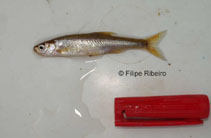
Klassifizierung / Names
Namen | Synonyme | Catalog of Fishes(Gattung, Arten) | ITIS | CoL | WoRMS | Cloffa
Environment: milieu / climate zone / Tiefenbereich / distribution range
Ökologie
; süßwasser pelagisch. Temperate; 44°N - 36°N, 8°W - 3°W
Europe: Guadiana drainage in Spain and Portugal (Ref. 59043). Considered the most endangered primary fish in Iberian waters (Ref. 13392).
Length at first maturity / Size / Gewicht / Alter
Geschlechtsreife: Lm ?, range 4 - ? cm
Max length : 7.5 cm FL Männchen/unbestimmt; (Ref. 43324); max. veröff. Alter: 3.00 Jahre (Ref. 59043)
The only species of the genus which can be diagnosed from other species of Cyprinidae in Iberian Peninsula by having upturned mouth, dorsal origin behind pelvic fin base, scaleless keel between pelvic fin and anus, 58-73 total scales in midlateral row, incomplete lateral line with perforating 2-23 scales (sometimes absent) and 84-130 gill rakes (Ref. 59043).
Body shape (shape guide): elongated.
Inhabits small streams with swift current (often pools in summer) and pebble to rock bottom, usually without submerged vegetation (Ref. 59043). Reported to occur in lowland streams with a moderate current and abundant submerged plants. Pelagic filter feeder (Ref. 26100) . Feeds on filamentous algae and small invertebrate. Migrates upstream to spawn then returns to downstream areas at beginning of summer, where permanent water is retained throughout the year (Ref. 59043). Due to its threats such as habitat destruction and water pollution (Ref. 26100), a conservation project started under the EU-Life Nature program (Ref. 59043).
Kottelat, M. and J. Freyhof, 2007. Handbook of European freshwater fishes. Publications Kottelat, Cornol and Freyhof, Berlin. 646 pp. (Ref. 59043)
IUCN Rote Liste Status (Ref. 130435: Version 2025-1)
Bedrohung für Menschen
Harmless
Nutzung durch Menschen
Fischereien: nicht kommerziell
Tools
Zusatzinformationen
Download XML
Internet Quellen
Estimates based on models
Phylogenetic diversity index (Ref.
82804): PD
50 = 0.7500 [Uniqueness, from 0.5 = low to 2.0 = high].
Bayesian length-weight: a=0.00813 (0.00374 - 0.01767), b=3.10 (2.92 - 3.28), in cm total length, based on LWR estimates for this (Sub)family-body shape (Ref.
93245).
Trophic level (Ref.
69278): 2.8 ±0.29 se; based on food items.
Generation time: 1.1 ( na - na) years. Estimated as median ln(3)/K based on 1
growth studies.
Widerstandsfähigkeit (Ref.
120179): hoch, Verdopplung der Population dauert weniger als 15 Monate. (Preliminary K or Fecundity.).
Fishing Vulnerability (Ref.
59153): Low vulnerability (14 of 100).
🛈