Classification / Names
Nombres comunes | Sinónimos | Catalog of Fishes(Género, Especie) | ITIS | CoL | WoRMS | Cloffa
>
Siluriformes (Catfishes) >
Amphiliidae (Loach catfishes) > Doumeinae
Etymology: Doumea: Taken form a locality, Doumé, in Congo (Ref. 45335).
Eponymy: Dr Pierre-Alfred Chappuis (1891–1960) was a French-born Swiss zoologist, entomologist and bio-speleologist who specialized in isopods. [...] (Ref. 128868), visit book page.
More on author: Pellegrin.
Environment: milieu / climate zone / rango de profundidad / distribution range
Ecología
; agua dulce demersal. Tropical; 14°N - 4°N
Africa: coastal river basins in Guinea, Liberia and Côte d’Ivoire (Ref. 85844). Also reported from the Corubal in Guinea Bissau (Ref. 85844).
Tamaño / Peso / Age
Madurez: Lm ? range ? - ? cm
Max length : 11.6 cm SL macho / no sexado; (Ref. 85844)
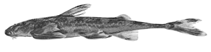
Espinas dorsales (total) : 0; Radios blandos dorsales (total) : 8; Espinas anales: 0; Radios blandos anales: 9 - 12. Diagnosis: Doumea chappuisi is distinguished from its congeners, except D. reidi and D. stilicauda, by having the dorsolateral and ventrolateral vertebral processes extending through the skin to form longitudinal bony ridges from the region of the base of adipose fin posteriorly to the caudal-fin base and from slightly posterior of the pelvic-fin origin to the caudal-fin base; exposed processes are in the shape of longitudinal bars with slightly corrugated surfaces that form irregular longitudinal ridges (Ref. 85844). It differs from D. reidi by a shorter caudal-peduncle length, 22-29% of standard length vs. 31%; the posterior extent of the adpressed pelvic fin in specimens over 90 mm standard length falling short of the anterior limit of the anal fin, vs. extending distinctly beyond that point; the anterior extent of the exposed vertebral processes along the ventral surface of the body extending to slightly posterior of pelvic-fin origin, vs. extending to the area lateral to the anal-fin base; and the uniform pigmentation pattern of the dorsal surface of the unbranched rays of the pectoral and pelvic fins, vs. with series of irregular dark spots against a lighter background (Ref. 85844). It differs from D. stilicauda in the longer predorsal length, 32-37% of standard length vs. 27-30%; longer head length, 18% of standard length vs. 15-17%; smaller caudal-peduncle length, 22-29% of standard length vs. 35-41%; and caudal-peduncle depth 7.3-14.5 times in caudal-peduncle length, vs. 19.6-25.8 times (Ref. 85844).
Body shape (shape guide): elongated.
Life cycle and mating behavior
Madurez | Reproducción | Puesta | Huevos | Fecundidad | Larva
Ferraris, C.J., P. Skelton and R.P. Vari, 2010. Species of the Doumea chappuisi complex (Siluriformes, Amphiliidae) with the descriptions of new species from the upper Sanaga River and Nyong River basins. Copeia 2010(4):705-715. (Ref. 85844)
IUCN Red List Status (Ref. 130435: Version 2025-1)
Threat to humans
Harmless
Human uses
Herramientas
Special reports
Download XML
Fuentes de Internet
Estimates based on models
Phylogenetic diversity index (Referencia
82804): PD
50 = 0.5020 [Uniqueness, from 0.5 = low to 2.0 = high].
Bayesian length-weight: a=0.00389 (0.00180 - 0.00842), b=3.12 (2.94 - 3.30), in cm total length, based on all LWR estimates for this body shape (Ref.
93245).
Nivel trófico (Referencia
69278): 3.1 ±0.4 se; based on size and trophs of closest relatives
Resiliencia (Referencia
120179): Medio, población duplicada en un tiempo mínimo de 1.4-4.4 años (Preliminary K or Fecundity.).
Fishing Vulnerability (Ref.
59153): Low vulnerability (10 of 100).
🛈