



Pareutropius debauwi (Boulenger, 1900)
African glass catfish
Hochladen Photos und videos
Google Bild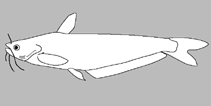 No image available for this species;
drawing shows typical species in Schilbeidae.
Google Bild
drawing shows typical species in Schilbeidae.
Klassifizierung / Names Namen | Synonyme | Catalog of Fishes(Gattung, Arten) | ITIS | CoL | WoRMS | Cloffa
> Siluriformes (Catfishes) > Schilbeidae (Schilbid catfishes)
Etymology: Pareutropius: Greek, par = beside, near + Greek, eu = well + Greek, tropis = keel, in reference to the compressed body of the fish; debauwi: Named for Mr. De Bauw, collector of the type material of this species (Ref. 43912).
Eponymy: Major Guillaume Clément Adolphe De Bauw (1865–1914) was a Belgian Army officer commissioned as a 2nd Lieutenant in the 2nd regiment of line infantry (1886). [...] (Ref. 128868), visit book page.
More on author: Boulenger.
Etymology: Pareutropius: Greek, par = beside, near + Greek, eu = well + Greek, tropis = keel, in reference to the compressed body of the fish; debauwi: Named for Mr. De Bauw, collector of the type material of this species (Ref. 43912).
Eponymy: Major Guillaume Clément Adolphe De Bauw (1865–1914) was a Belgian Army officer commissioned as a 2nd Lieutenant in the 2nd regiment of line infantry (1886). [...] (Ref. 128868), visit book page.
More on author: Boulenger.
Umwelt: Milieu / Klimazone / Tiefenbereich / Verbreitungsgebiet Ökologie
; süßwasser demersal. Tropical; 3°N - 13°S
Verbreitung Territorien | FAO Gebiete | Ökosysteme | Vorkommen | Punkt Karte | Einführungen | Faunafri
Africa: rivers Rembo Ngove and Nyanga in Gabon, Ogooué in Gabon and Republic of Congo, Kouilou in Republic of Congo, and Chiloango in Angola (Ref. 78218, 81643); also throughout the Congo River basin except for the Zambian Congo (Ref. 78218).
Länge bei der ersten Reifung / Größe / Gewicht / Alter
Kurzbeschreibung Bestimmungsschlüssel | Morphologie | Morphometrie
Rückenflossenstacheln (insgesamt) : 1; Rückenflossenweichstrahlen (insgesamt) : 4 - 6. Diagnosis: single pair of mandibular barbels; 4-5 (exceptionally 6) branched dorsal fin rays; 30-54 branched anal fin rays; no dark oblique band (from posterior border of operculum to above anus), no dark spots on caudal lobes, dorsal dark band continues onto caudal fin (Ref. 43912, 81643). 7-8 (rarely 9) branchiostegal rays on one side of head; base of anal fin marked by small dark line (Ref. 43912).
Body shape (shape guide): elongated.
Body shape (shape guide): elongated.
Riverine species with gregarious habits, confined to large as well as moderate and small water systems (Ref. 43912). Forms schools (Ref. 6868). Carnivorous with insectivorous preference; reproduction probably coincides mainly with flood periods (Ref. 43912). Oviparous, eggs are unguarded (Ref. 205). Maximum total length recorded 148 mm (Ref. 43912, 81643).
Lebenszyklus und Paarungsverhalten Geschlechtsreife | Fortpflanzung | Ablaichen | Eier | Fruchtbarkeit | Larven
Distinct pairing (Ref. 205).
Hauptreferenz
Laden Sie Ihre Referenzen hoch | Referenzen | Koordinator | Partner
De Vos, L., 1995. Results of a systematic revision of African schilbeids at the species level. p.113-364. In L. De Vos. A systematic revision of the African Schilbeidae (Teleostei, Siluriformes) with an annotated bibliography, Chapter 3. Ann. Mus. R. Afr. Centr. Zool. vol. 271. (Ref. 33556)
IUCN Rote Liste Status (Ref. 130435: Version 2025-2 (Global))
nicht bedroht (LC) ; Date assessed: 16 February 2009
CITES
Not Evaluated
Bedrohung für Menschen
Harmless
Nutzung durch Menschen
Aquarium: Kommerziell
FAO - Publication: search | FishSource |
Mehr Information
Trophische Ökologie
Lebensmittel (Beutetiere)
Nahrungszusammensetzung
Nahrungsaufnahme
Lebensmittelrationen
Räuber
Lebensmittel (Beutetiere)
Nahrungszusammensetzung
Nahrungsaufnahme
Lebensmittelrationen
Räuber
Ökologie
Ökologie
Ökologie
Populationsdynamik
Wachstumsparameter
Max. Alter/Größen
Länge-Gewicht-Rel.
Länge-Länge-Verhältnis.
Längenhäufigkeiten
Massenkonvertierung
Rekrutierung
Dichte
Wachstumsparameter
Max. Alter/Größen
Länge-Gewicht-Rel.
Länge-Länge-Verhältnis.
Längenhäufigkeiten
Massenkonvertierung
Rekrutierung
Dichte
Lebenszyklus
Fortpflanzung
Geschlechtsreife
Reifung/Kiemen rel.
Fruchtbarkeit
Ablaichen
Laichaggregationen
Eier
Eientwicklung
Larven
Larven Pop.Dyn.
Fortpflanzung
Geschlechtsreife
Reifung/Kiemen rel.
Fruchtbarkeit
Ablaichen
Laichaggregationen
Eier
Eientwicklung
Larven
Larven Pop.Dyn.
Anatomie
Kiemenoberfläche
Gehirn
Otolith
Kiemenoberfläche
Gehirn
Otolith
Physiologie
Körperliche Zusammensetzung
Nährstoffe
Sauerstoffverbrauch
Schwimmart
Schwimmgeschwindigkeit
Visuelle Pigmente
Fischgeräusche
Krankheiten und Parasiten
Toxizität (LC50s)
Körperliche Zusammensetzung
Nährstoffe
Sauerstoffverbrauch
Schwimmart
Schwimmgeschwindigkeit
Visuelle Pigmente
Fischgeräusche
Krankheiten und Parasiten
Toxizität (LC50s)
Genetik
Genom
Genetik
Heterozygotie
Vererbbarkeit
Genetische Vielfalt
Genom
Genetik
Heterozygotie
Vererbbarkeit
Genetische Vielfalt
Menschenbezogen
Aquakultur-Systeme
Aquakultur Profile
Zuchtlinien
Ciguatera-Fälle
Briefmarken, Münzen, Verschiedenes.
Aquakultur-Systeme
Aquakultur Profile
Zuchtlinien
Ciguatera-Fälle
Briefmarken, Münzen, Verschiedenes.
Tools
E-Book | Feldführer | Bestimmungsschlüssel | Längenhäufigkeits Tool | Lebensdaten Tool | Punkt Karte |
Catch-MSY |
Zusatzinformationen
Download XML
Zusammenfassung | Punktdaten | Namen | Photos
Internet Quellen
AFORO (otoliths) | Aquatic Commons | BHL | Cloffa | Websites from users | FishWatcher Einträge suchen | CISTI | Catalog of Fishes: Gattung, Arten | DiscoverLife | ECOTOX | FAO - Publication: search | Faunafri | Fishipedia | Fishtrace | GloBI | Google Books | Google Scholar | Google | IGFA World Record | OneZoom | Open Tree of Life | Otolith Atlas of Taiwan Fishes | Öffentliche Aquarien | PubMed | Reef Life Survey | Socotra Atlas | TreeBase | Tree of Life | Wikipedia: Gehe zu, Suchen | World Records Freshwater Fishing | Zoologischer Rekord
Schätzungen auf der Grundlage von Modellen
Phylogenetischer Diversitätsindex (Ref. 82804): PD50 = 0.5625 [Uniqueness, from 0.5 = low to 2.0 = high].
Bayesian length-weight: a=0.00550 (0.00251 - 0.01205), b=3.06 (2.87 - 3.25), in cm total length, based on LWR estimates for this (Sub)family-body shape (Ref. 93245).
Trophische Ebene (Ref. 69278): 3.3 ±0.5 se; based on size and trophs of closest relatives
Widerstandsfähigkeit (Ref. 120179): niedrig, Verdopplung der Population dauert 4,5 - 14 Jahre. (Assuming fec < 100).