>
Eupercaria/misc (Various families in series Eupercaria) >
Caesionidae (Fusiliers) > Caesioninae
Etymology: Pterocaesio: Greek, pteron = wing, fin + Latin, caesius = blue grey (Ref. 45335).
Environment: milieu / climate zone / distribuzione batimetrica / distribution range
Ecologia
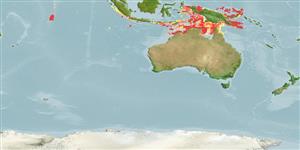
marino associati a barriera corallina; non migratori; distribuzione batimetrica 0 - 50 m (Ref. 90102). Tropical; 0°S - 15°S, 68°E - 154°E (Ref. 402)
Indian Ocean: Chagos Archipelago to Christmas and Cocos-Keeling islands. Western Central Pacific: Papua New Guinea, Philippines (Ref. 43437, 53416, 57038, 59110). Reports from the Comoros in western Indian Ocean (Ref. 4517) is being confirmed.
Size / Peso / Age
Maturità: Lm ? range ? - ? cm
Max length : 23.0 cm TL maschio/sesso non determinato; (Ref. 90102); common length : 11.4 cm SL maschio/sesso non determinato; (Ref. 37816)
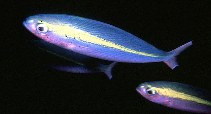
Spine dorsali (totale) : 10; Raggi dorsali molli (totale) : 14 - 16; Spine anali: 3; Raggi anali molli: 12 - 13. Body bluish or reddish dorsally, lighter ventrally. 4-5 cheek scales; 23-30 predorsal scales; scaled dorsal and anal fins; confluent Supra-temporal band of scales at dorsal midline. Upper peduncular scale rows 12-14; lower peduncular scale rows usually 16-17 (15-17). Post maxillary processes 2; posterior end of maxilla tapered. A small flat process on either side of ventrolateral surface of basioccipital, projection not ventrally far from ventral rim of condyle (Ref. 1723). Caudal fin lobes with dark tips. Head length 3.1-3.7 in SL; body depth 4.1-5.3 in SL (Ref. 90102).
Body shape (shape guide): fusiform / normal; Cross section: compressed.
Inhabits coastal, lagoon, and seaward areas around coral reefs (Ref. 90102). Feeds on zooplankton in midwater aggregations. Oviparous, with numerous, small pelagic eggs (Ref. 402). Maximum length observed in the field estimated at about 20-25 cm TL (Ref. 74965).
Life cycle and mating behavior
Maturità | Riproduzione | Deposizione | Uova | Fecundity | Larve
Carpenter, K.E., 1987. Revision of the Indo-Pacific fish family Caesionidae (Lutjanoidea), with descriptions of five new species. Indo-Pac. Fish. (15):56 p. (Ref. 1723)
IUCN Red List Status (Ref. 130435: Version 2025-1)
Threat to humans
Harmless
Human uses
Pesca: pesca di sussistenza
Strumenti
Special reports
Download XML
Fonti Internet
Estimates based on models
Preferred temperature (Fonte Biblio.
123201): 27.2 - 29, mean 27.9 °C (based on 128 cells).
Phylogenetic diversity index (Fonte Biblio.
82804): PD
50 = 0.5002 [Uniqueness, from 0.5 = low to 2.0 = high].
Bayesian length-weight: a=0.01072 (0.00469 - 0.02447), b=3.11 (2.93 - 3.29), in cm total length, based on LWR estimates for this Genus-body shape (Ref.
93245).
Trophic level (Fonte Biblio.
69278): 3.4 ±0.45 se; based on food items.
Resilienza (Fonte Biblio.
120179): Alto, tempo minimo di raddoppiamento della popolazione meno di 15 mesi (Preliminary K or Fecundity.).
Fishing Vulnerability (Ref.
59153): Low vulnerability (13 of 100).
🛈
Nutrients (Ref.
124155): Calcium = 78 [52, 124] mg/100g; Iron = 0.856 [0.563, 1.265] mg/100g; Protein = 19 [18, 20] %; Omega3 = 0.151 [0.102, 0.222] g/100g; Selenium = 31.5 [19.7, 54.2] μg/100g; VitaminA = 114 [47, 286] μg/100g; Zinc = 1.33 [0.96, 1.78] mg/100g (wet weight);