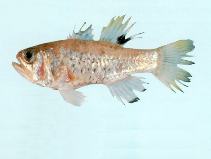
Jaydia carinatus, Ocellate cardinalfish

You can sponsor this page

Jaydia carinatus (Cuvier, 1828)

Ocellate cardinalfish
Add your observation in Fish Watcher
Native range | All suitable habitat | Point map | Year 2050
This map was computer-generated and has not yet been reviewed.
Jaydia carinatus   AquaMaps   Data sources: GBIF OBIS
Upload your photos and videos
Imágenes | Google image
Image of Jaydia carinatus (Ocellate cardinalfish)
Jaydia carinatus
Picture by CSIRO

Classification / Names Nombres comunes | Sinónimos | Catalog of Fishes(Género, Especie) | ITIS | CoL | WoRMS | Cloffa

> Kurtiformes (Nurseryfishes, cardinalfishes.) > Apogonidae (Cardinalfishes) > Apogoninae
More on author: Cuvier.

Environment: milieu / climate zone / rango de profundidad / distribution range Ecología

marino asociado a arrecife; rango de profundidad 50 - 146 m (Ref. 57178). Temperate

Distribución Países | Áreas FAO | Ecosistemas | Ocurrencias, apariciones | Mapa de puntos | Introducciones | Faunafri

Western Pacific: Japan and the China seas. Reported farther south from northwestern Australia (Ref. 3132).

Tamaño / Peso / Age

Madurez: Lm ?  range ? - ? cm
Max length : 15.0 cm TL macho / no sexado; (Ref. 559)

Short description Claves de identificación | Morfología | Morfometría

Espinas dorsales (total) : 8; Radios blandos dorsales (total) : 9; Espinas anales: 2; Radios blandos anales: 8. Second dorsal fin with black ovoid ocellus. Scales ctenoid, large and deciduous.
Body shape (shape guide): short and / or deep; Cross section: compressed.

Biología     Glosario (por ej. epibenthic)

Occurs on muddy bottoms. Adults are sometimes caught by trawl nets, but the young are rather rare (Ref. 559). Mximum depth reported taken from Ref. 57178.

Life cycle and mating behavior Madurez | Reproducción | Puesta | Huevos | Fecundidad | Larva

Mouthbrooders (Ref. 240). Distinct pairing during courtship and spawning (Ref. 205).

Main reference Upload your references | Referencias | Coordinador | Colaboradores

Paxton, J.R., D.F. Hoese, G.R. Allen and J.E. Hanley, 1989. Pisces. Petromyzontidae to Carangidae. Zoological Catalogue of Australia, Vol. 7. Australian Government Publishing Service, Canberra, 665 p. (Ref. 7300)

IUCN Red List Status (Ref. 130435: Version 2025-1)


CITES

Not Evaluated

CMS (Ref. 116361)

Not Evaluated

Threat to humans

  Harmless


Human uses

FAO - Publication: search | FishSource |

Más información

Ecología Trófica
Food items (preys)
Composición de la dieta
consumo de alimento
Food rations
Despredadores
Ecología
Ecología
Home ranges
Population dynamics
Coeficiente del crecimiento para
Max. ages / sizes
Length-weight rel.
Length-length rel.
Length-frequencies
Mass conversion
Reclutamiento
Abundancia
Life cycle
Reproducción
Madurez
Maturity/Gills rel.
Fecundidad
Puesta
Spawning aggregations
Huevos
Egg development
Larva
Dinámica larvaria
Distribución
Países
Áreas FAO
Ecosistemas
Ocurrencias, apariciones
Introducciones
BRUVS - Videos
Anatomy
Superficie branquial
Brain
Otolith
Physiology
Body composition
Nutrients
Consumo del oxígeno
Tipo de natación
Velocidad de natación
Visual pigments
Fish sound
Diseases & Parasites
Toxicity (LC50s)
Genética
Genome
Genética
Heterozygosity
heritabilidad
Human related
Aquaculture systems
Perfiles de acuicultura
Razas
Ciguatera cases
Stamps, coins, misc.
Outreach
Colaboradores
Referencias
Referencias

Herramientas

Special reports

Download XML

Fuentes de Internet

Estimates based on models

Preferred temperature (Referencia 123201): 17.3 - 27.7, mean 25.1 °C (based on 357 cells).
Phylogenetic diversity index (Referencia 82804):  PD50 = 0.5000   [Uniqueness, from 0.5 = low to 2.0 = high].
Bayesian length-weight: a=0.01995 (0.00906 - 0.04395), b=3.01 (2.83 - 3.19), in cm total length, based on all LWR estimates for this body shape (Ref. 93245).
Nivel trófico (Referencia 69278):  3.6   ±0.6 se; based on size and trophs of closest relatives
Resiliencia (Referencia 120179):  Alto, población duplicada en un tiempo mínimo inferior a 15 meses (Preliminary K or Fecundity.).
Fishing Vulnerability (Ref. 59153):  Low vulnerability (10 of 100). 🛈
Nutrients (Ref. 124155):  Calcium = 30.8 [12.9, 57.5] mg/100g; Iron = 0.275 [0.135, 0.527] mg/100g; Protein = 18.9 [17.7, 20.2] %; Omega3 = 0.377 [0.187, 0.784] g/100g; Selenium = 8.91 [3.64, 21.00] μg/100g; VitaminA = 39.8 [7.9, 185.0] μg/100g; Zinc = 0.637 [0.387, 1.009] mg/100g (wet weight);