



Hyporthodus cifuentesi (Lavenberg & Grove, 1993)
Olive grouper
Hochladen Photos und videos
Bilder | Google Bild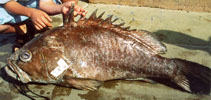 Hyporthodus cifuentesi
Photo von IGFA
Bilder | Google Bild
Photo von IGFA
Klassifizierung / Names Namen | Synonyme | Catalog of Fishes(Gattung, Arten) | ITIS | CoL | WoRMS | Cloffa
> Perciformes/Serranoidei (Groupers) > Epinephelidae (Groupers)
Eponymy: Miguel Cifuentes was a park administrator, though we only know what the etymology tells us: “Sr. Miguel Cifuentes, former lntendente of the Galapagos National Park in appreciation of his assistance in the field work at the Galapagos Islands.” (Ref. 128868), visit book page.
Eponymy: Miguel Cifuentes was a park administrator, though we only know what the etymology tells us: “Sr. Miguel Cifuentes, former lntendente of the Galapagos National Park in appreciation of his assistance in the field work at the Galapagos Islands.” (Ref. 128868), visit book page.
Umwelt: Milieu / Klimazone / Tiefenbereich / Verbreitungsgebiet Ökologie
seewasser demersal; tiefenbereich 40 - 120 m (Ref. 5222). Tropical; 10°N - 4°S, 92°W - 81°W (Ref. 5222)
Verbreitung Territorien | FAO Gebiete | Ökosysteme | Vorkommen | Punkt Karte | Einführungen | Faunafri
Eastern Pacific: Galapagos Islands, Isla del Coco, and off Costa Rica. It probably occurs off Mexico. Galapagos Islands subpopulation is classified as vulnerable in the 2004 IUCN red list of threatened species (Ref. 53964).
Größe / Gewicht / Alter
Geschlechtsreife: Lm ? range ? - ? cm
Max length : 100.0 cm TL Männchen/unbestimmt; (Ref. 5222); max. veröff. Gewicht: 22.3 kg (Ref. 40637)
Max length : 100.0 cm TL Männchen/unbestimmt; (Ref. 5222); max. veröff. Gewicht: 22.3 kg (Ref. 40637)
Kurzbeschreibung Bestimmungsschlüssel | Morphologie | Morphometrie
Rückenflossenstacheln (insgesamt) : 11; Rückenflossenweichstrahlen (insgesamt) : 14 - 16; Afterflossenstacheln: 3; Afterflossenweichstrahlen: 9. Distinguished by the following characteristics: head and body pale brown, with distinct greenish sheen on the body; dark color of lips, tip of lower jaw and dorsal part of the body; brown fins, darker than body, with blue-green sheen; pelvic fins pale brown with dusky membranes; juveniles without distinctive markings except for a dark maxillary groove; body depth 2.6-3.0 times in SL; head length 2.5-2.8 times in SL; convex interorbital area, width greater than eye diameter; preopercle subangular, serrae at angle slightly enlarged; slightly convex upper edge of operculum; subequal nostrils or posterior nostril slightly larger; maxilla reaches past vertical through centre of eye; midside of lower jaw with two rows of teeth; truncate caudal fin with rounded corners in adults, convex in juveniles; midlateral body scales distinctly ctenoid, auxiliary scales in large adults (Ref. 089707).
Body shape (shape guide): fusiform / normal; Cross section: compressed.
Body shape (shape guide): fusiform / normal; Cross section: compressed.
Deep-water species found on rocky reefs in depths of 40-120 m (Ref. 089707). Marketed fresh (Ref.9342).
Lebenszyklus und Paarungsverhalten Geschlechtsreife | Fortpflanzung | Ablaichen | Eier | Fruchtbarkeit | Larven
Hauptreferenz
Laden Sie Ihre Referenzen hoch | Referenzen | Koordinator | Partner
Heemstra, P.C. and J.E. Randall, 1993. FAO Species Catalogue. Vol. 16. Groupers of the world (family Serranidae, subfamily Epinephelinae). An annotated and illustrated catalogue of the grouper, rockcod, hind, coral grouper and lyretail species known to date. Rome: FAO. FAO Fish. Synop. 125(16):382 p. (Ref. 5222)
IUCN Rote Liste Status (Ref. 130435: Version 2025-2 (Global))
nicht bedroht (LC) ; Date assessed: 21 November 2016
CITES
Not Evaluated
Bedrohung für Menschen
Harmless
Nutzung durch Menschen
Fischereien: hoch kommerziell; Sportfisch: ja
FAO - Publication: search | FishSource |
Mehr Information
Trophische Ökologie
Lebensmittel (Beutetiere)
Nahrungszusammensetzung
Nahrungsaufnahme
Lebensmittelrationen
Räuber
Lebensmittel (Beutetiere)
Nahrungszusammensetzung
Nahrungsaufnahme
Lebensmittelrationen
Räuber
Ökologie
Ökologie
Ökologie
Populationsdynamik
Wachstumsparameter
Max. Alter/Größen
Länge-Gewicht-Rel.
Länge-Länge-Verhältnis.
Längenhäufigkeiten
Massenkonvertierung
Rekrutierung
Dichte
Wachstumsparameter
Max. Alter/Größen
Länge-Gewicht-Rel.
Länge-Länge-Verhältnis.
Längenhäufigkeiten
Massenkonvertierung
Rekrutierung
Dichte
Lebenszyklus
Fortpflanzung
Geschlechtsreife
Reifung/Kiemen rel.
Fruchtbarkeit
Ablaichen
Laichaggregationen
Eier
Eientwicklung
Larven
Larven Pop.Dyn.
Fortpflanzung
Geschlechtsreife
Reifung/Kiemen rel.
Fruchtbarkeit
Ablaichen
Laichaggregationen
Eier
Eientwicklung
Larven
Larven Pop.Dyn.
Anatomie
Kiemenoberfläche
Gehirn
Otolith
Kiemenoberfläche
Gehirn
Otolith
Physiologie
Körperliche Zusammensetzung
Nährstoffe
Sauerstoffverbrauch
Schwimmart
Schwimmgeschwindigkeit
Visuelle Pigmente
Fischgeräusche
Krankheiten und Parasiten
Toxizität (LC50s)
Körperliche Zusammensetzung
Nährstoffe
Sauerstoffverbrauch
Schwimmart
Schwimmgeschwindigkeit
Visuelle Pigmente
Fischgeräusche
Krankheiten und Parasiten
Toxizität (LC50s)
Menschenbezogen
Aquakultur-Systeme
Aquakultur Profile
Zuchtlinien
Ciguatera-Fälle
Briefmarken, Münzen, Verschiedenes.
Aquakultur-Systeme
Aquakultur Profile
Zuchtlinien
Ciguatera-Fälle
Briefmarken, Münzen, Verschiedenes.
Tools
E-Book | Feldführer | Bestimmungsschlüssel | Längenhäufigkeits Tool | Lebensdaten Tool | Punkt Karte |
Catch-MSY |
Zusatzinformationen
Download XML
Zusammenfassung | Punktdaten | Namen | Photos
Internet Quellen
AFORO (otoliths) | Aquatic Commons | BHL | Cloffa | Websites from users | FishWatcher Einträge suchen | CISTI | Catalog of Fishes: Gattung, Arten | DiscoverLife | ECOTOX | FAO - Publication: search | Faunafri | Fishipedia | Fishtrace | GloBI | Google Books | Google Scholar | Google | IGFA World Record | OneZoom | Open Tree of Life | Otolith Atlas of Taiwan Fishes | PubMed | Reef Life Survey | Socotra Atlas | TreeBase | Tree of Life | Wikipedia: Gehe zu, Suchen | World Records Freshwater Fishing | Zoologischer Rekord
Schätzungen auf der Grundlage von Modellen
Bevorzugte Temperatur (Ref. 123201): 15.3 - 20.9, mean 20.8 °C (based on 5 cells).
Phylogenetischer Diversitätsindex (Ref. 82804): PD50 = 0.5000 [Uniqueness, from 0.5 = low to 2.0 = high].
Bayesian length-weight: a=0.01096 (0.00618 - 0.01945), b=3.04 (2.89 - 3.19), in cm total length, based on LWR estimates for this species & Genus-body shape (Ref. 93245).
Trophische Ebene (Ref. 69278): 3.9 ±0.7 se; based on size and trophs of closest relatives
Generation time: 3.7 ( na - na) years. Estimated as median ln(3)/K based on 1 growth studies.
Widerstandsfähigkeit (Ref. 120179): mittel, Verdopplung der Population dauert 1,4 - 4,4 Jahre. (Preliminary K or Fecundity.).
Nährstoffe (Ref. 124155): Calcium = 65.4 [28.7, 144.6] mg/100g; Iron = 0.889 [0.406, 2.092] mg/100g; Protein = 18 [16, 20] %; Omega3 = 0.199 [0.102, 0.372] g/100g; Selenium = 77.5 [37.3, 183.6] μg/100g; VitaminA = 26.8 [6.5, 105.5] μg/100g; Zinc = 0.993 [0.618, 1.632] mg/100g (wet weight);