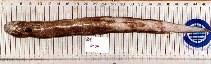
Simenchelys parasitica, Snubnosed eel

You can sponsor this page

Simenchelys parasitica Gill, 1879

Snubnosed eel
Add your observation in Fish Watcher
Native range | All suitable habitat | Point map | Year 2050
This map was computer-generated and has not yet been reviewed.
Simenchelys parasitica   AquaMaps   Data sources: GBIF OBIS
Upload your photos and videos
Imágenes | Google image
Image of Simenchelys parasitica (Snubnosed eel)
Simenchelys parasitica
Picture by Bañón Díaz, R.

Classification / Names Nombres comunes | Sinónimos | Catalog of Fishes(Género, Especie) | ITIS | CoL | WoRMS | Cloffa

> Anguilliformes (Eels and morays) > Synaphobranchidae (Cutthroat eels) > Simenchelyinae
Etymology: Simenchelys: Greek, simo = flattening + Greek, enchelys, -yos = eel (Ref. 45335).
More on author: Gill.

Environment: milieu / climate zone / rango de profundidad / distribution range Ecología

marino batidemersal; rango de profundidad 100 - 3000 m (Ref. 117245), usually 500 - 1800 m (Ref. 58302). Deep-water; 4°C - 9°C (Ref. 26895); 45°N - 45°S, 110°E - 23°E

Distribución Países | Áreas FAO | Ecosistemas | Ocurrencias, apariciones | Mapa de puntos | Introducciones | Faunafri

Eastern Atlantic: France to Madeira and the Azores, one specimen near Cape Verde, also off South Africa. Western Atlantic: USA. Western Pacific: off Japan, near Wake Island, Australia (Ref. 7300) and off New Zealand.

Length at first maturity / Tamaño / Peso / Age

Madurez: Lm ?, range 45 - ? cm
Max length : 61.0 cm TL macho / no sexado; (Ref. 559)

Short description Claves de identificación | Morfología | Morfometría

Grey to greyish brown in color, darker on fin edges and along lateral line (Ref. 3973). Body with scales in grouped, right-angle basketweave pattern. Thick head, blunt, cylindrical. Small mouth, gape falling well short of the orbit; strongly plicate lips around the slit-like mouth; hyomandibula canted anteriorly. Broadly separate gill slits. Reduced cephalic lateralis system (Ref. 26895).
Body shape (shape guide): eel-like.

Biología     Glosario (por ej. epibenthic)

Found on the continental slope and upper abyssal depths. Feed on invertebrates (epibenthic copepods and amphipods) and fishes (Ref. 6726). Reported to be parasitic on fishes. Eggs are probably pelagic (Ref. 6726).

Life cycle and mating behavior Madurez | Reproducción | Puesta | Huevos | Fecundidad | Larva

Main reference Upload your references | Referencias | Coordinador | Colaboradores

Sulak, K.J. and Y.N. Shcherbachev, 1997. Zoogeography and systematics of six deep-living genera of synaphobranchid eels, with a key to taxa and description of two new species of Ilyophis. Bull. Mar. Sci. 60(3):1158-1194. (Ref. 26895)

IUCN Red List Status (Ref. 130435: Version 2025-1)

  Least Concern (LC) ; Date assessed: 04 February 2009

CITES

Not Evaluated

CMS (Ref. 116361)

Not Evaluated

Threat to humans

  Harmless


Human uses

Pesquerías: sin interés
FAO - Publication: search | FishSource |

Más información

Ecología Trófica
Food items (preys)
Composición de la dieta
consumo de alimento
Food rations
Despredadores
Ecología
Ecología
Home ranges
Population dynamics
Coeficiente del crecimiento para
Max. ages / sizes
Length-weight rel.
Length-length rel.
Length-frequencies
Mass conversion
Reclutamiento
Abundancia
Life cycle
Reproducción
Madurez
Maturity/Gills rel.
Fecundidad
Puesta
Spawning aggregations
Huevos
Egg development
Larva
Dinámica larvaria
Distribución
Países
Áreas FAO
Ecosistemas
Ocurrencias, apariciones
Introducciones
BRUVS - Videos
Anatomy
Superficie branquial
Brain
Otolith
Physiology
Body composition
Nutrients
Consumo del oxígeno
Tipo de natación
Velocidad de natación
Visual pigments
Fish sound
Diseases & Parasites
Toxicity (LC50s)
Genética
Genome
Genética
Heterozygosity
heritabilidad
Human related
Aquaculture systems
Perfiles de acuicultura
Razas
Ciguatera cases
Stamps, coins, misc.
Outreach
Colaboradores
Referencias
Referencias

Herramientas

Special reports

Download XML

Fuentes de Internet

Estimates based on models

Preferred temperature (Referencia 123201): 2.4 - 9.5, mean 4.2 °C (based on 1993 cells).
Phylogenetic diversity index (Referencia 82804):  PD50 = 1.0000   [Uniqueness, from 0.5 = low to 2.0 = high].
Bayesian length-weight: a=0.00145 (0.00058 - 0.00361), b=3.01 (2.79 - 3.23), in cm total length, based on LWR estimates for this (Sub)family-body shape (Ref. 93245).
Nivel trófico (Referencia 69278):  3.7   ±0.54 se; based on food items.
Resiliencia (Referencia 120179):  Medio, población duplicada en un tiempo mínimo de 1.4-4.4 años (Assuming fecundity > 100).
Fishing Vulnerability (Ref. 59153):  Moderate vulnerability (44 of 100). 🛈
Nutrients (Ref. 124155):  Calcium = 8.42 [2.49, 28.96] mg/100g; Iron = 0.359 [0.119, 0.939] mg/100g; Protein = 17.5 [15.3, 19.9] %; Omega3 = 0.334 [0.136, 0.888] g/100g; Selenium = 25.7 [7.6, 83.9] μg/100g; VitaminA = 4.94 [0.96, 24.96] μg/100g; Zinc = 0.28 [0.14, 0.55] mg/100g (wet weight);