>
Scombriformes (Mackerels) >
Scombridae (Mackerels, tunas, bonitos) > Scombrinae
Etymology: Allothunnus: Greek, allos = other + Greek, thynnos = tunna (Ref. 45335).
Environment: milieu / climate zone / djupintervall / distribution range
Ekologi
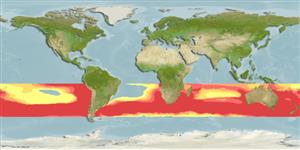
marina pelagic-oceanic; havsvandrande (Ref. 51243); djupintervall 0 - 20 m (Ref. 86942). Subtropical; 10°S - 50°S, 180°W - 180°E (Ref. 168)
Southern Ocean: circumglobal. One individual taken in Los Angeles Harbor.
Size / Vikt / Age
Könsmognad: Lm ? range ? - ? cm
Max length : 105 cm FL hane/ej könsbestämd; (Ref. 5313); common length : 86.0 cm TL hane/ej könsbestämd; (Ref. 9684); publicerad maxvikt: 13.7 kg (Ref. 5313)
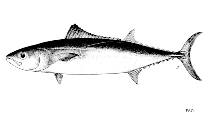
Taggstrålar i ryggfenan (totalt) : 15 - 18; Mjukstrålar i ryggfenan (totalt) : 12 - 13; Taggstrålar i analfenan: 0; Mjukstrålar i analfenan: 13 - 14; Ryggkotor: 40. Interpelvic process small and bifid. Body naked ventrally behind the long anterior corselet. Dorsal half of body to lateral line covered with scales. Swim bladder absent. The back is bluish, turning to deep purple or almost black on the head; the belly is white, without stripes or spots; the pectoral and pelvic fins purple, their inner sides black.
Body shape (shape guide): fusiform / normal; Cross section: oval.
An occasionally schooling species which feeds mainly on krill (euphausiids), and also on squids and small fishes. Juveniles are found between 20 and 35°S at surface temperatures ranging from 19 to 24°C. Its flesh is paler than that of most true tunas and is very oily, but the cooked meat has fine eating qualities. Mainly marketed fresh.
Life cycle and mating behavior
Könsmognad | Reproduktion | Lek | Ägg | Fecundity | Larver
Collette, B.B. and C.E. Nauen, 1983. FAO Species Catalogue. Vol. 2. Scombrids of the world. An annotated and illustrated catalogue of tunas, mackerels, bonitos and related species known to date. Rome: FAO. FAO Fish. Synop. 125(2):137 p. (Ref. 168)
IUCN Red List Status (Ref. 130435: Version 2025-1)
Threat to humans
Harmless
Human uses
Fiskeri: mindre kommeriell; sportfisk: ja
Verktyg
Special reports
Download XML
Internet-källor
Estimates based on models
Preferred temperature (Ref.
123201): 15.8 - 24.6, mean 18.4 °C (based on 182 cells).
Phylogenetic diversity index (Ref.
82804): PD
50 = 1.0000 [Uniqueness, from 0.5 = low to 2.0 = high].
Bayesian length-weight: a=0.00955 (0.00460 - 0.01984), b=3.06 (2.89 - 3.23), in cm total length, based on LWR estimates for this (Sub)family-body shape (Ref.
93245).
Trofisk nivå (Ref.
69278): 3.7 ±0.1 se; based on diet studies.
Resiliens (Ref.
120179): Mellan, lägsta populationsfördubblingstid 1,4-4,4 år (Preliminary K or Fecundity.).
Fishing Vulnerability (Ref.
59153): High to very high vulnerability (70 of 100).
🛈
Nutrients (Ref.
124155): Calcium = 47.8 [25.9, 89.1] mg/100g; Iron = 1.57 [0.92, 2.77] mg/100g; Protein = 21.7 [20.5, 22.9] %; Omega3 = 0.3 [0.2, 0.5] g/100g; Selenium = 19.6 [10.4, 39.2] μg/100g; VitaminA = 13.3 [4.8, 40.7] μg/100g; Zinc = 0.618 [0.430, 0.904] mg/100g (wet weight);