This website uses cookies to enhance your browsing experience and ensure the functionality of our site. For more detailed information about the types of cookies we use and how we protect your privacy, please visit our Privacy Information page.
×
Cookie Settings
This website uses different types of cookies to enhance your experience. Please select your preferences below:
Elasmobranchi (squali e razze) (sharks and rays) > Carcharhiniformes (Ground sharks) > Carcharhinidae (Requiem sharks)
Etymology: Triaenodon:triaeno, from triaina (Gr.), trident (having three points); odon (Gr.), tooth, referring to each having a cusp and two cusplets (See ETYFish); obesus:Latin for fat or stout, referring to its blunt head, said to give the shark a plump appearance (See ETYFish). More on author: Rüppell.
Ambiente: milieu / zona climatica / distribuzione batimetrica / gamma di distribuzione Ecologia
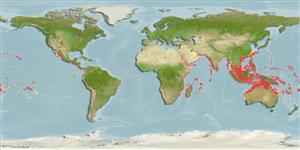
marino associati a barriera corallina; distribuzione batimetrica 0 - 330 m (Ref. 244), usually 8 - 40 m (Ref. 244). Tropical; 29°N - 30°S, 33°E - 77°W (Ref. 55196)
Indo-Pacific: Red Sea and East Africa to Indonesia and the Arafura Sea (Ref. 9819), north to Ryukyu and Ogasawara islands, south to New South Wales (Australia), New Caledonia, and the Austral and Pitcairn islands; throughout Micronesia. Eastern Pacific: Cocos and Galapagos islands, Panama to Costa Rica.
Lunghezza alla prima maturità / Dimensione / Peso / Età
Maturità: Lm107.0, range 105 - 109 cm Max length : 213 cm TL maschio/sesso non determinato; (Ref. 244); common length : 160 cm TL maschio/sesso non determinato; (Ref. 244); peso massimo pubblicato: 18.3 kg (Ref. 4699); Età massima riportata: 25 anni (Ref. 6807)
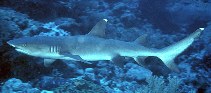
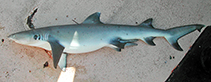
Spine dorsali (totale) : 0; Spine anali: 0. A small, slender shark with an extremely short, broad snout, oval eyes, and conspicuous white tips on the 1st dorsal (sometimes 2nd) and upper caudal fins; 2nd dorsal almost as large as 1st; no interdorsal ridge (Ref. 5578). Spiracles usually present, teeth 47-50/ 44-46, in at least 2 functional rows. Grey above, lighter below and sometimes with dark spots on sides (Ref. 5578). First dorsal-fin lobe and dorsal caudal-fin lobe with conspicuous white tips, second dorsal-fin lobe and ventral caudal-fin lobe often white-tipped (Ref. 9997). Body shape (shape guide): fusiform / normal.
Sluggish inhabitant of lagoons and seaward reefs where it is often found resting in caves or under coral ledges during the day (Ref. 6871, 58302), or usually on a sand patch, or in a channel (Ref. 37816). More active at night or during slack tide in areas of strong currents (Ref. 37816). Feeds on benthic animals such as fishes, octopi, spiny lobsters and crabs (Ref. 244). Viviparous (Ref. 50449). Travels distances from about 0.3 to 3 km in periods up to about 1 year (Ref. 244). Rarely reported to attack humans, but is potentially dangerous especially when fish had been speared (Ref. 244). Probably fished wherever it occurs (Ref. 244). Caught by inshore longline and gillnet fisheries, and probably adversely affected by dynamite fishing (Ref.58048). Meat and liver utilized fresh for human consumption (Ref. 244). The liver of this shark has been reported as toxic (Ref. 583). One to five 60 cm young per litter (Ref. 1602). Minimum depth reported taken from Ref. 128797.
Viviparous, placental (Ref. 50449), with 1 to 5 young per litter (Ref. 244); usually 2 or 3 pups after a gestation period of > 5 months (Ref.58048). Size at birth 52-60 cm TL (Ref. 9997). Distinct pairing with embrace (Ref. 205).
During courtship and prior to copulation, the male bites the female on her right pectoral fin and uses his medially flexed right clasper in copulation (Ref. 49562, 51119). During copulation which lasts from 15 seconds to 4 minutes (Ref. 49562, 51119), both heads of the male and female are slammed in the substrate and their bodies undulate to keep their tails elevated (Ref. 51155). This mating behavior was observed in individuals bred in captivity.
Compagno, L.J.V., 1984. FAO Species Catalogue. Vol. 4. Sharks of the world. An annotated and illustrated catalogue of shark species known to date. Part 2 - Carcharhiniformes. FAO Fish. Synop. 125(4/2):251-655. Rome: FAO. (Ref. 244)
Stato della Lista Rossa IUCN (Ref. 130435: Version 2025-2 (Global))
Ciclo di vita Riproduzione Maturità Maturità/Gli occhielli sono relativi. Fecondità Deposizione Aggregazioni riproduttive Uova Sviluppo delle uova Larve Dinamica popolazioni larvali
Fisiologia Composizione corporea Nutrienti Consumo di ossigeno Tipo di nuoto Velocità di nuoto Pigmenti visivi Suono del pesce Malattie e parassiti Tossicità (LC50)
Temperatura preferita (Fonte Biblio. 123201): 24.3 - 28.8, mean 27.6 °C (based on 898 cells).
Indice di diversità filogenetica (Fonte Biblio. 82804): PD50 = 1.0000 [Uniqueness, from 0.5 = low to 2.0 = high].
Bayesian length-weight: a=0.00355 (0.00213 - 0.00591), b=3.12 (2.98 - 3.26), in cm total length, based on LWR estimates for this species & (Sub)family-body (Ref. 93245).
Livello trofico (Fonte Biblio. 69278): 4.2 ±0.6 se; based on diet studies.
Resilienza (Fonte Biblio. 120179): Molto basso, tempo minimo di raddoppiamento della popolazione più di 14 anni (tm=5-9; tmax=25; Fec=1).
Vulnerabilità della pesca (Ref. 59153): Very high vulnerability (90 of 100). 🛈