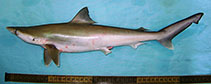
Elasmobranchi (squali e razze) (sharks and rays) >
Carcharhiniformes (Ground sharks) >
Carcharhinidae (Requiem sharks)
Etymology: Rhizoprionodon: rhiza (Gr.), root; prion (Gr.) saw; odon (Gr.), tooth, referring to teeth with serrated (saw-like) bases, or roots [replacement name for Rhizoprion Ogilby 1915, preoccupied by Rhizoprion Jourdan 1861 in mammals] (See ETYFish); oligolinx: Per Springer, Greek for “short furrow,” referring to short upper labial furrow (See ETYFish).
Environment: milieu / climate zone / distribuzione batimetrica / distribution range
Ecologia
marino associati a barriera corallina; distribuzione batimetrica 0 - 36 m (Ref. 9997). Tropical; 30°N - 18°S
Indo-West Pacific: Persian Gulf east to Thailand, Indonesia, China, and Japan. Recorded from the Gulf of Carpentaria (Ref. 6871) and Palau (Ref. 244). This species is very close to Rhizoprionodon taylori, but is geographically separated from it (Ref. 244).
Length at first maturity / Size / Peso / Age
Maturità: Lm 43.2, range 32 - 65 cm
Max length : 84.5 cm TL maschio/sesso non determinato; (Ref. 121648); 77.5 cm TL (female); peso massimo pubblicato: 2.8 kg (Ref. 121648)
Spine dorsali (totale) : 0; Spine anali: 0. Position of anal fin origin well in front of second dorsal fin origin, long labial furrows, and short pectoral fins (Ref. 37816).
Body shape (shape guide): fusiform / normal.
A little known inshore and offshore shark found on continental and insular shelves (Ref. 244). Found to depths of at least 36 m (Ref. 9997). Probably feeds on fishes, cephalopods, and crustaceans (Ref. 6871). Viviparous (Ref. 50449). Commonly caught by inshore demersal gillnet fisheries, especially off Java (Ref.58048). Utilized fresh and probably dried salted for human consumption (Ref. 244). Also used for fishmeal (Ref. 9997) and fins (Ref.58048). Minimum depth from Ref. 58018.
Viviparous, placental (Ref. 50449). With 3 to 5 young per litter (Ref. 244, 37816). Size at birth 20-30 cm TL (Ref. 9997, 37816). Distinct pairing with embrace (Ref. 205).
Compagno, L.J.V., 1984. FAO Species Catalogue. Vol. 4. Sharks of the world. An annotated and illustrated catalogue of shark species known to date. Part 2 - Carcharhiniformes. FAO Fish. Synop. 125(4/2):251-655. Rome: FAO. (Ref. 244)
IUCN Red List Status (Ref. 130435: Version 2025-1)
Threat to humans
Harmless
Human uses
Pesca: commerciale
Strumenti
Special reports
Download XML
Fonti Internet
Estimates based on models
Preferred temperature (Fonte Biblio.
123201): 26.2 - 29.3, mean 28.6 °C (based on 2593 cells).
Phylogenetic diversity index (Fonte Biblio.
82804): PD
50 = 0.5078 [Uniqueness, from 0.5 = low to 2.0 = high].
Bayesian length-weight: a=0.00339 (0.00271 - 0.00424), b=3.07 (3.03 - 3.11), in cm total length, based on LWR estimates for this species (Ref.
93245).
Trophic level (Fonte Biblio.
69278): 4.1 ±0.55 se; based on food items.
Generation time: 2.3 ( na - na) years. Estimated as median ln(3)/K based on 1
growth studies.
Resilienza (Fonte Biblio.
120179): Molto basso, tempo minimo di raddoppiamento della popolazione più di 14 anni (Fec=2).
Fishing Vulnerability (Ref.
59153): Moderate vulnerability (45 of 100).
🛈