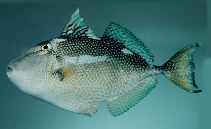
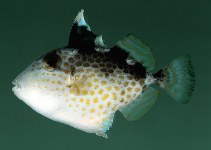
Abalistes stellatus, Starry triggerfish : fisheries, aquarium

Abalistes stellatus (Anonymous, 1798)

Starry triggerfish
Carica il tuo foto e Video
Immagini | Video | Francobolli, monete, materiale vario. | Google image

Classificazione / Nomi Nomi Comuni | Sinonimi | Catalog of Fishes(Genere, Specie) | ITIS | CoL | WoRMS | Cloffa

> Tetraodontiformes (Puffers and filefishes) > Balistidae (Triggerfishes)
Etymology: Abalistes: Greek, a = without + Greek, ballo = to throw (Ref. 45335).

Ambiente: milieu / zona climatica / distribuzione batimetrica / gamma di distribuzione Ecologia

marino demersale; amfidromo (Ref. 51243); distribuzione batimetrica 7 - 350 m (Ref. 58488). Tropical; 46°N - 36°S, 21°E - 164°W

Distribuzione Territories | Aree FAO | Ecosistemi | Presenze | Mappa dei ritrovamenti | Introduzioni | Faunafri

Indo-West Pacific: Red Sea, East Africa eastward through northern Australia to Fiji, northward to southern Japan.

Dimensione / Peso / Età

Maturità: Lm ?  range ? - ? cm
Max length : 60.0 cm TL maschio/sesso non determinato; (Ref. 111441); common length : 40.0 cm TL maschio/sesso non determinato; (Ref. 9770)

Breve descrizione Chiavi di identificazione | Morfologia | Morfometria

Spine dorsali (totale) : 3; Raggi dorsali molli (totale) : 25 - 27; Spine anali: 0; Raggi anali molli: 24 - 26. Scales enlarged above the pectoral fin base and just behind the gill slit to form a flexible tympanum; scales of posterior body with prominent keels, forming longitudinal ridges. A prominent groove in the skin extending anteriorly from front of eye for a distance of about 1 eye diameter. Caudal peduncle depressed. Caudal fin rays of adults prolonged above and below.
Body shape (shape guide): short and / or deep; Cross section: oval.

Biologia     Glossario (es. epibenthic)

Inhabit coastal areas, usually found over muddy and sandy bottoms, also around reefs, together with the sponges and algae (Ref. 5213). Adults on deep coastal slopes and usually seen swimming high above the bottom, sometimes found in estuaries. Juveniles in sheltered coastal bays and estuaries with outcrops of rubble or debris on open substrates (Ref. 48637). Feed on benthic animals (Ref. 9769). Oviparous (Ref. 205). Also caught with vertical long-lines (Ref. 9770). Marketed fresh and dried-salted (Ref. 9770).

Ciclo vitale e comportamento di accoppiamento Maturità | Riproduzione | Deposizione | Uova | Fecondità | Larve

Oviparous, distinct pairing during breeding (Ref. 205).

Riferimento principale Caricare le referenze | Bibliografia | Coordinatore : Matsuura, Keiichi | Collaboratori

Matsuura, K., 2001. Balistidae. Triggerfishes. p. 3911-3928. In K.E. Carpenter and V. Niem (eds.) FAO species identification guide for fishery purposes. The living marine resources of the Western Central Pacific. Vol. 6. Bony fishes part 4 (Labridae to Latimeriidae), estuarine crocodiles. FAO, Rome. (Ref. 9770)

Stato della Lista Rossa IUCN (Ref. 130435: Version 2025-2 (Global))

  Least Concern (LC) ; Date assessed: 11 January 2022

CITES

Not Evaluated

CMS (Ref. 116361)

Not Evaluated

Minaccia per l'uomo

  Harmless (Ref. 9770)


Usi umani

Pesca: commerciale; Acquario: Commerciale
FAO - Publication: search | FishSource | Sea Around Us

Informazioni ulteriori

Ecologia trofica
Articoli alimentari (prede)
Alimentazione
Consumo di cibo
Razioni alimentari
Predatori
Ecologia
Ecologia
Dinamica della popolazione
Parametri di crescita
Età massima / dimensioni massime
Rapporto lunghezza-peso.
Lunghezza-lunghezza rel.
Lunghezza-frequenze
Conversione di massa
Reclutamento
Abbondanza
Ciclo di vita
Riproduzione
Maturità
Maturità/Gli occhielli sono relativi.
Fecondità
Deposizione
Aggregazioni riproduttive
Uova
Sviluppo delle uova
Larve
Dinamica popolazioni larvali
Distribuzione
Territories
Aree FAO
Ecosistemi
Presenze
Introduzioni
BRUVS - Video
Anatomia
Area branchiale
Cervello
Otolite
Fisiologia
Composizione corporea
Nutrienti
Consumo di ossigeno
Tipo di nuoto
Velocità di nuoto
Pigmenti visivi
Suono del pesce
Malattie e parassiti
Tossicità (LC50)
Genetica
Genome
Genetica
Eterozigosi
Ereditarietà
Diversità genetica
Legato all'uomo
Sistemi di acquacoltura
Profili di acquacoltura
Varietà
Casi di Ciguatera
Francobolli, monete, materiale vario.
Raggiungimento
Collaboratori
Bibliografia
Bibliografia

Strumenti

Rapporti speciali

Scarica XML

Fonti Internet

AFORO (otoliths) | Aquatic Commons | BHL | Cloffa | Websites from users | Check FishWatcher | CISTI | Catalog of Fishes: Genere, Specie | DiscoverLife | ECOTOX | FAO - Publication: search | Faunafri | Fishipedia | Fishtrace | GloBI | Google Books | Google Scholar | Google | IGFA World Record | Database Nazionali | OneZoom | Open Tree of Life | Otolith Atlas of Taiwan Fishes | PubMed | Reef Life Survey | Socotra Atlas | TreeBase | Tree of Life | Wikipedia: Go, ricerca | World Records Freshwater Fishing | Record zoologico

Stime basate su modelli

Temperatura preferita (Fonte Biblio. 123201): 22.9 - 28.3, mean 27.1 °C (based on 501 cells).
Indice di diversità filogenetica (Fonte Biblio. 82804):  PD50 = 0.7500   [Uniqueness, from 0.5 = low to 2.0 = high].
Bayesian length-weight: a=0.02884 (0.02344 - 0.03548), b=2.90 (2.84 - 2.96), in cm total length, based on LWR estimates for this species (Ref. 93245).
Livello trofico (Fonte Biblio. 69278):  3.6   ±0.0 se; based on diet studies.
Resilienza (Fonte Biblio. 120179):  Medio, tempo minimo di raddoppiamento della popolazione 1.4 - 4.4 anni (Preliminary K or Fecundity.).
Vulnerabilità della pesca (Ref. 59153):  Moderate vulnerability (44 of 100). 🛈
Categoria di prezzo (Ref. 80766):   Medium.
Nutrienti (Ref. 124155):  Calcium = 25 [11, 64] mg/100g; Iron = 0.49 [0.25, 1.12] mg/100g; Protein = 18.4 [16.3, 20.6] %; Omega3 = 0.129 [0.063, 0.260] g/100g; Selenium = 58 [29, 125] μg/100g; VitaminA = 42 [11, 167] μg/100g; Zinc = 0.816 [0.542, 1.216] mg/100g (wet weight);