Elasmobranquios (tiburones y rayas) (sharks and rays) >
Carcharhiniformes (Ground sharks) >
Carcharhinidae (Requiem sharks)
Etymology: Isogomphodon: iso-, from isos (Gr.), equal; gomphos (Gr.), nail; odon (Gr.), tooth, referring to how teeth are equally fastened, i.e., claviform and straight in both jaws (See ETYFish); oxyrhynchus: oxys (Gr.), sharp; rhynchus (L.), snout, referring to its elongated, pointed and narrow snout [authorship often attributed to Müller & Henle, who published Valenciennes’ description] (See ETYFish).
Environment: milieu / climate zone / rango de profundidad / distribution range
Ecología
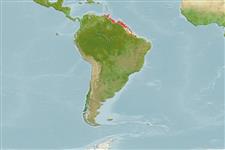
marino; salobre demersal; rango de profundidad ? - 15 m (Ref. 13608). Tropical; 12°N - 20°S, 63°W - 34°W (Ref. 244)
Western Atlantic: Trinidad, Guyana, Suriname, French Guiana, and Brazil.
Length at first maturity / Tamaño / Peso / Age
Madurez: Lm 115.0 range ? - ? cm
Max length : 160 cm TL macho / no sexado; (Ref. 34266); common length : 100.0 cm TL macho / no sexado; (Ref. 5217); edad máxima reportada: 12 años (Ref. 34266)
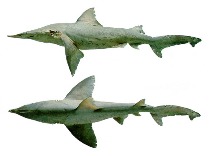
Large number of teeth, great length of very narrow snout. Yellow-gray above and white below (Ref. 6032).
Body shape (shape guide): fusiform / normal.
An inshore shark found over rocky bottoms, entering estuaries and river mouths. Feeds on small schooling fishes including herring, anchovies and croakers. Viviparous, generally 4 embryos per brood; size at birth 38 to 41 cm. 244 cm record unconfirmed.
Distinct pairing with embrace (Ref. 205). Viviparous, placental (Ref. 50449).
Compagno, L.J.V., 1984. FAO Species Catalogue. Vol. 4. Sharks of the world. An annotated and illustrated catalogue of shark species known to date. Part 2 - Carcharhiniformes. FAO Fish. Synop. 125(4/2):251-655. Rome: FAO. (Ref. 244)
IUCN Red List Status (Ref. 130435: Version 2025-1)
Human uses
Pesquerías: pesquerías de subsistencia
Herramientas
Special reports
Download XML
Fuentes de Internet
Estimates based on models
Preferred temperature (Referencia
123201): 27 - 27.8, mean 27.5 °C (based on 149 cells).
Phylogenetic diversity index (Referencia
82804): PD
50 = 1.0000 [Uniqueness, from 0.5 = low to 2.0 = high].
Bayesian length-weight: a=0.00490 (0.00229 - 0.01045), b=3.08 (2.91 - 3.25), in cm total length, based on LWR estimates for this (Sub)family-body shape (Ref.
93245).
Nivel trófico (Referencia
69278): 4.5 ±0.80 se; based on food items.
Generation time: 10.0 ( na - na) years. Estimated as median ln(3)/K based on 2
growth studies.
Resiliencia (Referencia
120179): Muy bajo, población duplicada en un tiempo mínimo superior a 14 años (K=0.11-0.12; tm=5-7; tmax=12; Fec=4).
Fishing Vulnerability (Ref.
59153): High to very high vulnerability (74 of 100).
🛈
Nutrients (Ref.
124155): Calcium = 25.1 [3.3, 144.5] mg/100g; Iron = 0.725 [0.183, 2.103] mg/100g; Protein = 21.1 [18.8, 23.3] %; Omega3 = 0.16 [0.06, 0.40] g/100g; Selenium = 29.2 [7.9, 91.1] μg/100g; VitaminA = 18.4 [5.8, 57.1] μg/100g; Zinc = 0.728 [0.335, 1.386] mg/100g (wet weight);