



Caspiomyzon wagneri (Kessler, 1870)
Caspian lamprey
อัพโหลดของคุณ ภาพถ่าย และ วิดีโอ
รูปภาพหลายรูป | Google image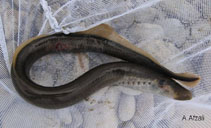 Caspiomyzon wagneri
ภาพโดย Afzali, A.
รูปภาพหลายรูป | Google image
ภาพโดย Afzali, A.
การจำแนกประเภท / ชื่อ ชื่อสามัญ | ชื่อพ้อง | Catalog of Fishes(สกุล, ชนิด) | ITIS | CoL | WoRMS | Cloffa
> Petromyzontiformes (Lampreys) > Petromyzontidae (Northern lampreys) > Lampetrinae
Etymology: Caspiomyzon: Caspio, from the Caspian Sea basin, where C. wagneri is endemic; myzon (Gr.), to suck (borrowed from Petromyzon), referring to their suctorial behavior (See ETYFish); wagneri: In honor of Nicolai Petrivitsch Wagner (1829-1907), Kessler’s colleague at the Zoological Institute in St. Petersburg, Russia; Kessler described this lamprey from a specimen in Wagner’s collection (See ETYFish).
Eponymy: Professor Dr Nicolai Petrovitch Wagner (1829–1907) was a Russian zoologist particularly interested in entomology. [...] (Ref. 128868), visit book page.
Etymology: Caspiomyzon: Caspio, from the Caspian Sea basin, where C. wagneri is endemic; myzon (Gr.), to suck (borrowed from Petromyzon), referring to their suctorial behavior (See ETYFish); wagneri: In honor of Nicolai Petrivitsch Wagner (1829-1907), Kessler’s colleague at the Zoological Institute in St. Petersburg, Russia; Kessler described this lamprey from a specimen in Wagner’s collection (See ETYFish).
Eponymy: Professor Dr Nicolai Petrovitch Wagner (1829–1907) was a Russian zoologist particularly interested in entomology. [...] (Ref. 128868), visit book page.
Taxonomic Remarks
Berg (1931) suggested that this species consists of two races; a normal form (forma typica) and a smaller praecox form (Ref. 89241).
สิ่งแวดล้อม : สิ่งแวดล้อม / เขตภูมิอากาศ / ระดับความลึก / ระยะการกระจายสินค้า นิเวศวิทยา
; น้ำจืด; กร่อย สัตว์น้ำหน้าดิน; ปลาที่อพยพจากแหล่งน้ำเค็มไปวางไข่ในแหล่งน้ำจืด (Ref. 89241); ระดับความลึก 1 - 22 m (Ref. 89241). Temperate; ? - 23°C (Ref. 59043); 59°N - 35°N, 42°E - 58°E (Ref. 59043)
การแพร่กระจาย อาณาเขต | พื้นที่จำแนกตาม FAO | ระบบนิเวศหลายระบบ | การปรากฏขึ้น,การเกิดขึ้น,พบ | ตำแหน่งบนแผนที่ | การแนะนำ | Faunafri
Eurasia: endemic to the Caspian Sea drainage. Construction projects along the rivers entering the Caspian Sea have had a very negative impact. Very rare now in the Volga river (Ref. 12275). Migrates to uppermost tributaries of Volga (Ref. 59043). Reported to migrate for spawning to the Sura River and its tributaries (the Penza, Aiva, and Inza rivers) as far as Penza Ciry in the 1920s (Ref. 58030).
ความยาวเมื่อครบกำหนดครั้งแรก / ขนาด / น้ำหนัก / อายุ
วัยเจริญพันธุ์: Lm 32.5, range 19 - 46 cm
Max length : 55.3 cm TL เพศผู้/กระเทย; (Ref. 12275); common length : 36.0 cm TL เพศผู้/กระเทย; (Ref. 12275); common length :37 cm TL (female); น้ำหนักสูงสุดที่มีการรายงาน: 206.00 g (Ref. 12275); อายุสูงสุดที่ได้รายงาน: 6 ปี (Ref. 59043)
Max length : 55.3 cm TL เพศผู้/กระเทย; (Ref. 12275); common length : 36.0 cm TL เพศผู้/กระเทย; (Ref. 12275); common length :37 cm TL (female); น้ำหนักสูงสุดที่มีการรายงาน: 206.00 g (Ref. 12275); อายุสูงสุดที่ได้รายงาน: 6 ปี (Ref. 59043)
คำอธิบายสั้นๆ เครื่องมือที่ใช้ในการแยกชนิดสัตว์,สิ่งมีชีวิตออกจากกัน | สัณฐานวิทยา | ความยาวต่างๆ
เงี่ยงครีบหลัง (รวม) : 0; ก้านครีบอ่อนที่หาง (รวม) : 0. Adult: 19.0-55.3 cm TL; max. body wet weight, 206 g; body proportions, as percentage of TL (based on 129 specimens measuring 30.5-53.0 cm TL): 8.7-12.1 prebranchial length, 7.7-11.0 branchial length, 43.6-57.6 trunk length (derived by deduction; represents a maximum possible range), 26-33 tail length, 0.8-2.2 eye length and 2.4-4.5 disc length; intestinal diameter in prespawning individuals has a mean of 0.27 cm and in spawning individuals a mean of 0.14 cm; urogenital papilla length (percentage of branchial length in 5 spawning males 30.1-34.4 cm TL), 14.3-21.2; trunk myomeres, 63-66. Adult dentition: supraoral lamina, one unicuspid (sometimes bicuspid) tooth; infraoral lamina, 4-6, usually 5, unicuspid teeth, but sometimes the lateralmost ones are bicuspid; 4 endolaterals on each side; endolateral formula, typically 1-1-1-1; 3-5 rows of anterials; first row of anterials, 3 unicuspid teeth; 8 rows of exolaterals on each side; 3 rows of posterials; first row of posterials, 11 unicuspid teeth; transverse lingual lamina straight, 5-8 unicuspid teeth, the median one not enlarged; longitudinal lingual laminae with undetermined number of unicuspid teeth. Velar tentacles in adults, 3, long and bearing papillae; body coloration in prespawning adults, dark gray on dorsal and lateral aspects and silvery white ventrally; spawning adults are black on dorsal and lateral aspects and gray with dark oval spots ventrally; color of eggs in prespawning females, light gray or yellow, while in spawning females is bluish-green; lateral line neuromasts unpigmented; caudal fin pigmentation unrecorded; caudal fin shape, spade-like; oral fimbriae, 93-115; oral papillae, 24-31(Ref. 89241).
Body shape (shape guide): eel-like; Cross section: circular.
Body shape (shape guide): eel-like; Cross section: circular.
Non-parasitic (Ref. 59043). Ammocoetes burrow 1-2 cm deep in substrates containing sand, clay, and detritus, in areas with slow current, and at water depths 0.3-22 m; also on surface of substrate among macrophytes and submerged wood. Metamorphosing individuals occur in areas with faster current, devoid of macrophytes, and in deeper water. Adults in rivers and marine waters; in shallow lakes in flood plain of the Volga River delta. Larval life is 3 years in the Volga River Basin and 2-4 years in the Kura River Basin. Ammocoetes feed on diatoms and detritus; feeding activity highest in summer, lowest in the winter. Metamorphosis begins in mid-July in the Volga River (Russian Federation); end of August to early September in the Kura River (Azerbaijan); and October in Iran (Islamic Republic of). Metamorphosing ammocoetes do not feed. Anadromous. Adult life at least 17 months. Indications that adults feed as scavengers or might feed on demersal fish eggs or on some invertebrates; feeding habits still subject of speculation since their teeth are blunt, yet their intestine remains functional and they grow considerably post-metamorphosis. Adults on their spawning run will attach, particularly in the opercular region, to likewise upstream-migrating winter form of brown sea trout (Salmo trutta caspius). Prespawning adults in the Kama River, Russian Federation, serve as a host for unionid glochidia, which attach to its gills. Spawning run is nocturnal; up the Kura River in November-February and Volga River, mid-September-March. Upstream migrants swim near the surface on dark nights and close to the river bottom on moonlit nights. During the day, they stay among stones on the bottom. Max. distance traveled, 1,500 km for larger individuals. Swimming speed, 2-16 km/day. Beginning migration, fat content of adult as high as 34% by body weight, terminating on spawning grounds with as low as 1-2% by body weight, at first concealing themselves amongst stones or burrow into the substrate, and later, swim and periodically break the water’s surface with their heads. Spawning in mid-March to mid-July over sandy and rocky substrate, at water temperatures 15-23 ˚C. Spawning grounds along the entire courses of the Volga and Kura rivers from estuaries to the upper reaches historically, and to man-made reservoirs presently. Redds are constructed by both sexes in sand and gravel substrates, usually in shallow waters. Fecundity, 14,000-60,000 eggs/female. Ammocoetes hatch 8-10 days after fertilization at lengths of 0.33-0.42 cm. Three to four days after hatching, yolk sac is almost completely absorbed. Volga River fishery carried out in both the spring and autumn, with over 75% of the catch occurring in autumn. Between 1910 and 1913 inclusively, from 16,900,000 to 33,400,000 Caspian Lamprey were harvested annually. Kura River fishery catches compiled in five-year increments from 1881 to 1935 with lowest record of 11,000 lamprey for the period 1891-1895 and highest of 612,000 lamprey for the period 1911-1915; 213,000 annual lamprey catch in 1936 and 304,000 in 1937; lipid content is 30.3% of the body weight. Prior to 1868, the catch was dried and used as a substitute for candles, and after 1868, it was harvested as food for humans. The caloric value for Caspian Lamprey is 3.4 kcal/g wet weight. Water regulation projects on the Volga and Kura rivers with deleterious effects on the abundance of Caspian Lamprey, preventing access to areas above the Volgograd and Mingechaur reservoirs, respectively, that it is no longer considered a commercially important species. There are reports of intoxication through eating this species (Ref. 89241).
วงจรชีวิตและพฤติกรรมการผสมพันธุ์ วัยเจริญพันธุ์ | การสืบพันธุ์ | การวางไข่ | เซลสืบพันธ์ของเพศเมีย(ไข่) | ความดกของไข่ | ตัวอ่อน
The nest is dug by either the male or the female. They attach themselves to stones before mating. Females die immediately after releasing their eggs, but males survive until spermatogenesis ceases and can mate with more than one female (Ref. 12275). Ammocoete stage lasts 2-4 years in freshwater after which metamorphosed juveniles migrate to the sea (Ref. 59043). In lower Volga, adults may feed one or two summers before breeding (Ref. 59043). These adults may begin to migrate to rivers in autumn and winter, usually from October to February, unstopped by ice flow in Volga (Ref. 59043).
อ้างอิงหลัก
อัพโหลดข้อมูลอ้างอิงของคุณ | อ้างอิง | ผู้ประสานงาน | ผู้ร่วมมือ
Holcík, J., 1986. Caspiomyzon wagneri (Kessler, 1870). p. 119-142. In J. Holcik (ed.) The Freshwater fishes of Europe. Vol.1, Part I, Petromyzontiformes. (Ref. 12275)
สถานะบัญชีแดงของ IUCN (Ref. 130435: Version 2025-2 (Global))
Least Concern (LC) ; Date assessed: 12 July 2022
CITES
Not Evaluated
ภัยคุกคามต่อมนุษย์
Poisonous to eat (Ref. 4537)
การใช้ของมนุษย์
การประมง: การค้า; การเพาะเลี้ยงสัตว์น้ำ: การทดลอง
FAO - Publication: search | FishSource |
ข้อมูลเพิ่มเติม
พลวัตของประชากร
พารามิเตอร์การเจริญเติบโต
อายุสูงสุด / ขนาด
ความยาว-น้ำหนักสัมพันธ์
ความยาว-ความยาวสัมพันธ์
ความยาว-ความถี่
การแปลงมวล
การทดแทนที่
อุดมสมบรูณ์
พารามิเตอร์การเจริญเติบโต
อายุสูงสุด / ขนาด
ความยาว-น้ำหนักสัมพันธ์
ความยาว-ความยาวสัมพันธ์
ความยาว-ความถี่
การแปลงมวล
การทดแทนที่
อุดมสมบรูณ์
วงจรชีวิต
การสืบพันธุ์
วัยเจริญพันธุ์
ความสมบูรณ์พันธุ์/เหงือกที่เกี่ยวข้อง
ความดกของไข่
การวางไข่
การรวมตัวของสปอน
เซลสืบพันธ์ของเพศเมีย(ไข่)
การพัฒนาไข่
ตัวอ่อน
พลวัตของสัตว์น้ำวัยอ่อน
การสืบพันธุ์
วัยเจริญพันธุ์
ความสมบูรณ์พันธุ์/เหงือกที่เกี่ยวข้อง
ความดกของไข่
การวางไข่
การรวมตัวของสปอน
เซลสืบพันธ์ของเพศเมีย(ไข่)
การพัฒนาไข่
ตัวอ่อน
พลวัตของสัตว์น้ำวัยอ่อน
การแพร่กระจาย
อาณาเขต
พื้นที่จำแนกตาม FAO
ระบบนิเวศหลายระบบ
การปรากฏขึ้น,การเกิดขึ้น,พบ
การแนะนำ
BRUVS - วิดีโอ
อาณาเขต
พื้นที่จำแนกตาม FAO
ระบบนิเวศหลายระบบ
การปรากฏขึ้น,การเกิดขึ้น,พบ
การแนะนำ
BRUVS - วิดีโอ
สรีรวิทยา
องค์ประกอบของร่างกาย
สารอาหาร
การใช้ออกซิเจน
ประเภทการว่ายน้ำ
ระดับความเร็วในการว่ายน้ำ
เม็ดสีที่มองเห็นได้
เสียงปลา
โรคและปรสิต
ความเป็นพิษ (LC50s)
องค์ประกอบของร่างกาย
สารอาหาร
การใช้ออกซิเจน
ประเภทการว่ายน้ำ
ระดับความเร็วในการว่ายน้ำ
เม็ดสีที่มองเห็นได้
เสียงปลา
โรคและปรสิต
ความเป็นพิษ (LC50s)
พันธุศาสตร์
จีโนม
พันธุศาสตร์
ความไม่สมดุลทางเชื้อชาติ
อัตราพันธุกรรม
ความหลากหลายทางพันธุกรรม
จีโนม
พันธุศาสตร์
ความไม่สมดุลทางเชื้อชาติ
อัตราพันธุกรรม
ความหลากหลายทางพันธุกรรม
เกี่ยวข้องกับมนุษย์
ระบบการเพาะเลี้ยงสัตว์น้ำ
ประวัติการเพาะเลี้ยงสัตว์น้ำ
สายพันธุ์
กรณีซิเกวเทอรา
แสตมป์ เหรียญ อื่นๆ
ระบบการเพาะเลี้ยงสัตว์น้ำ
ประวัติการเพาะเลี้ยงสัตว์น้ำ
สายพันธุ์
กรณีซิเกวเทอรา
แสตมป์ เหรียญ อื่นๆ
เครื่องมือ
หนังสืออิเล็กทรอนิกส์ | คู่มือภาคสนาม | เครื่องมือที่ใช้ในการแยกชนิดสัตว์,สิ่งมีชีวิตออกจากกัน | ผู้มีความชำนาญในเรื่องความถี่ของความยาว | เครื่องมือในการศึกษาชีวประวัติ | ตำแหน่งบนแผนที่ |
จับ-MSY |
รายงานพิเศษ
ตรวจสอบการบำรุงรักษาตู้ปลา | ตรวจสอบเอกสารข้อเท็จจริงเกี่ยวกับสายพันธุ์ | ตรวจสอบเอกสารข้อเท็จจริงเกี่ยวกับการเพาะเลี้ยงสัตว์น้ำ
ดาวน์โหลด XML
หน้าสรุป | ข้อมูลสำคัญ | ชื่อสามัญ | ภาพถ่าย
แหล่งที่มาจากอินเตอร์เน็ต
AFORO (otoliths) | Alien/Invasive Species database | Aquatic Commons | BHL | Cloffa | Websites from users | Check FishWatcher | CISTI | Catalog of Fishes: สกุล, ชนิด | DiscoverLife | ECOTOX | FAO - Publication: search | Faunafri | Fishipedia | Fishtrace | GloBI | Google Books | Google Scholar | Google | IGFA World Record | ฐานข้อมูลแห่งชาติ | OneZoom | Open Tree of Life | Otolith Atlas of Taiwan Fishes | PubMed | Reef Life Survey | Socotra Atlas | TreeBase | แผนภูมิชีวิตแบบต้นไม้ | Wikipedia: Go, ค้นหา | World Records Freshwater Fishing | บันทึกทางด้านสัตววิทยา
การประมาณค่าตามแบบจำลอง
ดัชนีความหลากหลายทางวิวัฒนาการ (อ้างอิง 82804): PD50 = 0.6250 [Uniqueness, from 0.5 = low to 2.0 = high].
Bayesian length-weight: a=0.00120 (0.00088 - 0.00164), b=2.96 (2.88 - 3.04), in cm total length, based on LWR estimates for this species (Ref. 93245).
ระดับชั้นอาหาร (อ้างอิง 69278): 4.0 ±1.00 se; based on food items.
ความสามารถในการกลับคืนสู่ปกติ (อ้างอิง 120179): ต่ำ, เวลาต่ำสุดที่จะทำให้ประชากรเพิ่มขึ้นเป็น 2 เท่าใช้เวลา 4.5 - 14 ปี (Semelparous species, assuming tm (= tmax) > 4).