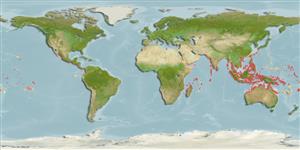
Environment: milieu / climate zone / distribuzione batimetrica / distribution range
Ecologia
marino; acqua dolce; salmastro associati a barriera corallina; dH range: 15 - 30; amfidromo (Ref. 51243); distribuzione batimetrica 0 - 15 m (Ref. 1602). Tropical; 23°C - 28°C (Ref. 13614); 30°N - 23°S
Indo-West Pacific: Red Sea and East Africa to the western Pacific.
Size / Peso / Age
Maturità: Lm ? range ? - ? cm
Max length : 400 cm TL maschio/sesso non determinato; (Ref. 3258); common length : 70.0 cm TL maschio/sesso non determinato; (Ref. 3258)
Vertebre: 183 - 196. Brownish grey above, lighter below (Ref. 3257). Body moderately elongate, cylindrical in front, compressed along tail; eyes small; teeth small, biserial, inner series enlarged; head not obviously distinct from trunk although the profile is moderately steep; very large mouth, extending to well beyond eye; biserial sharp teeth on jaws, larger in front and in inner row; dorsal fin inserted on head before gill-opening; scales absent (Ref. 4832).
Body shape (shape guide): eel-like.
Inhabits muddy ocean bottoms (Ref. 6934) and estuarine areas (Ref. 2334), but sometimes found in rivers (Ref. 2334) and inner bays (Ref. 37816). Feeds mainly on a variety of small fishes and crustaceans. Known to extend itself vertically from a burrow with its head held horizontally beneath the surface, rising and falling with the tide (Ref. 9710). Marketed fresh and consumed locally (Ref. 3258). Solitary (Ref 90102).
Life cycle and mating behavior
Maturità | Riproduzione | Deposizione | Uova | Fecundity | Larve
Chen, H.-M., K.-T. Shao and C.T. Chen, 1994. A review of the muraenid eels (Family Muraenidae) from Taiwan with descriptions of twelve new records. Zool. Stud. 33(1):44-64. (Ref. 6934)
IUCN Red List Status (Ref. 130435: Version 2025-1)
Human uses
Pesca: scarso interesse commerciale; Pesce da pesca sportiva: si
Strumenti
Special reports
Download XML
Fonti Internet
Estimates based on models
Preferred temperature (Fonte Biblio.
123201): 25.5 - 29.3, mean 28.5 °C (based on 3263 cells).
Phylogenetic diversity index (Fonte Biblio.
82804): PD
50 = 0.6250 [Uniqueness, from 0.5 = low to 2.0 = high].
Bayesian length-weight: a=0.00023 (0.00015 - 0.00035), b=3.13 (3.01 - 3.25), in cm total length, based on LWR estimates for this species & (Sub)family-body (Ref.
93245).
Trophic level (Fonte Biblio.
69278): 3.4 ±0.46 se; based on food items.
Resilienza (Fonte Biblio.
120179): Basso, tempo minimo di raddoppiamento della popolazione 4.5 - 14 anni (K=0.01).
Fishing Vulnerability (Ref.
59153): Very high vulnerability (90 of 100).
🛈
Nutrients (Ref.
124155): Calcium = 12.2 [5.3, 21.0] mg/100g; Iron = 0.313 [0.161, 0.702] mg/100g; Protein = 19.2 [16.9, 21.9] %; Omega3 = 0.0736 [, ] g/100g; Selenium = 52.2 [22.8, 125.0] μg/100g; VitaminA = 29.2 [6.0, 132.4] μg/100g; Zinc = 0.872 [0.561, 1.335] mg/100g (wet weight);