



Coryphaenoides acrolepis (Bean, 1884)
Pacific grenadier
Beobachtung melden im Fish Watcher
| Native range | All suitable habitat | Point map | Year 2050 |

|
| This map was computer-generated and has not yet been reviewed. |
| Coryphaenoides acrolepis AquaMaps Data sources: GBIF OBIS |
Hochladen Photos und videos
Bilder | Google Bild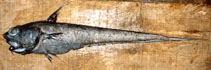 Coryphaenoides acrolepis
Photo von Orlov, A.
Bilder | Google Bild
Photo von Orlov, A.
Klassifizierung / Names Namen | Synonyme | Catalog of Fishes(Gattung, Arten) | ITIS | CoL | WoRMS | Cloffa
> Gadiformes (Cods) > Macrouridae (Grenadiers or rattails)
Etymology: Coryphaenoides: Greek, koryphaina = dolphin fish + Suffix oides = similar to (Ref. 45335); acrolepis: From the Greek 'acros' meaning sharp and 'lepis' meaning scale (Ref. 6885).
More on author: Bean.
Etymology: Coryphaenoides: Greek, koryphaina = dolphin fish + Suffix oides = similar to (Ref. 45335); acrolepis: From the Greek 'acros' meaning sharp and 'lepis' meaning scale (Ref. 6885).
More on author: Bean.
Umwelt: Milieu / Klimazone / Tiefenbereich / Verbreitungsgebiet Ökologie
seewasser bathydemersal; standorttreu; tiefenbereich 300 - 3700 m (Ref. 50550), usually 900 - 1300 m (Ref. 56476). Deep-water; 1°C - 4°C (Ref. 1371); 62°N - 28°N, 134°E - 115°W (Ref. 1371)
Verbreitung Territorien | FAO Gebiete | Ökosysteme | Vorkommen | Punkt Karte | Einführungen | Faunafri
North Pacific: northern Japan to Okhotsk and Bering seas, south along North American coasts to northern Mexico.
Länge bei der ersten Reifung / Größe / Gewicht / Alter
Geschlechtsreife: Lm 55.5, range 46 - 65 cm
Max length : 104 cm TL Männchen/unbestimmt; (Ref. 56527); common length : 46.9 cm TL Männchen/unbestimmt; (Ref. 56476); max. veröff. Gewicht: 3.0 kg (Ref. 56476); max. veröff. Alter: 73 Jahre (Ref. 35883)
Max length : 104 cm TL Männchen/unbestimmt; (Ref. 56527); common length : 46.9 cm TL Männchen/unbestimmt; (Ref. 56476); max. veröff. Gewicht: 3.0 kg (Ref. 56476); max. veröff. Alter: 73 Jahre (Ref. 35883)
Kurzbeschreibung Bestimmungsschlüssel | Morphologie | Morphometrie
Rückenflossenstacheln (insgesamt) : 2; Rückenflossenweichstrahlen (insgesamt) : 122; Afterflossenstacheln: 0; Afterflossenweichstrahlen: 94. Head large, scaled completely except for a narrow ventrolateral strip on snout; eyes also large; snout short, pointed and with tubercular scales along its leading edge; chin with a small chin barbel. Body tapering to a point posteriorly from behind the insertion of the first dorsal-fin spine. Scales adherent, with 3 to 5 divergent rows of coarse spinules. Pyloric caeca 12 to 14. Overall color is gray to grayish-brown in young, turning to dark brown in adults; fins generally dark. Branchiostegal rays: 6-6 (Ref. 36385).
Body shape (shape guide): elongated; Cross section: circular.
Body shape (shape guide): elongated; Cross section: circular.
A benthopelagic mid-slope species, that appears to wander off slope bottoms into midwater (Ref. 1371). Adults feed on small fish, euphausiids, prawns, amphipods and cephalopods (Ref. 1371). Oviparous, with planktonic larvae (Ref. 36385).
Lebenszyklus und Paarungsverhalten Geschlechtsreife | Fortpflanzung | Ablaichen | Eier | Fruchtbarkeit | Larven
Oviparous (Ref. 36385).
Hauptreferenz
Laden Sie Ihre Referenzen hoch | Referenzen | Koordinator : Iwamoto, Tomio | Partner
Cohen, D.M., T. Inada, T. Iwamoto and N. Scialabba, 1990. FAO species catalogue. Vol. 10. Gadiform fishes of the world (Order Gadiformes). An annotated and illustrated catalogue of cods, hakes, grenadiers and other gadiform fishes known to date. FAO Fish. Synop. 125(10). Rome: FAO. 442 p. (Ref. 1371)
CITES
Not Evaluated
Bedrohung für Menschen
Harmless
Nutzung durch Menschen
Fischereien: kommerziell
FAO - Publication: search | FishSource |
Mehr Information
Trophische Ökologie
Lebensmittel (Beutetiere)
Nahrungszusammensetzung
Nahrungsaufnahme
Lebensmittelrationen
Räuber
Lebensmittel (Beutetiere)
Nahrungszusammensetzung
Nahrungsaufnahme
Lebensmittelrationen
Räuber
Populationsdynamik
Wachstumsparameter
Max. Alter/Größen
Länge-Gewicht-Rel.
Länge-Länge-Verhältnis.
Längenhäufigkeiten
Massenkonvertierung
Rekrutierung
Dichte
Wachstumsparameter
Max. Alter/Größen
Länge-Gewicht-Rel.
Länge-Länge-Verhältnis.
Längenhäufigkeiten
Massenkonvertierung
Rekrutierung
Dichte
Lebenszyklus
Fortpflanzung
Geschlechtsreife
Reifung/Kiemen rel.
Fruchtbarkeit
Ablaichen
Laichaggregationen
Eier
Eientwicklung
Larven
Larven Pop.Dyn.
Fortpflanzung
Geschlechtsreife
Reifung/Kiemen rel.
Fruchtbarkeit
Ablaichen
Laichaggregationen
Eier
Eientwicklung
Larven
Larven Pop.Dyn.
Anatomie
Kiemenoberfläche
Gehirn
Otolith
Kiemenoberfläche
Gehirn
Otolith
Physiologie
Körperliche Zusammensetzung
Nährstoffe
Sauerstoffverbrauch
Schwimmart
Schwimmgeschwindigkeit
Visuelle Pigmente
Fischgeräusche
Krankheiten und Parasiten
Toxizität (LC50s)
Körperliche Zusammensetzung
Nährstoffe
Sauerstoffverbrauch
Schwimmart
Schwimmgeschwindigkeit
Visuelle Pigmente
Fischgeräusche
Krankheiten und Parasiten
Toxizität (LC50s)
Genetik
Genom
Genetik
Heterozygotie
Vererbbarkeit
Genetische Vielfalt
Genom
Genetik
Heterozygotie
Vererbbarkeit
Genetische Vielfalt
Menschenbezogen
Aquakultur-Systeme
Aquakultur Profile
Zuchtlinien
Ciguatera-Fälle
Briefmarken, Münzen, Verschiedenes.
Aquakultur-Systeme
Aquakultur Profile
Zuchtlinien
Ciguatera-Fälle
Briefmarken, Münzen, Verschiedenes.
Tools
E-Book | Feldführer | Bestimmungsschlüssel | Längenhäufigkeits Tool | Lebensdaten Tool | Punkt Karte |
Catch-MSY |
Zusatzinformationen
Download XML
Zusammenfassung | Punktdaten | Namen | Photos
Internet Quellen
AFORO (otoliths) | Aquatic Commons | BHL | Cloffa | Websites from users | FishWatcher Einträge suchen | CISTI | Catalog of Fishes: Gattung, Arten | DiscoverLife | ECOTOX | FAO - Publication: search | Faunafri | Fishipedia | Fishtrace | GloBI | Google Books | Google Scholar | Google | IGFA World Record | OceanAdapt | OneZoom | Open Tree of Life | Otolith Atlas of Taiwan Fishes | PubMed | Reef Life Survey | Socotra Atlas | TreeBase | Tree of Life | Wikipedia: Gehe zu, Suchen | World Records Freshwater Fishing | Zoologischer Rekord
Schätzungen auf der Grundlage von Modellen
Bevorzugte Temperatur (Ref. 123201): 2.3 - 3.8, mean 2.4 °C (based on 174 cells).
Phylogenetischer Diversitätsindex (Ref. 82804): PD50 = 0.5000 [Uniqueness, from 0.5 = low to 2.0 = high].
Bayesian length-weight: a=0.00141 (0.00085 - 0.00234), b=3.19 (3.04 - 3.34), in cm total length, based on LWR estimates for this species & (Sub)family-body (Ref. 93245).
Trophische Ebene (Ref. 69278): 3.8 ±0.54 se; based on food items.
Generation time: 45.8 ( na - na) years. Estimated as median ln(3)/K based on 2 growth studies.
Widerstandsfähigkeit (Ref. 120179): sehr niedrig, Verdopplung der Population dauert mehr als 14 Jahre. (K=0.02-0.04; tmax=73).
Nährstoffe (Ref. 124155): Calcium = 11.1 [5.3, 31.5] mg/100g; Iron = 0.291 [0.136, 0.661] mg/100g; Protein = 16.4 [14.6, 18.1] %; Omega3 = 0.203 [0.082, 0.497] g/100g; Selenium = 33.6 [11.1, 135.0] μg/100g; VitaminA = 9.83 [1.59, 61.63] μg/100g; Zinc = 0.42 [0.24, 0.75] mg/100g (wet weight);