Élasmobranches (requins et raies) (sharks and rays) >
Carcharhiniformes (Ground sharks) >
Scyliorhinidae (Cat sharks) > Scyliorhininae
Etymology: Poroderma: poros (Gr.), hole or passage; derma (Gr.), skin or hide, allusion not explained nor evident (Smith proposed name without a description) (See ETYFish); africanum: -anum (L.), belonging to: Africa, described from South Africa (See ETYFish).
More on author: Gmelin.
Environment: milieu / climate zone / profondeur / distribution range
Écologie
marin démersal; profondeur 0 - 100 m (Ref. 5510). Subtropical; 28°S - 36°S
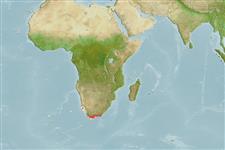
Southeast Atlantic: endemic to South Africa (Ref. 12484). There are old records from Madagascar and Mauritius, but these require confirmation (Ref. 244).
Length at first maturity / Taille / Poids / Âge
Maturité: Lm 68.5, range 65 - 72 cm
Max length : 101 cm TL mâle / non sexé; (Ref. 244); 93.0 cm TL (female)
Description synthétique
Clés d'identification | Morphologie | Morphométrie
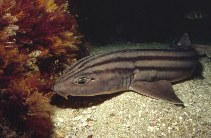
Épines dorsales (Total) : 0; Épines anales: 0. A large catshark with short nasal barbels and long horizontal black stripes (Ref. 5578).
Body shape (shape guide): elongated.
Occurs in the continental shelf, both inshore and offshore (Ref. 5578). Prefers rocky reefs from the intertidal zone down to 100 m depth (Ref. 5578). Nocturnal, often found in caves and crevices during the day (Ref. 5578). Feeds mainly on crustaceans, but also bony fish and cephalopods (Ref. 244). Oviparous (Ref. 50449). Readily kept in captivity (Ref. 244).
Life cycle and mating behavior
Maturité | Reproduction | Frai | Œufs | Fécondité | Larves
Oviparous, with a single egg-case per oviduct (Ref. 244). Embryos feed solely on yolk (Ref. 50449). Size at hatching between 14 and 15 cm.
Compagno, L.J.V., 1984. FAO Species Catalogue. Vol. 4. Sharks of the world. An annotated and illustrated catalogue of shark species known to date. Part 2 - Carcharhiniformes. FAO Fish. Synop. 125(4/2):251-655. Rome: FAO. (Ref. 244)
Statut dans la liste rouge de l'IUCN (Ref. 130435: Version 2025-1)
Menace pour l'homme
Harmless
Utilisations par l'homme
Pêcheries: pêcheries vivrières; pêche sportive: oui
Outils
Articles particuliers
Télécharger en XML
Sources Internet
Estimates based on models
Preferred temperature (Réf.
123201): 16.2 - 22, mean 19 °C (based on 20 cells).
Phylogenetic diversity index (Réf.
82804): PD
50 = 0.7500 [Uniqueness, from 0.5 = low to 2.0 = high].
Bayesian length-weight: a=0.00282 (0.00157 - 0.00507), b=3.22 (3.05 - 3.39), in cm total length, based on LWR estimates for this species & (Sub)family-body (Ref.
93245).
Niveau trophique (Réf.
69278): 3.6 ±0.5 se; based on diet studies.
Résilience (Réf.
120179): Faible, temps minimum de doublement de population : 4,5 à 14 années (Fec assumed to be <100).
Fishing Vulnerability (Ref.
59153): High vulnerability (61 of 100).
🛈
Nutrients (Ref.
124155): Calcium = 20.9 [3.6, 115.7] mg/100g; Iron = 0.674 [0.178, 1.992] mg/100g; Protein = 18.3 [15.2, 21.4] %; Omega3 = 0.166 [0.072, 0.366] g/100g; Selenium = 22.6 [6.9, 64.6] μg/100g; VitaminA = 8.49 [2.90, 24.19] μg/100g; Zinc = 0.614 [0.294, 1.120] mg/100g (wet weight);