



Waarneming toevoegen in Fish Watcher
| Native range | All suitable habitat | Point map | Year 2050 |

|
| This map was computer-generated and has not yet been reviewed. |
| Galeus polli AquaMaps Data sources: GBIF OBIS |
Uploaden van uw Foto's en video's
Afbeeldingen | Google afbeelding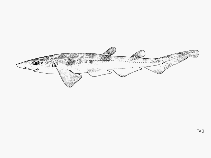 Galeus polli
Afbeelding van FAO
Afbeeldingen | Google afbeelding
Afbeelding van FAO
Classificatie / Namen Lokale namen | Synoniemen | Catalog of Fishes(Genus, Soort(en)) | ITIS | CoL | WoRMS | Cloffa
Elasmobranchii (haaien en roggen) (sharks and rays) > Carcharhiniformes (Ground sharks) > Pentanchidae (Deepwater catsharks)
Etymology: Galeus: galeos, a small shark or dogfish according to Aristotle and others (See ETYFish); polli: In honor of Belgian ichthyologist Max Poll (1908-1991), who first brought attention to this species (See ETYFish).
Eponymy: Dr Max Fernand Leon Poll (1908–1991) was a Belgian ichthyologist, and ‘connoisseur of the fish fauna’. [...] (Ref. 128868), visit book page.
Etymology: Galeus: galeos, a small shark or dogfish according to Aristotle and others (See ETYFish); polli: In honor of Belgian ichthyologist Max Poll (1908-1991), who first brought attention to this species (See ETYFish).
Eponymy: Dr Max Fernand Leon Poll (1908–1991) was a Belgian ichthyologist, and ‘connoisseur of the fish fauna’. [...] (Ref. 128868), visit book page.
Milieu: milieu / Klimaatzone / Diepte / verspreidingsgebied Ecologie
marien bathydemersaal; diepte 200 - 720 m (Ref. 244), usually 300 - 500 m (Ref. 9996). Deep-water; 26°N - 26°S
Verspreiding Gebieden | FAO regio's | Ecosystemen | Voorkomen | Verspreidingskaart | Introducties | Faunafri
Eastern Atlantic: southern Morocco to Namibia (Ref. 244).
Lengte bij maturiteit / Grootte / Gewicht / Leeftijd
Maturiteit: Lm 30.5 range ? - ? cm
Max length : 45.0 cm TL mannelijk / geslacht onbekend; (Ref. 5578)
Max length : 45.0 cm TL mannelijk / geslacht onbekend; (Ref. 5578)
Korte beschrijving Determinatiesleutels | Morfologie | Morfometrie
Dorsale stekels (totaal) : 0; Anale stekels: 0. A long-nosed, dwarf catshark with a narrow head, large eyes, and small labial furrows; upper caudal fin margin with prominent crest of enlarged sawtooth-like denticles (Ref. 5578). Pale brown, paler ventrally; juveniles have dark saddles that become less prominent in adults (Ref. 5510).
Body shape (shape guide): elongated.
Body shape (shape guide): elongated.
Found on the outermost shelf and upper slope. Feeds mainly on small bony fish, including lanternfish, hakes, grenadiers, rockfish and lightfish, also squid and crustaceans. Ovoviviparous (Ref. 50449). Tolerates bottom with low oxygen levels (Ref. 5578). Utilized fresh (Ref. 244).
Levenscyclus en paargedrag Maturiteit | Voortplanting | Paaien | Eieren | Fecunditeit | Larven
Eggs are sometimes fertilized internally by accident via close apposition of gonopores in otherwise oviparous fishes and may be retained within the female's body and complete some of the early stages of embryonic development. Embryos feed solely on yolk (Ref. 50449). Bears up to 12 young (Ref. 5578), size at birth 11-12 cm (Ref. 5510).
Hoofdreferentie
Upload uw referenties | Referenties | Coördinator | Medewerkers
Compagno, L.J.V., 1984. FAO Species Catalogue. Vol. 4. Sharks of the world. An annotated and illustrated catalogue of shark species known to date. Part 2 - Carcharhiniformes. FAO Fish. Synop. 125(4/2):251-655. Rome: FAO. (Ref. 244)
Status op de Rode Lijst van het IUCN (Ref. 130435: Version 2025-2 (Global))
Kwetsbaar (VU) (A2d); Date assessed: 31 August 2020
CITES
Not Evaluated
Gevaar voor de mens
Harmless
Gebruik door de mens
Visserij: van minder commercieel belang
FAO - Publication: search | FishSource |
Meer informatie
Trofische ecologie
Voedsel (prooien)
Dieetsamenstelling
Voedselconsumptie
Voedselrantsoenen
Predatoren
Voedsel (prooien)
Dieetsamenstelling
Voedselconsumptie
Voedselrantsoenen
Predatoren
Populatiedynamica
Groeiparameters
Max. leeftijden / maten
Lengte-gewicht rel.
Lengte-lengte rel.
Lengtefrequenties
Massaconversie
Rekrutering
Abundantie
Groeiparameters
Max. leeftijden / maten
Lengte-gewicht rel.
Lengte-lengte rel.
Lengtefrequenties
Massaconversie
Rekrutering
Abundantie
Levenscyclus
Voortplanting
Maturiteit
Rijpheid/kieuwen rel.
Fecunditeit
Paaien
Paaibestanden
Eieren
Ontwikkeling van de eieren
Larven
Larvale populatiedynamiek
Voortplanting
Maturiteit
Rijpheid/kieuwen rel.
Fecunditeit
Paaien
Paaibestanden
Eieren
Ontwikkeling van de eieren
Larven
Larvale populatiedynamiek
Fysiologie
Lichaamssamenstelling
Voedingsstoffen
Zuurstofverbruik
Type zwemmen
Zwemsnelheid
Visuele pigmenten
Vis geluid
Ziekten en parasieten
Toxiciteit (LC50)
Lichaamssamenstelling
Voedingsstoffen
Zuurstofverbruik
Type zwemmen
Zwemsnelheid
Visuele pigmenten
Vis geluid
Ziekten en parasieten
Toxiciteit (LC50)
Genetica
genoom
Genetica
Heterozygositeit
Erfelijkheid
Genetische diversiteit
genoom
Genetica
Heterozygositeit
Erfelijkheid
Genetische diversiteit
Menselijk gerelateerd
Aquacultuursystemen
Aquacultuurprofielen
Kweeklijnen
Ciguatera gevallen
Postzegels, munten, diversen.
Aquacultuursystemen
Aquacultuurprofielen
Kweeklijnen
Ciguatera gevallen
Postzegels, munten, diversen.
Tools
Speciale rapporten
Bekijk gegevens voor het houden in een aquarium | Bekijk Fact Sheets voor de soort | Bekijk Aquacultuur Fact Sheets
Download XML
Internetbronnen
AFORO (otoliths) | Aquatic Commons | BHL | Cloffa | Websites from users | Bekijk FishWatcher | CISTI | Catalog of Fishes: Genus, Soort(en) | DiscoverLife | ECOTOX | FAO - Publication: search | Faunafri | Fishipedia | Fishtrace | GloBI | Google Books | Google Scholar | Google | IGFA World Record | OneZoom | Open Tree of Life | Otolith Atlas of Taiwan Fishes | PubMed | Reef Life Survey | Socotra Atlas | TreeBase | Tree of Life | Wikipedia: ga naar, zoek | World Records Freshwater Fishing | Zoobank | Zoological Record
Schattingen op basis van modellen
Gewenste temperatuur (Ref. 123201): 6.7 - 11, mean 8.7 °C (based on 38 cells).
Fylogenetische diversiteitsindex (Ref. 82804): PD50 = 0.5000 [Uniqueness, from 0.5 = low to 2.0 = high].
Bayesian length-weight: a=0.00229 (0.00141 - 0.00371), b=3.06 (2.92 - 3.20), in cm total length, based on LWR estimates for this species & (Sub)family-body (Ref. 93245).
Trofisch niveau (Ref. 69278): 4.2 ±0.7 se; based on diet studies.
Weerstandsvermogen (Ref. 120179): laag, minimale populatieverdubbelingstijd 4,5-14 jaar (Fec=12).
Voedingsstoffen (Ref. 124155): Calcium = 10.4 [1.8, 67.5] mg/100g; Iron = 0.351 [0.075, 1.198] mg/100g; Protein = 17 [14, 20] %; Omega3 = 0.218 [0.089, 0.525] g/100g; Selenium = 6.92 [2.23, 20.67] μg/100g; VitaminA = 21.2 [4.5, 99.2] μg/100g; Zinc = 0.409 [0.190, 0.785] mg/100g (wet weight);