>
Anguilliformes (Eels and morays) >
Ophichthidae (Snake eels) > Ophichthinae
Etymology: Pisodonophis: Greek, piso, pipisko = to drink + Greek, odous = teeth + Greek, ophis = serpent.
More on author: Hamilton.
Environment: milieu / Klimaatzone / Diepte / distribution range
Ecologie
marien; zoet water; brak water demersaal; anadroom (Ref. 51243); diepte 0 - 10 m (Ref. 86942). Tropical
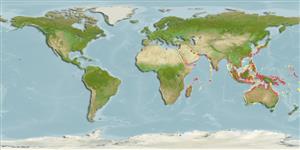
Indo-West Pacific: Somalia (Ref. 30573) and Tanzania south to Knysna, South Africa (Ref. 3972), including the Seychelles (Ref. 7245); also southern India and Sri Lanka (Ref. 7245). Widespread elsewhere from the east Indian coast throughout Indonesia to Polynesia (Ref. 7245).
Grootte / Gewicht / Leeftijd
Maturiteit: Lm ? range ? - ? cm
Max length : 100.0 cm TL mannelijk / geslacht onbekend; (Ref. 3972); common length : 70.0 cm TL mannelijk / geslacht onbekend; (Ref. 7245)
Korte beschrijving
Determinatiesleutels | Morfologie | Morfometrie
Dorsale stekels (totaal) : 0; Anale stekels: 0; Wervels: 171 - 180. Diagnosis: Body snake-like, cylindrical, compressed only along extreme tail tip; anterior nostril tubular, posterior along lower edge of lip; teeth granular to molariform, multiserial bands on jaws and vomer, but sharper on jaws and more pointed in young individuals; median fins not continuous posteriorly; extreme tip of tail stiff and finless; dorsal fin origin about a pectoral fin length behind tips of pectoral fins; lateral line inconspicuous (Ref. 4832).
Body shape (shape guide): eel-like.
Found in lagoons and estuaries, entering freshwater and paddy fields (Ref. 7245, 30573). Common in tidal reaches and nearby upstream areas of coastal rivers (Ref. 12693). Lives in holes in the river bottom and bank and actively forages for small fishes at night (Ref. 12693). Reported to spawn in rice-paddies during the rainy season (Ref. 12693). Caught in bag nets and similar gear. Marketed fresh.
Levenscyclus en paargedrag
Maturiteit | Voortplanting | Paaien | Eieren | Fecunditeit | Larven
Castle, P.H.J., 1984. Ophichthidae. p. 38-39. In J. Daget, J.-P. Gosse and D.F.E. Thys van den Audenaerde (eds.) Check-list of the freshwater fishes of Africa (CLOFFA). ORSTOM, Paris and MRAC, Tervuren. Vol. 1. (Ref. 3508)
Status op de Rode Lijst van het IUCN (Ref. 130435: Version 2025-1)
Gevaar voor de mens
Harmless
Gebruik door de mens
Visserij: van minder commercieel belang; aas: usually
Tools
Speciale rapporten
Download XML
Internetbronnen
Estimates based on models
Preferred temperature (Ref.
123201): 24.6 - 29.2, mean 28.5 °C (based on 2626 cells).
Fylogenetische diversiteitsindex (Ref.
82804): PD
50 = 0.5039 [Uniqueness, from 0.5 = low to 2.0 = high].
Bayesian length-weight: a=0.00095 (0.00049 - 0.00186), b=2.97 (2.79 - 3.15), in cm total length, based on LWR estimates for this species & (Sub)family-body (Ref.
93245).
Trofisch niveau (Ref.
69278): 4.0 ±0.71 se; based on food items.
Weerstandsvermogen (Ref.
120179): Gemiddeld, minimale populatieverdubbelingstijd 1,4-4,4 jaar (Preliminary K or Fecundity.).
Fishing Vulnerability (Ref.
59153): High vulnerability (60 of 100).
🛈